
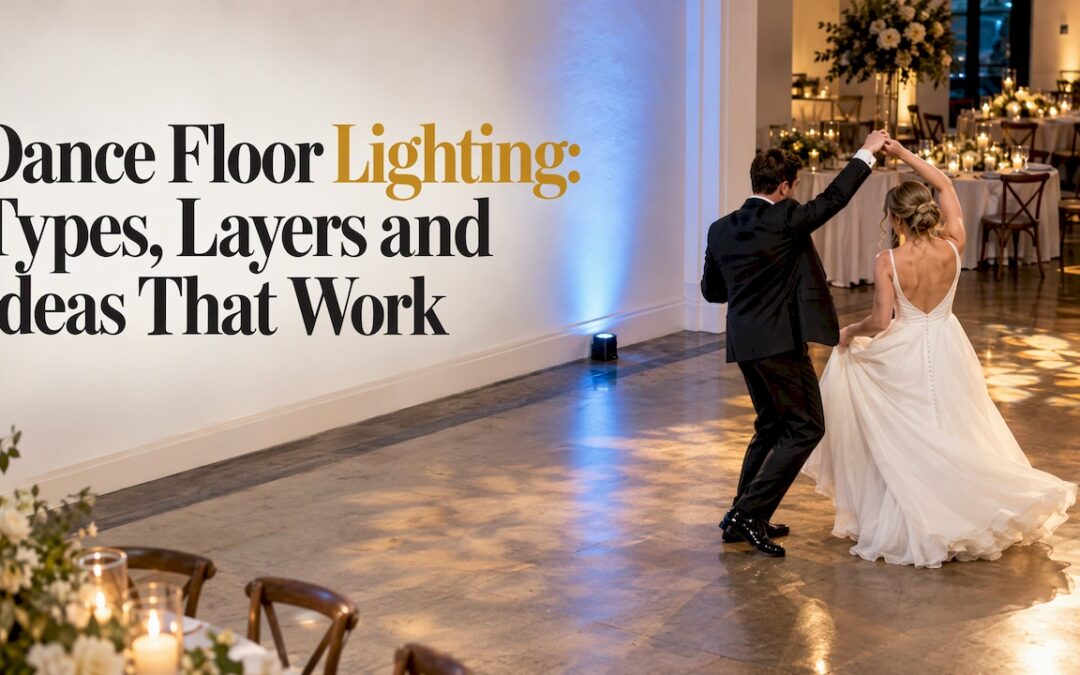
Good dance floor lighting is built in layers: a color wash as the base, a few moving lights for motion, and a small amount of texture and sparkle on top. Add haze so beams show up, then change the look as the night moves from dinner to dancing. Guests step onto a floor that looks like a destination. They hesitate at one that looks like an empty patch of carpet. Even glow party lighting ideas show how much color and contrast shape whether a space feels inviting. This guide is for couples, corporate planners and hosts who want a lively floor and need to know what to ask for.
TL;DR
- Start with a wash of color on the floor and walls, then add two to four moving heads overhead. Treat lasers, strobes and mirror balls as seasoning.
- Uplighting colors the room’s walls and ceiling. Dance floor lighting shapes the dancing area itself. Most good events use both.
- Change the look through the night: warm and calm at dinner, richer color and faster movement once dancing opens, warm and soft at the close.
- Keep strobes short, aim lasers at the floor or upper walls, and keep beams out of guests’ eyes.
- Plan lighting together with the band or DJ, the room’s ceiling height and the first dance, not as a separate afterthought.
Table of Contents
- The main types of dance floor lighting
- Uplighting vs. dance floor lighting
- Build the rig in four layers
- Change the look as the night moves
- Choose color by mood and music
- Effects mistakes that empty a floor
- Dance floor lighting ideas by venue and event
- Light the floor around the band
- Our perspective
- Plan the floor with us
- FAQ
- Sources
The main types of dance floor lighting
You do not need to learn fixture catalogs, but knowing the vocabulary helps you read a proposal and brief a vendor. These are the building blocks most event guides describe.
Wash lights. LED washes flood the floor, walls or ceiling with color. A UK event guide says the strongest results come from warm-white or deeply saturated washes aimed at the floor, and that when the wash is right even a modest rig looks deliberate. If you only get one thing right, get this right.
Moving heads. These are motorized fixtures that sweep and swing beams of light. Event lighting guides commonly describe a working rig as washes as the base layer plus two to four moving heads. They make the biggest difference when a band or DJ is playing, the ceiling has decent height and the room is large enough that static lighting feels weak.
Gobos and monograms. A gobo is a small stencil placed in front of a light so it projects a pattern or shape. At weddings, that is often a couple’s initials on the floor. At corporate events, it can be a logo. Gobo projections can match an event’s theme or branding.
Effect lights. Thomann’s lighting effects reference separates several families: beam effects with colored lenses, flower effects that react to sound and suit small rooms, centerpieces with mirrors above the floor, color changers and scanners. They add motion and sparkle, and they work best in small doses.
Lasers, strobes and mirror balls. These are the texture and accent pieces. The same UK guide calls everything beyond washes, moving heads and a gobo “seasoning rather than the meal”.
LED dance floor panels. In-floor LED panels light the surface itself. Combined with perimeter uplighting, they create a vibrant centerpiece and can pulse in time with the music.
Haze and fog. Atmospheric effects make beams visible. A fog machine guide citing ESTA technical standards separates three kinds: standard fog for thick, fast-dispersing bursts, haze for a thin, even mist that keeps beams crisp through a set, and low-lying fog that hugs the floor, a popular choice for a “dancing on a cloud” first dance.
Uplighting vs. dance floor lighting
The two get confused because both involve colored LEDs, but they do different jobs.
| Uplighting | Dance floor lighting | |
|---|---|---|
| Where it points | Walls, columns, ceiling | The floor and the air above it |
| What it does | Sets the color and mood of the whole room | Creates energy and focus where people dance |
| Typical gear | Wireless LED fixtures along the perimeter | Washes, moving heads, gobos, effects, haze |
| When it matters most | From the first guest arrival through dinner | When dancing opens |
A lighting guide for weddings describes uplighting as wall and ceiling color rather than strictly dance floor lighting. Another wedding design guide calls it the most impactful way to transform a venue, with 15 to 20 wireless LED uplights mentioned for a full room.
The practical answer to “which one do I need?” is both, in proportion. Uplighting makes the room feel finished. Dance floor lighting makes the floor feel alive. If the room is beautifully washed in color but the dance floor sits in flat overhead light, guests tend to treat the floor as an afterthought. Our own wedding lighting ideas for every part of the night walk through how the two fit together from cocktail hour to the last song.
Build the rig in four layers
A simple way to plan is to think in layers, an approach laid out in a DJ lighting guide from StarShine Lights:
- Fill layer: washes and uplights that paint walls and floor.
- Motion layer: moving heads or scanners that create rhythm.
- Texture layer: lasers, gobos and mirror-ball sparkle.
- Accent layer: strobes saved for drops and big moments.
The order matters. A common design mistake, according to a club lighting design guide, is putting strong beam fixtures above the floor without enough wash coverage underneath, which leaves the room feeling visually thin. Beams need something to land on. Crossing beam paths adds depth, and a smaller number of well-aimed fixtures beats a crowded truss.
If you are speaking with a lighting vendor, ask them to describe their rig in these four layers. If they can explain what each layer does for your room, they have thought about the space. If they only list fixtures, push for more detail.
Change the look as the night moves
The best dance floors do not look the same at 6 p.m. and 10 p.m. Lighting guides across weddings and nightlife describe the same arc.
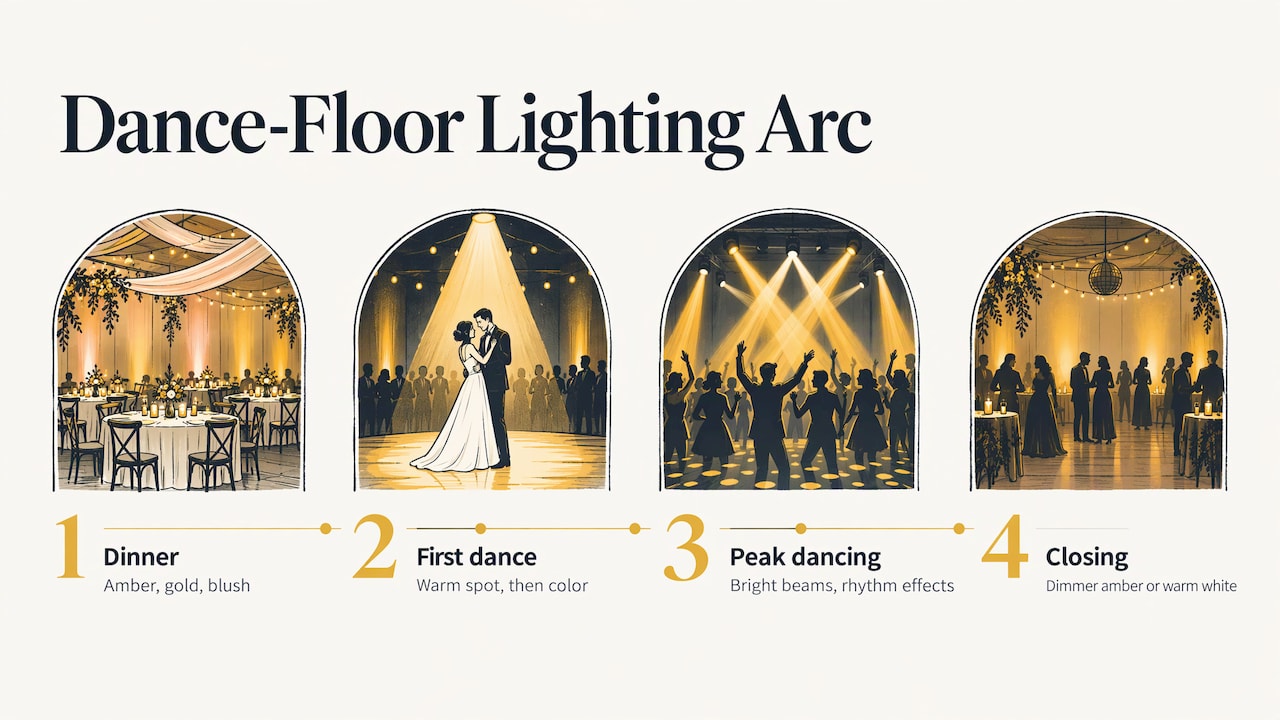
Dinner and early evening. Keep the floor dimmer than the dining area and choose warm tones. One wedding design guide suggests amber, soft gold and blush for dinner, then shifting to more saturated colors as dancing opens.
The first dance. Treat it as its own scene. A single warm spotlight, or a pair of warm-white lights, followed by a burst of color when the song ends, makes a clear handoff from ceremony to party. If you are choosing the song, our guides to first dance mashups and first dance song picks help you shape the moment the lighting will frame.
Peak dancing. Scene-based lighting guides describe peak time as brighter beams, stronger color contrast and rhythm-based effects, with narrow moving-head beams most effective at drops and build-ups because they cut through haze.
Closing. Reduce brightness and movement and move to softer color. The same guide describes closing time as lower brightness with gentler tones, and a color-scheme guide suggests amber or warm white to close the set.
The principle, put simply: restraint early, release late.
Choose color by mood and music
Color is the cheapest way to change how a room feels. Some starting points from lighting guides:
- Cool tones (blues, cyans, purples) suit early sets and lounge moods, while warm tones (reds, oranges, yellows) ignite the party. Pastels are flattering for weddings.
- A color-scheme guide pairs purple with R&B and trap, and amber or yellow with fast-paced drops. Those are guidelines, not rules.
- At corporate events, match floor colors to the company’s brand palette. At weddings, soft floor lighting with fairy lights reads romantic, and pulsing patterns synced to the music fit a dance party.
Because a mashup set moves from pop to rock to hip-hop to R&B within an hour, you want a lighting plan that can move with it. A single static color all night will fight the music at some point. If you want ideas for the songs themselves, see our picks for hip hop wedding songs and R&B wedding songs.
Effects mistakes that empty a floor
Most lighting problems come from too much, not too little.
Constant strobing. A design guide recommends strobe flashes of only two to four seconds at musical peaks and calls continuous strobing the fastest way to clear a floor. Intense strobe patterns are also a safety matter: tell guests in advance if strobes will be used, and ask your vendor to limit them, especially if anyone in your group is sensitive to flashing light.
Lasers pointed at people. Keep laser accents on the floor or upper walls. Keep any beam angle clear of guests’ eyes, as the club design guide advises for glare.
Haze without a plan. Haze makes beams visible, but some venues have smoke detectors that react to it. One design guide suggests running haze on a timer relay, one minute on and then off, to avoid setting off fire alarms. Confirm with the venue before anyone brings a machine into the room.
Fixtures with no wash. Covered above: beams without a base layer look thin.
One look all night. If the lights never change, they stop registering within twenty minutes.
Dance floor lighting ideas by venue and event
Ballroom or hotel venue. Frame the floor with uplighting and a fairy-light canopy overhead so it reads as a destination. Framing with festoon lights, marquee letters and uplighting is one approach. Check ceiling height before planning moving heads.
Barn or tent. Low ceilings and open sides limit overhead rigging. Perimeter uplighting, string lights and a floor-level wash do more here than a big truss.
Large, high-ceiling room. Moving heads shine. Cross their beams, add haze and let them take over once the floor is full.
Corporate gala. Use brand colors on the wash, a logo gobo on the floor and a clean, polished look. Slower color movement keeps conversation comfortable until the dancing starts. Our corporate event music ideas cover how to pace the program around the lighting.
Private party. A single wash color, one mirror ball and some haze can do more than a full rig. Pick one color story and commit to it.
Guest-participation moments. If you plan group dances or other interactive moments, tell your lighting team. Our guide to interactive wedding reception ideas shows how those moments work, and lighting can mark each one with a quick color change.
Light the floor around the band
With a live band, lighting and music are one performance. The band sets the pace, and the lights should follow it. That is why it helps to share the setlist flow, the timing of the first dance and any special moments with whoever runs lighting. If you are weighing a band against a DJ, our live band vs. DJ questions include how each approach affects the room, the stage and the lighting.
A short brief to your lighting vendor covers most needs:
- Room dimensions, ceiling height and any rigging limits.
- Where the band or DJ will stand and where the dance floor sits.
- The color story and any brand or wedding palette.
- Moments to light separately: grand entrance, first dance, cake, last song.
- Any effects to avoid, such as haze or strobes.
- The venue’s rules on power, haze and load-in times.
Our perspective
We have been playing weddings, corporate events and private celebrations since 2009, and the best dance floors we have played all share one trait: the lighting and the music were planned as one show. When the band moves from a pop singalong into a hip-hop or R&B run, the room should feel that shift.
That is why we treat lighting and staging as part of the performance rather than an add-on. Our event production services include lighting, staging and dance floor rentals, so the look of the floor can be planned alongside the setlist, the band size and the flow of the night. We work closely with couples and event planners so nothing feels bolted on.
Our advice: decide how you want the floor to feel at dinner, at the first dance and at peak, then build the lighting around those three moments.
Jimmy
Plan the floor with us
If you want the band, the stage and the dance floor look to work together, our event production services cover lighting, staging and dance floor rentals, and our bands range from the 5-, 8- and 10-piece lineups to the 14- and 18-piece wedding bands. Tell us about your venue and your timeline, and we will help you shape the night.
FAQ
What are the different types of dance floor lighting?
The main types are wash lights for color, moving heads for sweeping beams, gobos for patterns and monograms, effect lights, lasers and mirror balls for texture, LED floor panels, and haze machines that make beams visible. Most setups pair a wash base with two to four moving heads and add effects sparingly.
Do you need dance floor lighting at a wedding?
You do not need it for a wedding to happen, but it makes a clear difference when you have a band or DJ, a room with decent ceiling height and a real goal of getting people dancing. In larger rooms, static lighting tends to feel weak. Uplighting alone sets the mood, while dance floor lighting gives the floor its own energy.
What is the difference between uplighting and dance floor lighting?
Uplighting colors walls, columns and ceilings to set the mood of the whole room. Dance floor lighting works on the dancing area, with washes, moving heads, gobos and effects. They work best together: uplighting frames the room, and dance floor lighting energizes the floor.
How should dance floor lighting change during the night?
Keep it warm and subdued at dinner, light the first dance as a separate scene, move to richer colors and faster movement once dancing opens, and soften again at the end. Saving the most intense effects for peak moments keeps them effective.
Is strobe lighting safe at a party?
Short strobe bursts at musical peaks are standard, but flashing light can bother some guests. Ask your lighting team to keep strobes brief, let guests know in advance, and ask anyone with a medical concern about flashing lights to check with their doctor before the event.
Sources
- Dance Floor Lighting Effects: What Works Best in the UK
- What Lighting Patterns Transform Dance Floors
- Lighting Effect Types, Thomann
- Best Fog Machines for Events, Clubs and Stages
- Wedding Lighting Guide
- Wedding Lighting Design Guide
- DJ Lighting Guide, StarShine Lights
- Club Lighting Design Guide for Nightclubs and Dance Floors
- Nightclub Lighting Trends for 2026
- The Ultimate Guide to DJ Stage Lighting Color Schemes
- How LED Dance Floors Are Transforming 2026 Event Experiences
- Dance Floor Lighting Ideas: 15 Designs That Work
- Dance Floor Lighting Ideas, Lume Hire
Recent Comments