
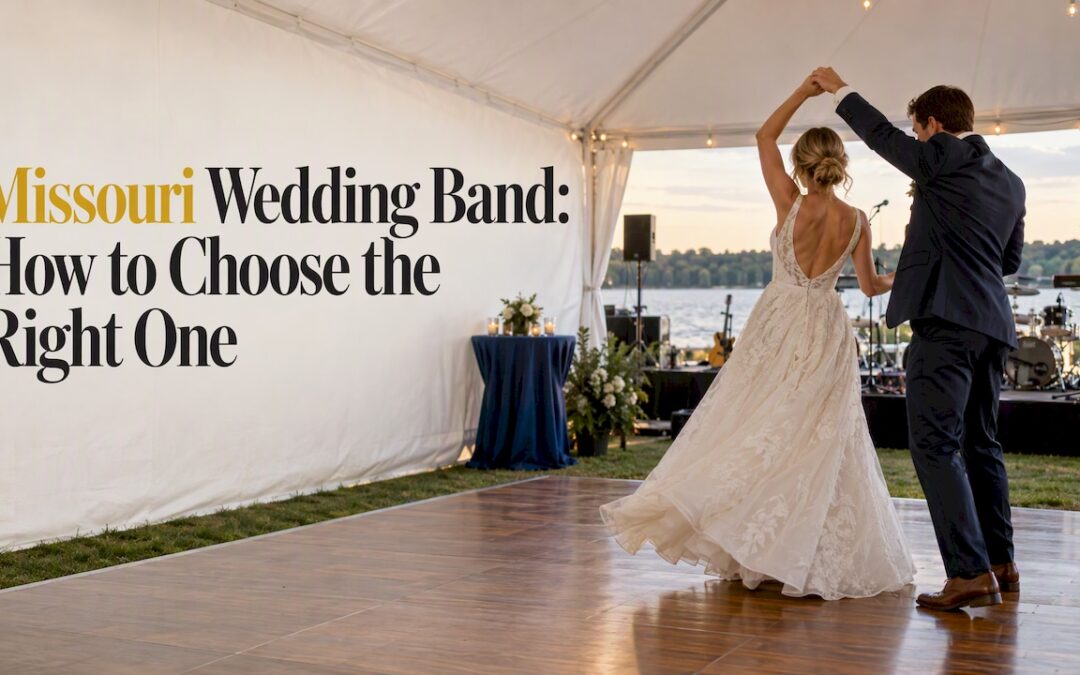
The right Missouri wedding band is the one whose lineup fits your room, whose style fits your guests, and whose contract answers every logistics question before you sign. Whether you are marrying in St. Louis, Columbia, Kansas City or at the Lake of the Ozarks, the decision comes down to the same few things: format, size, repertoire, proof that the band can move a real crowd, and a clear plan for the day. This guide walks through each, so you can compare bands on facts instead of a pretty promo reel.
TL;DR
- Decide the atmosphere first (conversation-friendly background music or a full dance floor), then choose the lineup size and style to match.
- Watch live footage, not just studio tracks, and see the band in person if you can.
- Send every band the same details about your room, hours, crowd and power, then compare what each one proposes.
- Book soon after you lock in the venue. Popular Missouri dates can go a year or more ahead.
- Get the date, load-in window, breaks, MC duties and song requests in writing.
Table of Contents
- What kinds of wedding bands can you book in Missouri?
- Match the format to the atmosphere you want
- How band size changes the night
- Be honest about your own style
- Perspective: why we build sets around the room, not the repertoire
- How to vet a band before you sign
- Matching the band to your venue
- What to confirm before you book
- When to book
- Planning the schedule around the band
- Your next step
- FAQ
- Sources
What kinds of wedding bands can you book in Missouri?
Missouri’s live music market is broad, and the label “wedding band” covers very different acts. Knowing the types helps you search with intent instead of scrolling through dozens of near-identical listings.
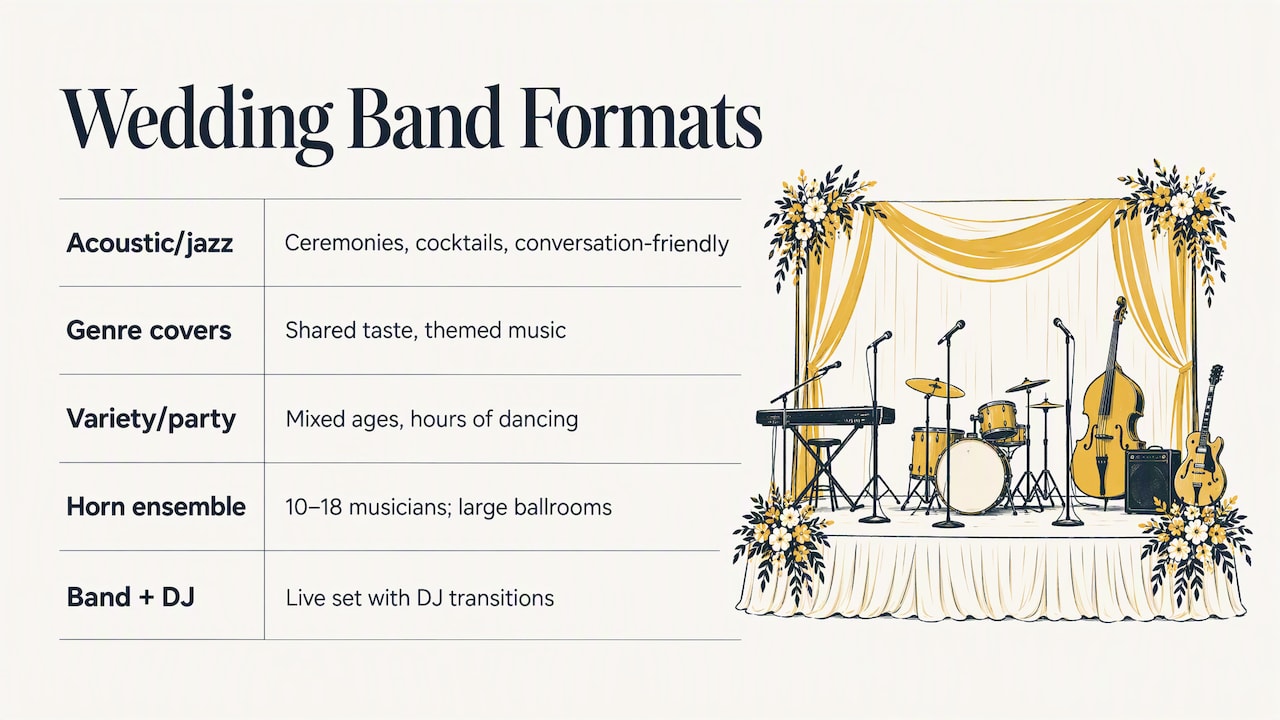
Small acoustic or jazz groups. Duos, trios and string quartets fit ceremonies, cocktail hours and dinners. One local planner notes that a jazz trio or string quartet suits couples who want conversation, while a big band is a weaker match for that mood.
Genre-specific cover bands. Classic rock, country, soft rock, Motown, funk or soul. These work when your crowd shares one taste and you want a theme.
Variety and party bands. These play across decades and genres, usually pop, rock, hip-hop and R&B, and are built to keep a mixed-age crowd on the dance floor for hours. This is the category we work in.
Horn-driven and large ensembles. Ten to eighteen musicians, with brass, multiple vocalists and a bigger sound. They suit large ballrooms and couples who want the show to feel like an event in itself.
Band plus DJ hybrids. A live set with a DJ covering transitions, or a DJ opening the night before the band takes over. If you are weighing the two formats, our breakdown of live band versus DJ for weddings lists what to ask each vendor.
None of these is the “correct” answer. The right one depends on how you want the night to feel.
Match the format to the atmosphere you want
Start with the feeling, not the genre list. Research on live concerts suggests that the format of a performance shapes how audiences experience it, and the quality of the venue affects how immersed people become. A wedding is not a concert, but the principle carries over: the same songs land differently in a candlelit barn, a hotel ballroom and a tent.
Think in three moments:
- Ceremony. Solo or small acoustic acts, or a band member stepping out to play processional music. Clear, well-placed sound matters more than volume.
- Cocktail hour and dinner. Lower energy, conversation-friendly sets. Some bands split into a smaller ensemble for this window.
- Dancing. The full band, high energy, crowd interaction, tight transitions between songs.
If you want all three from one vendor, ask whether the band can scale its lineup through the evening and whether it can supply ceremony sound. Our production services and ceremony sound are built for that kind of handoff, so you are not renting separate systems from separate companies.
How band size changes the night
Lineup size is the biggest decision after style. Here is how it generally plays out.
| Lineup | Typical feel | Best fit |
|---|---|---|
| Duo to trio | Intimate, acoustic, easy conversation | Ceremonies, small receptions, cocktail hours |
| 4 to 6 pieces | Tight, flexible, full dance energy | Barns, restaurants, mid-sized venues |
| 8 to 10 pieces | Fuller vocals, horns or extra keys, bigger sound | Ballrooms, 150+ guests |
| 14 to 18 pieces | Show-level production, layered arrangements | Large galas and grand receptions |
A bigger band is not automatically better. More musicians need more stage space, more power and more load-in time, and a very large group in a small room can overwhelm conversation. A smaller band in a huge ballroom can feel thin unless the sound system is sized properly.
Our lineup options run from the 5-, 8- and 10-piece bands and The Collective up to the ELITE 14-piece and SHOWSTOPPER 18-piece bands, so the size can follow your guest count and room instead of the other way around.
Be honest about your own style
The best advice we see from local planners is also the simplest: be honest about who you are. A planner in the St. Louis area says the entertainment should reflect the couple, and that is what encourages guests to join in. If neither of you dances, a band built around choreographed crowd games may feel forced. If you both live for the dance floor, a polite background act will waste the night.
Ask yourselves:
- What did the last great wedding you attended sound like?
- Which decades does your guest list actually know the words to?
- Do you want the band to talk to the crowd, or stay mostly musical?
- Are there songs that must be played, and songs that must never be played?
A good band will want those answers. If a band hands you a fixed list and never asks, that tells you something.
Perspective: why we build sets around the room, not the repertoire
We have been playing weddings, corporate events and private celebrations since 2009, and the pattern has not changed: the best nights are the ones where the band understood the people in the room before the first downbeat. We blend pop, rock, hip-hop and R&B into mashups because a wedding crowd rarely shares one taste. Grandparents, college friends and coworkers all need a reason to stand up, and a mashup lets a single song speak to several generations at once.
That is why we work closely with couples and planners on setlists, transitions and the flow of the evening, and why we offer flexible band sizes and optional DJ integration instead of one fixed package. Our work has been recognized with Wed KC Band of the Year and a place in The Knot Best of Weddings Hall of Fame, but the honest measure is simpler: did the dance floor stay full, and did the planner have an easy day? If you are comparing bands, push each one to explain how it would adapt to your event. The answer matters more than the sample reel.
— Jimmy
How to vet a band before you sign
Polished websites all look alike. These steps separate bands that perform well from bands that market well.
- Watch full live performances. Studio tracks and highlight reels hide a lot. Local booking guidance recommends watching live performance videos and, where possible, attending a show to see how the band handles a real crowd.
- Look for events like yours. A band that thrives at festivals may not suit a 100-person barn wedding, and the reverse is also true.
- Talk to the person who will actually run your event. Ask who your point of contact is and who leads on the night.
- Ask for references from planners. Planners see bands under pressure and will tell you how they handle delays, weather and last-minute changes.
- Request the contract early. Read it before you commit emotionally.
We keep a full checklist in questions to ask a wedding band before you sign, and a broader walkthrough in our practical guide to choosing a wedding band.
Matching the band to your venue
Missouri venues vary enormously: historic St. Louis ballrooms, Kansas City event halls, Columbia lofts, farm and barn venues, lakeside tents near the Lake of the Ozarks. Each creates different demands.
A useful method is to give every band the same brief. Local booking advice says to tell each band identical details about the room, hours, crowd and other events, then compare what each proposes against what you described, including space and power needs. If one band suggests a lineup that does not fit your stage, or never asks about power, that is a flag.
Share these details up front:
- Space. Dimensions of the performance area and whether it is level. Dance floor size and location.
- Power. Number and location of outlets, and whether circuits are shared with catering.
- Access. Parking, load-in route, elevators or stairs, and the earliest the band can enter.
- Noise limits. Any venue or municipal curfew, and where it is measured.
- Weather. The plan for outdoor events if it rains or the wind picks up.
- Timeline. Ceremony, dinner, toasts, cake, first dance, send-off.
The same guidance says that venue needs include a level performance space, suitable power and parking plus load-in access for band vehicles. Sound and lighting setups also change by room. We handle this through event production services, including lighting, staging and dance floor rentals, so you do not have to coordinate several vendors around one stage.
Regional notes
If you are marrying in the state’s biggest markets, we have pages for each: see our Missouri party band overview, the St. Louis party band page, Columbia, and the Lake of the Ozarks. Resort and lake venues often involve longer load-ins, boat or shuttle logistics and weather exposure, so build extra time into the schedule.
What to confirm before you book
A handshake and a good feeling are not a booking. Make sure each of these is settled in writing:
- Date and written agreement. Names, hours, location and the lineup you are actually getting.
- Arrival and load-in window. And the soundcheck time, so it does not happen while guests are arriving.
- Performance and finish times. Including what happens if the event runs late.
- Breaks. How long, how often, and what plays during them.
- Equipment. What the band brings and what the venue must provide. A booking checklist for live music also lists travel, weather plans, MC duties and song requests as items to confirm.
- Catering. Whether the band expects a meal and where they will eat.
- Song requests. Must-plays, do-not-plays, and how the band handles guest requests on the night.
The UK’s Musicians’ Union gives a similar list in its guidance on hiring live musicians: arrival and soundcheck time, performance and finish times, breaks, catering, whether the band supplies sound and lighting suited to the venue, unloading access and any requested songs. It is written for the UK, but the logistics are the same anywhere a band loads into a room.
When you compare proposals, compare what each includes, not just the headline. Sound engineers, lighting packages and the number of performers are the kinds of components that make quotes differ from one another. Lay the proposals side by side and mark which one covers sound, lighting, ceremony music, MC duties and backup plans.
When to book
Book live music shortly after you secure the venue. Wedding planning advice is to do so often a year or more ahead for popular dates. In Missouri, that means prime fall Saturdays and long weekends tend to disappear first. If your date is flexible, a Friday or a Sunday can open up more options.
If you are closer to the date than that, do not assume it is too late. Send inquiries to several bands at once with your date, venue and guest count, and ask about availability before anything else.
Planning the schedule around the band
For planners and coordinators, the band is part of the run of show, not an add-on to it. Coordinate these touchpoints with the band lead:
- Load-in and soundcheck before guests arrive, ideally with the venue contact present.
- Key moments. Grand entrance, first dance, parent dances, toasts, cake cutting, bouquet toss, send-off. Tell the band exactly which songs and cues you want.
- Breaks. Schedule them around dinner service or toasts so the dance floor does not go quiet at a peak moment.
- Handoffs. If a DJ, emcee or photographer is cueing events, decide who gives the signal.
- Load-out. Agree on when the band can strike its gear and who controls venue access afterward.
Our team works directly with planners on this, and we have a dedicated page for corporate event entertainment if your Missouri event is a gala, fundraiser or company celebration rather than a wedding.
Your next step
If you want a high-energy party band that blends pop, rock, hip-hop and R&B and adapts its size, setlist and production to your venue, start with our wedding band lineups or tell us about your date and room through our packages page. We will help you choose a lineup and talk through load-in, power and timeline before you commit.
FAQ
How far ahead should I book a Missouri wedding band?
Book soon after you lock in your venue. Wedding planning guidance suggests a year or more ahead for popular dates, so Saturdays in peak seasons go first. If your date is closer, still inquire, since cancellations and flexible days happen.
Is a big band or a small band better for a wedding?
Neither is better in general. Smaller groups suit conversation and compact rooms, while larger lineups bring a fuller sound for big ballrooms and dance-focused crowds. Match the size to your guest count, stage space and the atmosphere you want.
What should I ask a wedding band before signing?
Ask about the exact lineup, arrival and soundcheck times, breaks, equipment, travel, weather plans, MC duties and how song requests are handled. Ask who will be your contact and who leads on the night. Our wedding band question list covers the full set.
Can one band play both the ceremony and the reception?
Some can. It usually means a smaller ensemble or solo performer for the ceremony and cocktail hour, then the full band for dancing. Ask whether the band supplies ceremony sound and how long the changeover takes.
How do I know a band can actually get guests dancing?
Watch full live performance videos, not only studio recordings, and attend a show if you can. Ask planners who have worked with the band how the crowd responded, and look for events similar in size and mix of ages to yours.
Sources
- A St. Louis area wedding planner’s advice on booking a live band or musicians
- How to Book Live Music for an Event in St. Louis
- Concert formats influence how audiences experience live performances
- Hiring Live Musicians for an Event, The Musicians’ Union
Recent Comments