
The best wedding mashup songs pair a song that means something to the two of you with a song the whole room already knows, and join them at a moment of real contrast. Keep it to two to four songs, keep it short, and make the hand-off from slow to fast a planned part of the arrangement, not an afterthought. Below you will find pairings that work, the tempo and timing numbers behind them, how a live band handles the join, and what to know about music rights.
TL;DR
- Two to three songs is the sweet spot for a first dance mashup, and about 2 to 3 minutes total is plenty.
- Pair a slow, meaningful song (roughly 60 to 80 BPM) with an upbeat crowd favorite (roughly 110 to 128 BPM) for the biggest reaction.
- Read every lyric before you commit. A romantic title does not guarantee a romantic song.
- A live band can build the join into the arrangement with a drum break, a shared chord or a riff, which is why rehearsal matters.
- A custom audio edit may raise copyright questions, so check the rights before anyone plays or posts it.
Table of Contents
- What makes a wedding mashup work
- Wedding mashup song pairings that work
- How to match mood, lyrics and tempo
- How long a first dance mashup should be
- Mashups for a dance floor of every age
- How a band or DJ makes the transition smooth
- Our perspective on mashups
- Music rights: what to check before using an edited mashup
- How to personalize your mashup
- Booking a band that builds mashups for your night
- FAQ
- Sources
What makes a wedding mashup work
A mashup is two or more songs fused into one moment. At a wedding it usually shows up in two places: the first dance, where it turns a slow, sentimental song into a party, and the reception, where it keeps the dance floor moving without a dead second between tracks.
The idea behind the first-dance version is contrast. One song-writing studio puts it plainly: the bigger the gap between the slow moment and the upbeat one, the bigger the reaction, and the theatrics of the switch (a freeze, a pretend technical glitch, one partner walking away) is what sells the surprise.
Three things separate a mashup that lands from one that feels like a gimmick:
- A clear story. The slow half says who you are as a couple. The fast half says the party starts now.
- Songs that actually fit together. Tempo, key and phrasing matter more than clever titles.
- A short runtime. The surprise fades if it drags.
Wedding mashup song pairings that work
The most dependable pairings put a tender classic or modern ballad up against a song that gets every age group moving. A first-dance guide from Dedicated Song lists four combinations that have worked for couples:
- ‘At Last’ into ‘Crazy in Love’
- ‘Perfect’ into ‘Uptown Funk’
- ‘Can’t Help Falling in Love’ into ‘Shut Up and Dance’
- ‘A Thousand Years’ into ‘I Gotta Feeling’
Another pairing that circulates widely among couples is Lana Del Rey’s ‘Young and Beautiful’ into Fergie’s ‘A Little Party Never Killed Nobody (All We Got)’. Both songs are on the soundtrack to The Great Gatsby, so they already share a sonic world, which helps the join feel natural.
Here is how we think about building your own, using the same logic:
| Slow half (the story) | Fast half (the party) | Why the pairing works |
|---|---|---|
| A timeless standard | A modern pop or hip-hop floor hit | Grandparents recognize the first, friends scream for the second |
| A current acoustic ballad | A 2000s sing-along | Everyone between 25 and 45 knows every word |
| A country love song | A classic rock anthem | Keeps both sides of a mixed-taste guest list in the game |
| A movie-soundtrack ballad | A big-band or swing-flavored dance song | Gives the room a theatrical beat before the beat drops |
These are starting ideas, not rules. The strongest mashup is the one where at least one song already belongs to you.
How to match mood, lyrics and tempo
Choosing songs is where most couples either overthink or underthink. A simple filter helps. MixClap’s first-dance guide recommends three: the narrative you want to tell, the tempo, and the couple, meaning at least one song should already mean something to you.
Tempo: how far apart can two songs be?
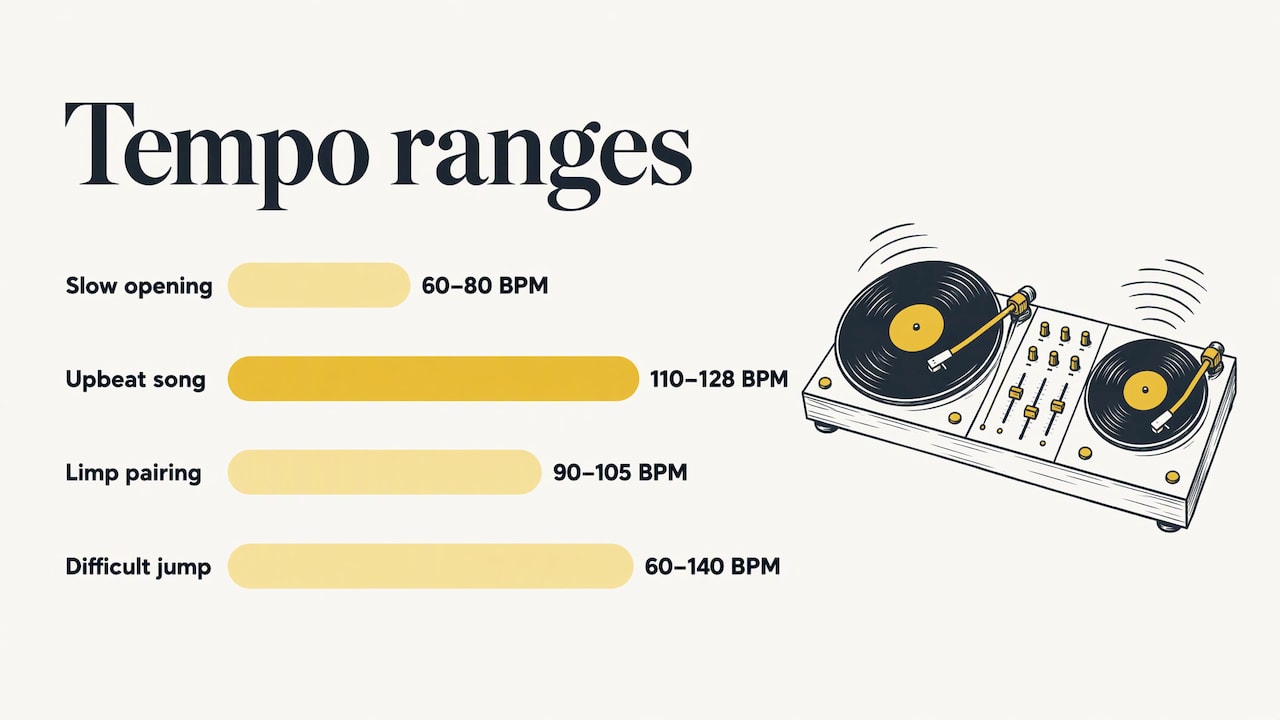
The same guide suggests an opening slow song between 60 and 80 BPM and an upbeat song between 110 and 128 BPM. It warns that songs too close together (90 to 105 BPM) feel limp, while a jump from 60 to 140 BPM makes the join technically difficult.
If you want a quick way to find a song’s tempo, many music apps and free BPM tools will tell you. You do not need to be a musician: you only need to know whether your two songs are in the right neighborhood.
For mashups where the songs blend over each other rather than switching, Soundtrap’s mashup guide lists compatible keys, beat matching, clear song structures and aligned vocal phrasing as the core requirements, and notes that songs already within roughly 5 to 10 BPM of each other are easier to blend convincingly. A first-dance mashup that deliberately jumps in tempo is a different animal: there you are choosing a dramatic cut, not a smooth blend. Decide which one you want before you pick songs.
Lyrics: read every word
A chorus can sound like a vow while the verses tell a story of heartbreak. Today’s Weddings warns that some popular wedding choices are about breakups, unrequited love or even stalking, and recommends listening to every word of a song before you choose it. Do this for both halves of the mashup. Your grandmother will hear the lyrics even if the dance floor does not.
If you want more help narrowing the slow half, our guide on how to choose the perfect first dance song walks through ten popular picks and what each one does for the room.
Songs from your own heritage or wedding location can work as the slow half too. Couples planning an island ceremony, for instance, often start from Hawaiian wedding song ideas and then pair one favorite with a pop floor-filler for the second half.
How long a first dance mashup should be
Short beats long. One Australian dance studio recommends 30 to 60 seconds per song, a total of 2 to 3 minutes, and no more than 2 to 4 songs for a multi-song first dance. On when to make the switch, another studio says that most couples find transitioning between 60 and 90 seconds in works well: long enough to set the romantic mood, short enough that the whole dance does not outstay its welcome.
A sample three-minute plan:
- 0:00 to 1:15. Slow song, just the two of you.
- 1:15 to 1:25. The join: a freeze, a drum fill, a dramatic stop.
- 1:25 to 2:30. Upbeat song, and the parents, wedding party and friends flood the floor.
- 2:30 to 3:00. A big finish or a hand-off to open dancing.
Rehearse it. Practicing with the actual mashup helps you get comfortable with its flow and spot any timing tweaks, as The Wedding Network notes. Even two or three run-throughs in your living room will show you where the awkward steps are.
Mashups for a dance floor of every age
Outside the first dance, mashups earn their place by solving a classic reception problem: a room full of people with wildly different tastes. A song that pulls in your cousins might clear the floor for your aunts and uncles. A well-built mashup stacks a throwback hook against a current one so that every generation gets a moment inside the same three minutes.
Some ways to do it:
- Era pairing. Link a 1950s or 60s rocker with a recent pop or hip-hop track that samples or echoes it.
- Genre pairing. Run a rock anthem into an R&B groove so the energy stays up but the sound changes.
- Singalong pairing. Close a mashup on the song everyone knows by heart, so even the non-dancers join in.
Vogue’s interview with DJ Ross One frames the goal well: a successful set balances your personal taste with songs that suit a broad age range, keeping your individuality while the party builds. A mashup is one of the most efficient tools for that balance.
The energy arc matters too. MixClap’s reception guide puts the dance floor at roughly 100 to 130 BPM through the main stretch of the night, advises against dropping more than 10 BPM between consecutive tracks without a long crossfade, and says the energy peak of a Western wedding tends to land between 11:30 PM and 12:30 AM. If your reception ends earlier, shift that peak to match your own timeline, and save your highest-energy mashups for it.
If you want ideas for the hip-hop end of the night, see our rundown of hip hop wedding songs for every moment. For floor fillers across decades and how a band arranges them, read mashup wedding dance songs. And if you are planning how the whole evening flows, from the entrance onward, our grand entrance songs guide covers timing.
How a band or DJ makes the transition smooth
The join is where a mashup either becomes magic or falls apart. For recorded edits, MixClap recommends a 10-second equal-power crossfade for a slow-to-upbeat hand-off, staying between 6 and 12 seconds total, so the perceived loudness stays steady.
A live band has more tools. According to expert.band’s guide for cover bands, effective joins can use a drum break, a shared chord, an overlapping instrumental riff or, when the harmony allows, a vocal pivot. The same guide says mashups call for related keys, compatible tempos and melodies that do not clash, and that they are less forgiving than medleys, so rehearsal is essential. It also treats the transition itself as the decisive musical moment, not a seam to hide.
That is also why a live band can do things a playlist cannot. A drummer can hold a break until you give the cue. A singer can slow a phrase to let you finish a dip. The band can read the room and extend the party half for another chorus if the floor is packed. If you are weighing the two options for your wedding, our guide on live band vs DJ lists the questions to ask any vendor.
Our perspective on mashups
We built Lost Wax around mashups. Since 2009 we have blended pop, rock, hip-hop and R&B so that a room of mixed ages stays on the dance floor, and what we have learned is that the join is the performance.
A great mashup is arranged, not stitched. We choose where the two songs share a chord, where the drums can carry the turn, and where a vocalist can pivot, then we rehearse until the move feels effortless. Guests never notice the work. They just notice that nobody wanted to sit down.
We also think a mashup should be personal. Every setlist is customized to the style and energy of the event, so the songs that matter to you sit next to the songs your guests will shout along to. We work with you and your planner on the flow, so the first dance, the parent dances and the late-night peak feel like one story.
If a song is on your must-have list and you wonder how it could live next to something louder, bring it to us. That is the fun part of our job.
Jimmy
Music rights: what to check before using an edited mashup
There is one practical point couples rarely hear about. When a mashup is a recorded edit, it combines parts of existing recordings, and that raises copyright questions.
The U.S. Copyright Office explains that a mashup combines two or more samples of sound recordings into a new work. In many cases it may infringe copyright unless it is authorized or covered by a legal exception such as fair use, and licenses from both the sound-recording and musical-work owners may be necessary. Downtown Music says the same from the industry side: because a mashup uses portions of multiple masters and compositions, it needs clearance from all rights holders.
For distributing an edit, Open Music Business advises identifying exactly what was changed, confirming who controls each right, and getting permission in writing where required.
What that means for your planning:
- If you hire someone to produce a custom edit for your first dance, ask who made it and whether they know the rights picture before the file is shared or posted publicly.
- If you plan to post a video of the dance online, remember the same questions apply to the audio.
- If a live band performs the mashup in its own arrangement, you are not distributing a recorded edit. Ask the band about how it handles music licensing for performances.
If you need certainty about a specific recording you plan to publish, ask a music attorney.
How to personalize your mashup
The best mashups have fingerprints on them. A few ways to make yours yours:
- Start with the story. Where did you meet, what played on the first road trip, what song did your parents dance to? One of those is your slow half.
- Tell your performers everything. Vogue’s DJ Ross One recommends sharing favorite songs, family and friend requests, guest demographics and a do-not-play list so personal picks and crowd-pleasers can sit together without killing the energy. The same brief helps a band arrange your mashup.
- Use two artists that define you. If one of you loves country and the other loves pop, make that the contrast. It reads as a joke and a love letter at once.
- Plan the surprise. Decide whether the switch is a freeze, a spin, a cue to the wedding party or a quick costume-free reveal that suits your personalities.
- Make room for the room. Give your guests a clear signal to join, like a raised hand or a direct look at the dance floor.
Look early at who you want performing, too. Vendor timing is a real constraint, and a destination wedding timeline is a useful reminder of when to lock in key vendors, entertainment included.
Booking a band that builds mashups for your night
If you want the mashup performed live, we do it for weddings across the U.S. Our bands range from a 5-piece to a SHOWSTOPPER 18-piece, and each show has a customizable setlist, smooth transitions and crowd engagement built in. You can compare our wedding band packages, look at the larger ELITE and SHOWSTOPPER lineups, or, if you want sound for the ceremony as well, our event production services. When you are ready to talk setlists, get in touch.
FAQ
How many songs should a wedding mashup have?
Two to three songs is the sweet spot for a first dance, and four is the practical ceiling. More than that and the dance runs long, while the transitions start to feel like a checklist. Keep the whole thing near 2 to 3 minutes.
What tempo should the two songs be?
A common approach is a slow opener around 60 to 80 BPM and an upbeat second song around 110 to 128 BPM. Songs that are only slightly different in tempo feel flat, and a huge gap makes a clean join harder. A live band can bridge a big gap with a drum break or a shared chord.
Can a live band play a wedding mashup?
Yes, and it is often the most flexible way to do it. A band can arrange the join, hold a pause until you give the cue and stretch the party half if the floor is full. It needs rehearsal and a clear brief on your must-have songs, so share your list well ahead of the wedding.
Do I need permission to use a mashup at my wedding?
Playing a mashup privately at your reception is a different question from distributing or posting a recorded edit. The U.S. Copyright Office notes that mashups may need licenses from both the recording and composition owners unless an exception applies. If you plan to publish the audio, check the rights first or ask a music attorney.
Sources
- Dedicated Song: First Dance Mashup and Medley Ideas
- Clash Magazine: Lana Del Rey, Young & Beautiful
- MixClap: Wedding First Dance Mix
- MixClap: Wedding Mix, How to Build the Reception Soundtrack
- MixClap: How to mix two songs for a first dance
- Soundtrap: How To Mashup Songs
- Today’s Weddings: Choosing Your First Dance Song
- Dream Wedding Dance: Creating a Multi-Song First Dance Mashup
- Let’s Dance Studios: Wedding Dance Mashups
- The Wedding Network: Creating a Personalised First Dance Mashup
- Vogue: How to Create the Ultimate Wedding Playlist
- expert.band: Medleys and mashups for cover bands
- U.S. Copyright Office: Sampling, Interpolations, Beat Stores and More
- Downtown Music: Music’s Many (Re)Uses
- Open Music Business: Distributing Remixes and Edits
- Maui Elopement: Hawaiian Wedding Songs
- Hidden Door Travel: Destination Wedding Timeline
Recent Comments