
The best wedding lighting is layered: soft uplighting around the room for atmosphere, warm light where people eat and give toasts, and livelier color and movement over the dance floor. Plan those three jobs separately, make sure each fixture has a purpose, and let the light change as the night does. Below are specific ideas for each part of the evening, how uplighting differs from wash lighting, and what to confirm with your venue before you book anything.
TL;DR
- Uplighting sits at the base of walls or columns and adds depth and color. Wash lighting covers an area, such as the dance floor or head table, with an even field of light.
- Amber is the safest uplighting color for most rooms. Use pink, blue or your palette only when it suits the venue.
- Give every light a visual job and a practical job. Faces, food and speeches need to be lit, not just the décor.
- Fade scenes into each other (dinner, toasts, first dance, party) instead of flipping switches.
- Ask your venue about open flames, haze and sparks in writing before you plan candles or special effects.
Table of Contents
- What uplighting is, and what it does to a room
- Uplighting vs. wash lighting
- Uplighting ideas by venue and mood
- Lighting the ceremony and cocktail hour
- Reception lighting design: decorative plus practical
- Dance floor lighting ideas
- Build scenes and fade between them
- Candles, lanterns and string lights: charming, with rules
- Perspective: why the band and the lighting should plan together
- Ideas by venue type
- A simple planning checklist
- Lighting and sound from one team
- FAQ
- Sources
What uplighting is, and what it does to a room
Uplighting places individual light sources at the base of architectural details or points of interest, usually around the perimeter of the space. It draws the eye to those details and adds depth and background to photos and video, as Brides explains in its uplighting guide.
Think of a plain ballroom with beige walls. Without uplighting, the walls swallow light and the room feels flat. With it, the walls glow, the ceiling seems higher, and the people in front of them separate from the background. Event designer Brian Toner calls uplighting the first brush stroke in event design, and says it looks best when it is lighting something, such as dramatically fluted columns in a historic venue (same Brides guide).
That “lighting something” point is the practical test. Before you rent a single fixture, walk the venue and list what is worth highlighting: brick, a stone fireplace, wood beams, columns, arches, a tall draped backdrop, a row of windows. Fixtures placed where there is nothing to graze just create random colored patches.
Uplighting vs. wash lighting
Couples often hear both terms from vendors and assume they are the same. They do different jobs.
| Uplighting | Wash lighting | |
|---|---|---|
| What it does | Accents walls, columns and details from floor level | Covers a zone, such as the dance floor or head table, with even color or white light |
| Where it goes | Around the perimeter of the room | On stands or truss, angled in toward the area it lights |
| Main benefit | Ambience, depth, color matching | Visibility, flattering light on people, color change for the party |
| Typical moment | Arrival, cocktail hour, dinner | Toasts, first dance, dancing |
For a ballroom, one practical recommendation is perimeter uplighting for ambience, two to four wash fixtures angled in toward the dance floor, and pinspots to highlight décor such as centerpieces, according to Amplifire Entertainment’s breakdown of uplighting, wash and spot lighting. The same guide suggests setting stage and head table wash to warm white, roughly 2700 to 3200K, so skin tones look natural.
In short: uplighting makes the room look good, and wash lighting makes the people look good.
Uplighting ideas by venue and mood
Choose a color that flatters people
Amber is described as the most universally flattering LED shade for wedding uplighting. It reads as romantic yet formal and brings out skin tones, though Toner warns against going too orange (Brides). Uplighting can also unify a color scheme: pink for a very pink wedding, or light amber for a candlelit look with white tablecloths.
A few combinations that work in practice:
- Historic ballroom or hotel: warm amber on columns and walls, with a slightly cooler white on the ceiling edges for depth.
- Barn or industrial loft: amber or soft white on beams and brick, saved color for the dance floor later.
- Modern white-box venue: a single bold color from your palette, such as deep blue or blush, since the walls take color cleanly.
- Tent: soft white or amber on the poles and fabric, which glows nicely at dusk.
Keep dinner-hour color gentle. Saturated purples and reds on a white wall can make food and faces look off in photos.
Place fixtures where guests will see them
For a larger wedding of 300 to 800 guests, one guide suggests 16 to 24 battery uplights spaced about 8 to 12 feet apart along visible walls. It prioritizes the head-table wall, the dance-floor edge, the entrance and any wall that will show up behind the couple in photos (SHEHDS). Smaller guest lists need fewer, but the priority order holds: light the walls in your photos first.
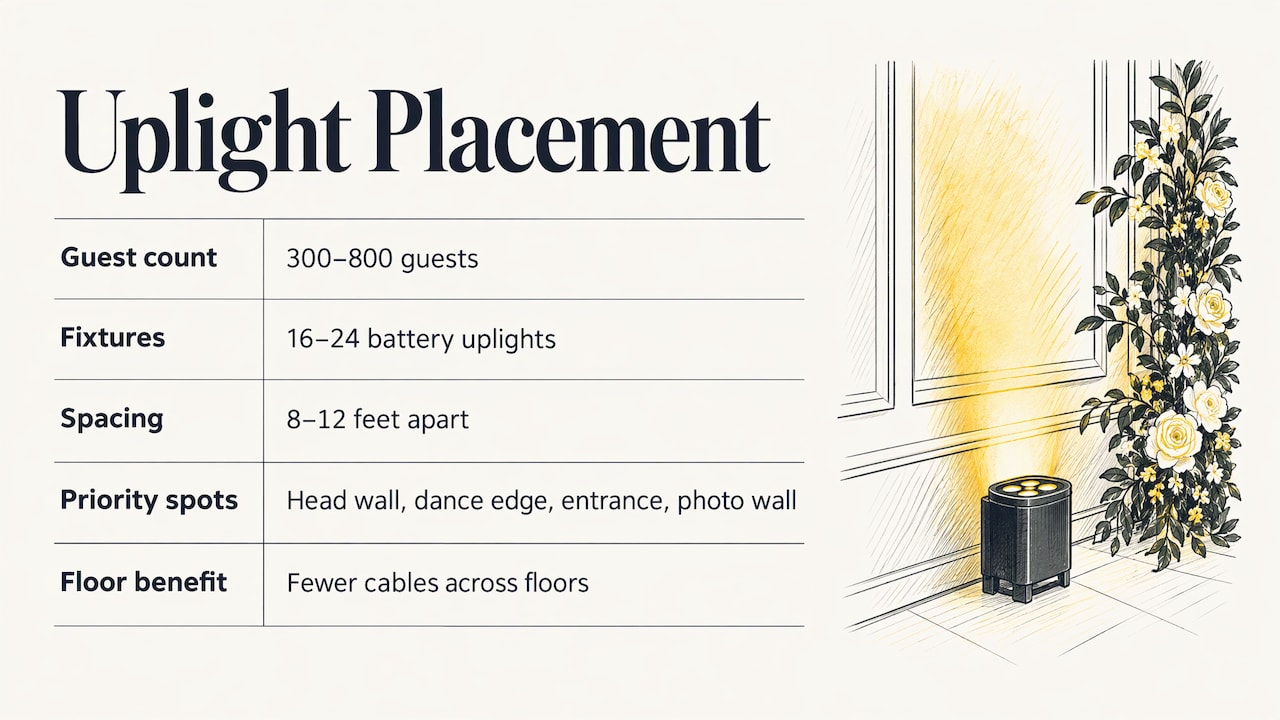
Battery and wireless fixtures also mean fewer cables across floors, which matters for guests in heels and for the servers.
Lighting the ceremony and cocktail hour
If your ceremony is outdoors in daylight, you need almost no added light. Focus on what the sun does at your ceremony time and position guests so faces are lit, not backlit into silhouette. For an indoor or dusk ceremony, three ideas work in almost any venue:
- Light the aisle edge softly. Lanterns on the ground or at pew ends, either LED or enclosed candles, guide guests without glare.
- Frame the couple. A backdrop such as an arch, draped fabric or a wall washed in soft light gives the photographer a clean background.
- Keep the faces bright and the background lower. The couple should be the brightest thing in the frame.
For cocktail hour, string lights overhead, lanterns hung from trees on an outdoor patio, and warm uplighting on the walls create an inviting space without competing with the room reveal that comes next.
Reception lighting design: decorative plus practical
The most common design mistake is picking lights only for how they look. GEO Events puts it this way: functional lighting ensures visibility and safety, including stage wash, catering task lighting, wayfinding and house lights, while atmospheric lighting creates mood and hierarchy with accent uplighting, washes, color shifts and gobo projections. A good plan integrates both so every fixture serves a purpose (GEO Events). Its team also flags two opposite errors: flooding the room with flat, even light so nothing feels dramatic, or going purely atmospheric so speakers are in shadow and guests cannot read menus.
A simple rule from Sortra’s reception lighting guide: each lighting choice should have a visual purpose and a practical one. Uplighting adds color while separating the background from the tables. Candles add romance while softening the look of long banquet tables.
Zones to plan separately
- Entrance: bright enough that guests see steps and the sign-in table, warm enough to feel like an arrival.
- Dining tables: low, warm and even. Candles, small lamps or votives work well, and guests should still be able to see each other’s faces.
- Head table, cake and toasts: one marquee-style guide suggests around 300 lux for cake and top tables so they stand out and photograph well, with bars at about 200 lux for consistent task lighting (Marquee Vision). You do not need a light meter. The takeaway is that these spots should be noticeably brighter than the rest of the room.
- Bar and buffet: steady task lighting so people can see what they are ordering and servers can work safely.
- Dance floor: lower light with colored effects, per the same guide.
If you are renting for a tent, the same source offers a rule of thumb of about 3.5W per guest for ambient lighting, plus accent and task lighting on top. It is a UK marquee guideline, so use it only as a starting point and let your lighting vendor size the system.
Dance floor lighting ideas
A dance floor should feel different from the dining room. People dance more freely when the light drops a little and color starts to move. Ideas that work:
- Wash color over the floor. Two to four fixtures angled in from stands or truss give you color changes without lighting the whole room.
- Moving beams and patterns. Use them sparingly during the peak. Constant flashing tires guests and makes photos harder.
- Pinspots on the centerpieces. The dance floor gets energy while the tables stay pretty for anyone sitting out.
- Cold sparks for moments. These are described as heat-free and smoke-free, can be timed to the music, usually go in pairs flanking the dance floor, and look best in darker settings. Common uses are the grand entrance, first dance, cake cutting and the end-of-night send-off (Pixelit). Because they are a special effect, confirm with the venue first (see the safety section below).
- A lit dance floor surface. A rented floor with built-in glow can anchor the whole party zone, and it keeps the dance area clearly defined as the room gets dimmer.
The key is that lighting should follow the band or DJ, not fight it. Ask your entertainment to tell your lighting vendor the order of the night: toasts, first dance, parent dances, open dancing, last song.
Build scenes and fade between them
Lighting is at its best when it changes gradually. One lighting vendor’s guide recommends fading each look into the next over about 10 to 30 seconds rather than hard on/off changes. Dinner fades into a speech setting, speech mode crossfades into the first dance, and a short, intentional build with colors intensifying and beams picking up speed lands the room in party mode (UKING).
A workable scene list for most receptions:
- Arrival and cocktails: warm uplighting, string lights, bright entrance.
- Dinner: warm and low, candles or lamps on tables, nothing moving.
- Toasts: a clean, brighter wash on the speakers so they are visible and photographed well.
- First dance: the room dims, a soft spotlight or warm wash on the couple, uplighting stays.
- Open dancing: color wash, movement and effects on the floor.
- Last dance and send-off: a final lift in energy, then house lights up gently, not suddenly.
Ask your vendor whether the fixtures can be controlled from one place, so the lighting changes when the schedule changes, not ten minutes later.
Candles, lanterns and string lights: charming, with rules
Simple votives, hanging lanterns and festoon string lights all earn their place in photos, especially for outdoor, barn and tent weddings. They are also where venue rules come in.
Fire codes vary by city, so there is no single national answer. A few examples show what to expect:
- In Dallas, open flames, candles and burning or smoke-emitting materials must be approved and permitted by the Fire Marshal before the event, and special effects, pyrotechnics and fireworks need approval too (Dallas fire code requirements).
- In Gresham, Oregon, candelabras must be secured and kept away from exits, combustibles and people, and handheld lit candles may not be passed from person to person. Flammable liquids and propane may not be used for decorative or lighting purposes indoors, in tents or under canopies (Gresham Fire Department guide).
- The model code language that many places adopt requires a permit for open flames in assembly-type spaces and says open flames must be kept a safe distance from combustible materials (UpCodes). In New York City, that permit applies to any Group A occupancy.
The common workaround is enclosure: many venues insist on glass hurricane shades because a glass chimney turns an open flame into a contained one that meets typical safety standards (ULS NYC). Flameless LED candles give the same glow with no permit question at all.
Before you commit to candles, haze, sparks or hanging lights, ask your venue coordinator these questions and get the answers by email:
- Are open flames allowed, and is a permit or fire marshal approval needed?
- Are there limits on haze, fog or cold sparks?
- Where can we hang or rig lights, and what can be attached to ceilings, beams or trees?
- Where are the power outlets and what is the capacity?
- Are there rules on how late outdoor lighting can run?
Perspective: why the band and the lighting should plan together
We have played a lot of rooms, and the pattern is consistent: the nights that feel effortless are the ones where the music and the light were planned as one thing. A room that is lit beautifully for dinner but never changes leaves a great dance set fighting a dining-room atmosphere. A room with a dramatic light show but no plan for toasts leaves the best man in the dark.
Our approach is to build the night around energy. We blend Pop, Rock, Hip-Hop and R&B so guests of all ages stay on the floor, and we customize setlists to the event. That means we know when the energy should climb, when it should drop for a ballad, and when the room needs to feel like a party. Share that flow with your lighting vendor and the lights can lift with it.
We also work closely with planners and couples, and we offer event production services, so lighting, staging and dance floor details can be considered alongside the performance instead of as an afterthought. Tell us your venue and your guest count early, and we will help you think through where the band sits, where the dance floor goes and what the room needs.
Jimmy
Ideas by venue type
Ballroom or hotel. Perimeter uplighting in amber or a palette color, wash on the dance floor and head table, pinspots on centerpieces. Check ceiling rigging rules with the hotel.
Barn or farm. String lights across the beams, uplighting on wood or brick walls, and lanterns outside. Plan extra pathway light for parking and restrooms.
Tent. Soft lights on the poles and fabric, string or festoon lights overhead, and color wash for the dance zone. Tents typically have stricter rules about flames and fuels, so confirm those first.
Backyard. Traditional string lights, large round or Edison bulbs and battery or solar lanterns give you plenty of options without a big rental. Hang from trees, poles, or even a pop-up canopy for an intimate seating area.
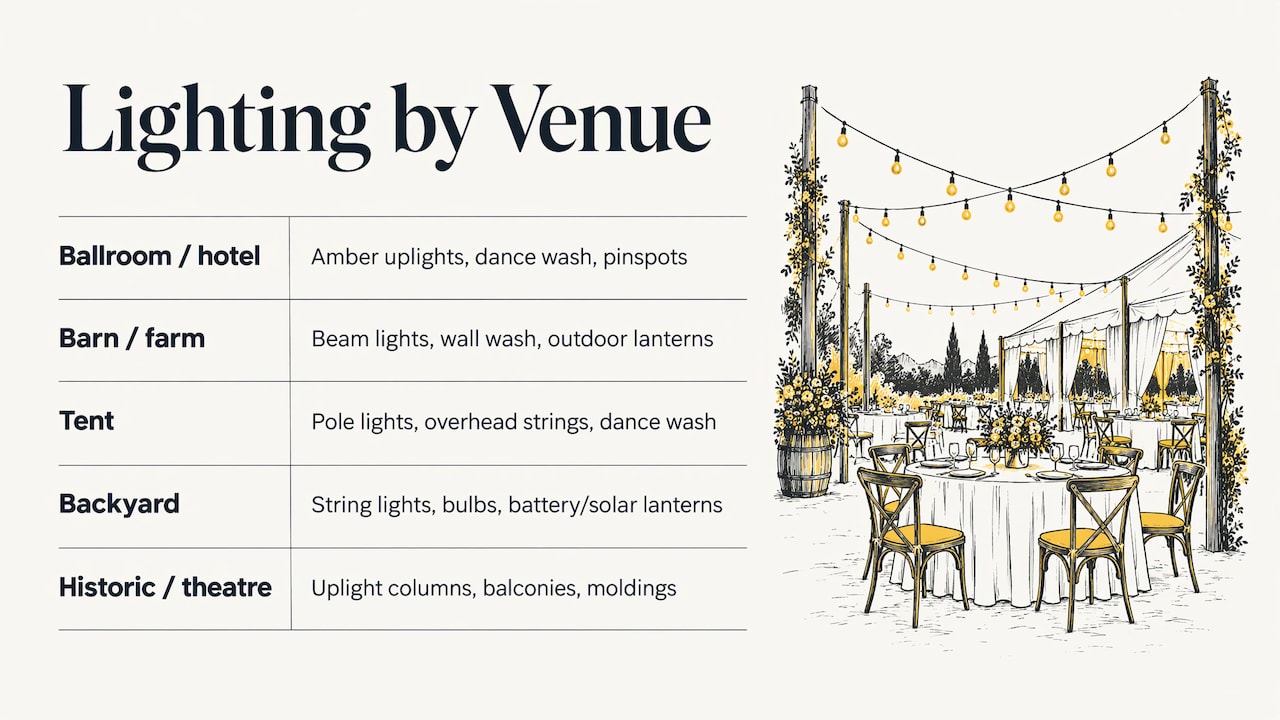
Historic or theatre venue. Let the architecture lead. Use uplighting on columns, balconies and moldings, and keep added décor light. If you are marrying at a Columbia, Missouri, venue, see how we approach it at Rose Music Hall or The Atrium on Tenth, or in Iowa City at The Englert Theatre.
A simple planning checklist
- Walk the venue at the time of day of your reception. Note natural light, dark corners and the walls that will appear in photos.
- Choose one main uplight color and one accent. Amber is a safe default.
- Map the zones: entrance, dining, head table, cake, bar, dance floor.
- Write the timeline and ask your lighting vendor to match scenes to it.
- Confirm venue rules on flames, haze, sparks, rigging and power.
- Coordinate with your entertainment on where the band or DJ will set up and what the dance floor needs.
- Do a quick run-through with the vendor before guests arrive, checking faces at the head table, the cake and the speaker spot.
If you are still deciding what will fill your dance floor, our guides on live band vs. DJ for weddings and choosing a wedding band walk through the decisions, and our mashup wedding dance songs article helps you shape the set that your lighting will follow.
Lighting and sound from one team
Our event production services cover lighting, staging and dance floor rentals alongside the band, and our ceremony sound option keeps vows and readings clear. If you want the room, the music and the flow planned together, tell us about your venue and date through our packages page or start from lostwaxband.com.
FAQ
What is uplighting at a wedding?
Uplighting uses small fixtures placed at the base of walls, columns or other features, usually around the room’s perimeter. The light washes upward, adds color and depth, and gives photos and video a richer background. Most modern fixtures are battery powered and can be set to match your color palette.
What is the difference between uplighting and wash lighting?
Uplighting accents the walls and architecture from floor level to set the mood. Wash lighting is aimed at an area, such as the dance floor or head table, to cover it with even color or warm white light. Many weddings use both: uplighting for the room, wash for the people.
What is the best lighting color for a wedding reception?
Amber is widely considered the most flattering because it is warm, formal and kind to skin tones, as long as it is not pushed too orange. If you want color, match one or two shades from your palette and save the bolder, moving colors for the dance floor.
How many uplights do I need?
It depends on the size and shape of the room. For a larger celebration of 300 to 800 guests, one guide recommends 16 to 24 fixtures spaced about 8 to 12 feet apart on visible walls. Ask your lighting vendor to walk the venue and recommend a number based on the walls that matter most in your photos.
Can I use real candles at my reception?
Often only with conditions. Many cities require approval or a permit for open flames, and many venues require candles to sit inside glass shades. Ask your venue and, if needed, the local fire marshal before you plan, or choose flameless LED candles for the same glow.
Sources
- Everything You Need to Know About Uplighting for Your Wedding, Brides
- Uplighting vs Wash vs Spot: What You Actually Need for a Ballroom, Amplifire Entertainment
- Medium Wedding Lighting Setup for 300-800 Guests, SHEHDS
- Event Lighting Design: A Cinematic Approach, GEO Events
- How to Plan Wedding Reception Lighting, Sortra
- Marquee Lighting guide, Marquee Vision
- Wedding Lighting Guide: Uplighting, Cold Sparks, Lasers, Pixelit
- Wedding Reception Lighting: Dinner to Dance Transitions, UKING
- Dallas Fire Code Requirements for Exhibits and Special Events
- Fire Prevention Planning Guide for Special Events, Gresham Fire Department
- Use of Open Flames in Group A Occupancies, UpCodes
- A Guide to Using Glass Hurricane Candle Shades for Weddings, ULS NYC
Recent Comments