
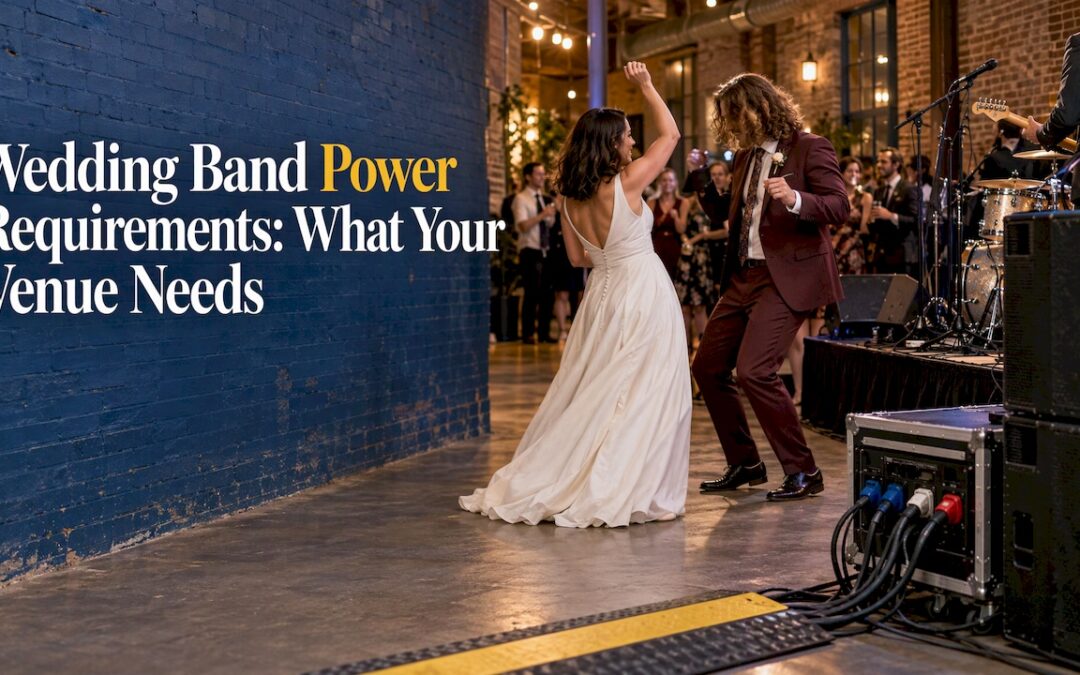
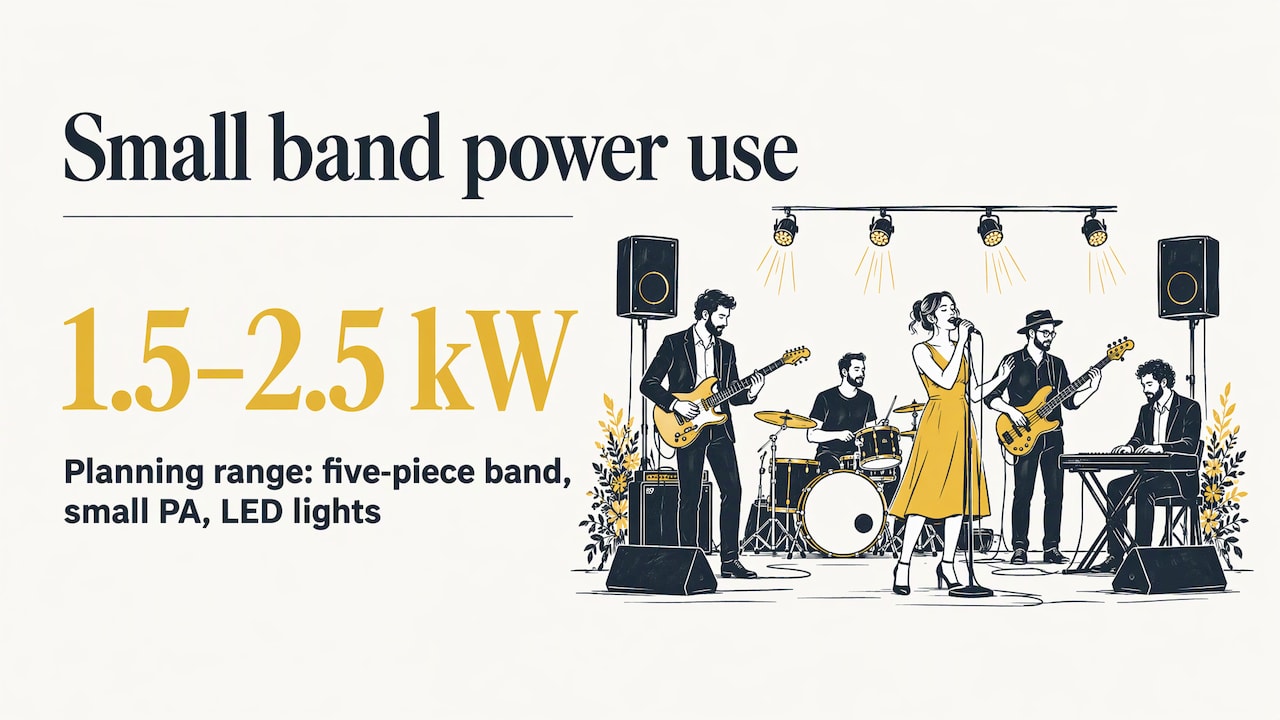
A typical five-piece wedding band with a small PA and LED lighting draws roughly 1.5 to 2.5 kW, according to one planning range for stage power. In the US, that usually means two separate 20-amp, 120-volt circuits, kept free of catering, coffee urns and other lighting. Larger lineups and outdoor receptions need more planning. The simplest way to get it right is to hand your venue coordinator the band’s tech sheet early, then confirm outlets, circuits and generator details in writing.
This guide explains the numbers in plain terms: what each piece of band gear draws, how to turn watts into amps, how many circuits to request, what to do at a tent or barn venue, and what to keep off the band’s power.
TL;DR
- Plan on about 1.5 to 2.5 kW for a five-piece band with a small PA and LED lighting. Bigger bands, subwoofers and moving lights push that higher.
- Ask the venue for two dedicated 20-amp, 120-volt circuits near the stage, and keep catering, coffee, heaters and décor lighting off them.
- Watts divided by volts gives amps. A standard 15-amp household circuit is about 1.8 kW at its limit, and continuous loads should stay well under that.
- At outdoor venues with no building power, size a generator at well above the total load, use an inverter model, and have a qualified electrician connect it.
- Send your band’s technical sheet to the venue and your planner a few weeks out, not on the wedding day.
Table of Contents
- How much power a wedding band actually uses
- What each piece of gear draws
- Watts, amps and volts: the quick math
- How many circuits to ask the venue for
- Outdoor, tent and barn receptions
- What to keep off the band’s circuit
- A planning timeline that works
- How Lost Wax approaches the electrical plan
- Our point of view
- Frequently asked questions
- Sources
How much power a wedding band actually uses
People tend to picture a rock concert when they think of band power. A wedding band is much smaller. The planning range of 1.5 to 2.5 kW for a five-piece act with a small PA and LED lights comes from Expert.band’s stage power guide. Treat it as a ballpark, not a rule. A band with big subwoofers, a haze machine or moving lights will land higher.
A useful comparison: a typical electric space heater draws about as much as a whole small band. That is why a venue’s kitchen, a bar’s refrigerators and a band’s rig can trip a breaker when they share a line.
Watts also don’t stay at their maximum. Audio gear draws far less on average than its rated peak, and the rated number is what you plan around so the circuit never gets close to its limit.
What each piece of gear draws
Breaking the rig into parts shows where the power goes. The figures below are typical continuous draws published in Stage Supply’s band power checklist. They are planning figures, and your band’s actual gear will differ.
| Gear | Typical continuous draw |
|---|---|
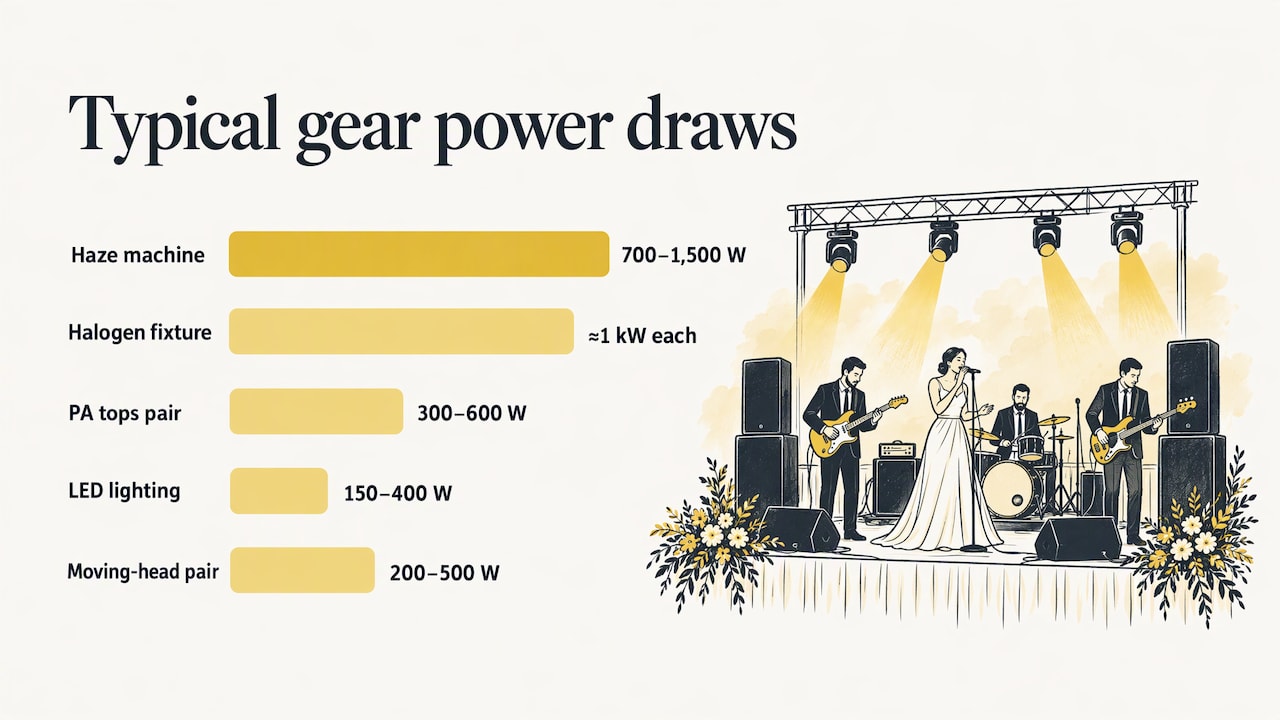
| Powered PA tops (pair) | 300 to 600 W |
| Powered subwoofers (pair) | 400 to 800 W |
| Powered stage monitors (two wedges) | 150 to 300 W |
| Digital mixer, stage box and in-ear racks | 100 to 200 W |
| Guitar amp | 100 to 300 W |
| Bass amp | 150 to 300 W |
| Keyboards, laptop and interfaces | 50 to 150 W |
| LED lighting | 150 to 400 W |
| Two moving-head lights | 200 to 500 W |
| Haze or smoke machine | 700 to 1,500 W |
Two things stand out. First, the haze machine can draw as much as the entire PA. Second, lighting type matters enormously: older halogen fixtures can draw about 1 kW each, while an LED bar or a set of LED pars is a small fraction of that.
If you want to see how lighting choices shape the night beyond the electrical side, our wedding lighting ideas cover each part of the evening.
How band size changes the total
More musicians means more amplifiers, more monitors, more microphones and usually a larger PA. A five-piece act and an eighteen-piece show are different electrical projects. The spec sheet for a horn section is lighter than you might expect, since horns are acoustic and use microphones. Keyboards, bass and guitar amps, drum monitors and in-ear systems are what add up. If you are still deciding on lineup size, our guide to wedding band size and live band lineups walks through the tradeoffs.
Watts, amps and volts: the quick math
Circuits are rated in amps. Gear is rated in watts. The bridge is simple: watts equal volts times amps. In the US, standard outlets run at 120 volts.
- A 15-amp, 120-volt circuit tops out around 1.8 kW, per Expert.band’s North American comparison.
- A 20-amp, 120-volt circuit is about 2.4 kW at its absolute limit (20 x 120).
- For continuous loads, the National Electrical Code’s 80 percent rule applies. A 15-amp circuit is limited to 12 amps continuous, and a 20-amp circuit to 16 amps. That works out to about 1,440 W and 1,920 W.
That is why a 2 kW band can fit on one 20-amp circuit on paper, yet is much safer on two. A band that is sharing one line with anything else is a band waiting for a tripped breaker mid-first-dance.
Reading the label correctly
To estimate a rig yourself, use each item’s mains power rating from its rear panel, not its audio output rating. Sound On Sound’s guide to stage electrics warns that amplifier output watts and mains consumption are different numbers: a 240 W active speaker may carry a mains rating around 350 W. It also notes that startup demand can exceed normal running demand. Add the mains ratings together, then divide by your voltage. (That article is written for 230-volt UK systems, so in the US divide by 120 instead.)
You rarely need to do this yourself. A working band keeps a tech rider with its total draw. Your job is to pass it to the venue.
How many circuits to ask the venue for
The common request among working bands is simple: two dedicated 20-amp, 120-volt circuits within about 25 feet of the stage, not shared with catering or lighting. The ranking guidance on this topic says the same thing, and it is a sensible default for a band of five to eight players.
Here is what to confirm with the venue:
- Where the outlets are. Short runs matter. Long, thin extension cords lose power and can overheat.
- Which breakers feed them. Ask the venue manager or facilities lead to identify the breaker for each outlet. Two outlets on the wall can sit on the same circuit.
- What else is on those circuits. Coffee stations, warming ovens, refrigerators, space heaters and the DJ or photo booth should be on separate lines. Expert.band flags fridges, coffee machines, heaters and older halogen rigs as common causes of circuit trouble.
- Whether the outlets are GFCI protected. Outdoor and wet-area outlets in the US usually are. Nuisance tripping on a GFCI outlet is a real risk with some audio gear, so ask whether a different protected circuit is available.
- Who to call on the day. A named person with breaker access can solve a problem in two minutes. Searching for one takes twenty.
Homes are a special case. Standard house outlets are generally 15-amp circuits, and one room’s outlets often share a single breaker. If your reception is at a private home, walk through with your planner and the band’s production contact before the wedding.
Outdoor, tent and barn receptions
A tent or field has no panel to tap. The whole event, band, lighting, caterer, bar and restroom trailer, may run on a generator or several. A rental company’s breakdown of wedding-day power needs estimates a band at 3,600 to 8,000 watts, and a full wedding day across ceremony sound, lighting, refrigeration, food, coffee, the band and a restroom trailer at 5,000 to 15,000 watts. Those are rental-industry estimates and run higher than the planning range for a small band, since they allow for large rigs.
Sizing a generator
Headroom is the point. Guidance varies by source, so aim for the generous side:
- Professional guidance from the NADJ Power Planner is to size a generator at a minimum of double the peak load, to cover power factor losses, harmonic distortion and motor start surges. It also advises 30 mA RCDs on all outdoor circuits (the UK equivalent of GFCI protection), testing them before every event, and keeping sockets at no more than 80 percent continuous load.
- A sound-industry article from FOH magazine recommends at least 25 percent headroom on top of your equipment total for outdoor events or unusually large systems. Its example: a 5,000 W PA calls for a generator of at least 7.5 kVA.
In practice, the more conservative number protects you. A generator running at its limit will sag and distort, and that shows up as hum, crackle or a sudden shutdown during your reception.
Inverter generators and separate power for the band
Inverter generators produce a clean, stable sine wave and behave far better with audio gear than conventional open-frame units. They are also quieter, which matters when a generator is parked near a ceremony.
Two rules keep the party safe:
- Put the band on its own supply wherever possible, separate from catering and refrigeration. Motors starting up cause surges, and surges cause audible problems.
- Have a qualified electrician connect it. Earthing and bonding a generator is not a job for the band or the couple. The same checklist says earthing is a task for a competent person, and it advises plugging into generator power only when a competent person has set it up, with ground-fault protection confirmed. The guidance is rooted in UK practice, and the principle holds anywhere: if a qualified person hasn’t confirmed the setup, don’t plug in. In the US, your rental company or venue electrician can do this, and local codes apply.
Also check the practical details: fuel for the whole event, where the unit sits relative to guests and cables, and how cords are routed so no one trips over them.
What to keep off the band’s circuit
Most power failures at weddings are not caused by the band. They come from someone plugging a second load onto the same line. Keep these on their own circuits:
- Coffee makers and hot-water urns
- Refrigerators and beverage coolers
- Food warmers, chafing fuel substitutes with heating elements, and griddles
- Space heaters and portable air conditioners
- Décor and uplighting, especially older halogen fixtures
- A DJ, photo booth, or video wall
- Haze and fog machines unless the band’s tech lead has counted them
If your caterer has a list of electrical needs, trade lists with the band’s tech rider and have the planner compare them. It is a five-minute conversation, and it prevents the most common failure.
A planning timeline that works
- Three to four months out: Share the band’s tech sheet with your venue and planner. Ask the venue what outlets, circuits and generator hookups it provides.
- Six to eight weeks out: Confirm circuit locations and the stage position. Decide whether lighting, ceremony sound or a dance floor will be added, since each changes the electrical plan.
- Two weeks out: Collect the caterer’s and other vendors’ power needs. Confirm who has breaker access on the day.
- Load-in day: The band’s team checks outlets before plugging in, and the venue contact stays reachable until the first set starts.
If you want the full conversation with the band covered, our list of questions to ask a wedding band before you sign includes the technical items to raise.
How Lost Wax approaches the electrical plan
We have been playing weddings, corporate events and private celebrations since 2009, with lineups from our 5-piece, 8-piece and 10-piece bands to the ELITE 14-piece and SHOWSTOPPER 18-piece shows. Because the lineup changes the electrical picture, we work closely with your planner so the stage, sound and lighting fit the room. If you want sound and lighting handled with the band, our event production services include ceremony sound and lighting, and you can see the band packages to match a lineup to your guest count and venue.
Our point of view
Power is the least glamorous part of a wedding and the one that can quietly ruin it. A couple can spend a year choosing the perfect band and a perfect room, then lose the first dance to a tripped breaker because a coffee urn shared a line with the PA.
We think the best approach is a plan made early, in writing, with everyone who touches the room. The planner, the venue, the caterer and the band should all see the same page. We build our shows around flexible lineups, from five players to a full stage, so the electrical load should be matched to the show you chose, not guessed at on the day.
Our advice to couples is to treat the power conversation as part of booking the band, not an afterthought. Bring us in while you are still picking the venue layout, and we will work with your planner so the music, the sound and the lighting all run on a plan everyone has read.
Jimmy
Frequently asked questions
How many amps does a wedding band need?
A small band with a modest PA and LED lights commonly needs two dedicated 20-amp, 120-volt circuits in the US. The total draw for a five-piece act is around 1.5 to 2.5 kW, which is more than a single 15-amp circuit handles comfortably. Larger bands, subwoofers and extra lighting call for additional circuits.
Can a band run off one regular outlet?
A very small acoustic setup might. A full wedding band with a PA, amps and monitors should not. A standard 15-amp household circuit tops out at about 1.8 kW and should not be loaded to that limit for hours, and many outlets in the same room share one breaker. Ask the venue for two separate circuits.
What size generator do I need for a band at an outdoor wedding?
Add up the band’s total draw, then size the generator well above it. Industry guidance runs from 25 percent headroom to double the peak load, depending on the source and the equipment. An inverter generator is a good fit for audio gear, and a qualified electrician should connect it. Ask your band for its total load first.
What should not share a circuit with the band?
Keep coffee machines, refrigerators, heaters, food warmers, older halogen lights and other motor or heating loads on separate circuits. These draw heavily and can cause surges or trip breakers. Haze machines can also draw as much as a whole PA.
Sources
- Stage power and safety, Expert.band
- Stage Power for Bands: The Complete Checklist, Stage Supply
- Power & Electrical Safety On Stage, Sound On Sound
- Power Generators at a Wedding, Ty’s Wedding Services
- Power Planner, NADJ
- Using a Generator to Power a Small P.A. System, FOH
- How Many Amps Does a Light Bulb Use, DG Floors
Recent Comments