
A first dance mashup works when two or three songs share a key or a mood, the shift between them is planned to the second, and the whole thing runs about two to three minutes. Start slow and personal, then give the room a lift it can feel. The rest of this guide shows how to choose the songs, build the arc, handle the transition, include parents, and rehearse so the moment looks easy.
We are Lost Wax, a mashup party band that has blended Pop, Rock, Hip-Hop and R&B for weddings since 2009. A first dance is the one moment of the night where the whole room watches, so it deserves the same care as the dance floor that follows it.
TL;DR
- Use two songs, three at most. Open with a slow, meaningful song and turn to something brighter once guests are leaning in.
- Aim for roughly two to three minutes in total. Keep each song to a short excerpt, not a full verse-chorus run.
- Songs in the same key, or with a tempo you can bridge, make the transition feel intentional rather than abrupt.
- Parent dances can use the same trick: one classic for them, one song from your own playlist.
- Plan the final moment and the music that follows it, then rehearse in the shoes you will wear.
Table of Contents
- Why a mashup instead of one song
- Choosing songs that belong together
- Build the arc: order, length and the ending
- Make the transition seamless
- Parent dances and family mashups
- Live band or recorded edit
- What comes right after the dance
- Rehearse and coordinate
- Planning a mashup for the rest of the event
- Book a band that builds the moment with you
- Perspective
- FAQ
- Sources
Why a mashup instead of one song
One song asks you to commit to a single mood for three or four minutes. A mashup lets you say two things: the sentimental one and the fun one. Most couples have a song that reflects how they fell in love and another that reflects how they actually live. Putting them together gives guests a short story with a beginning and a turn.
There is a practical side too. Many of the best-loved wedding ballads run well past four minutes, and a couple standing in the middle of a floor with everyone watching feels every extra bar. A mashup gives you the emotional peak of each song and skips the long instrumental stretches.
The risk is the opposite one: too many songs. If a mashup jumps through four tracks in three minutes, nothing lands. Keep it to the moments that matter to the two of you.
Choosing songs that belong together
Start with meaning, then check the music. Make a short list of songs tied to a real moment: the first road trip, the song playing when you got engaged, a track a grandparent loved. Then look for a pair that contrasts in energy but not in feel.
Check the key and the tempo
Songs that share a key blend more easily, because the melody of one can lead naturally into the other. Take a popular pairing. “A Thousand Years” by Christina Perri is in B-flat major, in 6/8 time, and runs 4:45 in its original single version. “Rewrite the Stars” from The Greatest Showman is also in B-flat major, at 125 beats per minute, and runs 3:37. Same key, very different pulse: the first sways, the second moves. That is the kind of contrast that gives a mashup its turn.
A third option is “Say You Won’t Let Go” by James Arthur, a pop folk R&B ballad of 3:31 released in 2016. It sits comfortably between the other two in mood: warm, steady and singable.
A few questions help you sort a list:
- Does the first song let you hold each other and talk quietly for the first minute?
- Is the second song one your friends already sing along to?
- Can you hum the end of the first song and the start of the second back to back without a clash?
- Does each song still mean something to you if you hear only the chorus?
If you want more ideas on picking the opening song, our guide to choosing a first dance song covers the options in depth, and our piece on wedding mashup songs shows pairings and timing in more detail.
Mix eras and genres on purpose
The strongest mashups often pair genres, not just songs. A classic soul ballad into a hip-hop party hit surprises the room in a good way. A pop ballad into a rock singalong gives older and younger guests something to cheer for. If hip-hop is part of your playlist, see our list of hip hop wedding songs for tracks that fit different moments of the night.
Blend two traditions
If you and your partner come from different cultural backgrounds, a mashup is a graceful way to honor both. One approach is to begin with a romantic song from one tradition and move into a well-known song from the other at the chorus or the beat change. Decide ahead of time exactly where the language or musical style changes, so the moment feels designed. Our guide to multicultural wedding music goes through how to blend two traditions across the whole day.
Build the arc: order, length and the ending
Think of the dance as a very short piece of theater.
- Open slow. Spend the first minute or so on the emotional song. This is when guests take photos and you get to breathe.
- Turn. Move into the brighter song at a natural lift: a chorus, a drum fill, a key change.
- Land it. End on a resolved note, not a fade, so people know exactly when to clap.
For length, our advice is to land between two and three minutes for the whole dance. With two songs, that is roughly a minute to a minute and a half each. With three songs, each gets about 45 seconds. Beyond that, you are asking the room to watch something that has stopped changing, and you are asking your feet to keep going in front of a crowd.
A good test: play the mashup for a friend who does not know the plan. If they can tell you where the story starts, where it turns and where it ends, the structure is working.
Plan the last ten seconds
Couples often rehearse the opening and improvise the end. Pick the final move in advance, whether that is a dip, a spin or a kiss, and make sure it falls on the last note. A planned finish gives guests the cue to applaud and gives photographers a clear moment to catch.
Make the transition seamless
The transition is where mashups succeed or fail. A few ways to make it feel deliberate:
- Use an instrumental bridge. Let the first song end on an instrumental phrase, then bring in the second.
- Match the beat. If the tempos differ a lot, a drum fill or a short pause can reset the pulse so the shift sounds like a choice.
- Echo a vocal line. A final lyric from the first song can overlap the opening of the second.
- Stay in key. As the B-flat pairing above shows, a shared key removes the biggest source of awkwardness.
Avoid fading the first song out and starting the second from silence. That creates the exact pause where couples feel exposed and guests start to chat.
Parent dances and family mashups
The same idea works for the father-daughter, mother-son or parent dance, and it can be the most fun part of the reception. The trick is to reflect both generations: a song that belongs to the parent, then one that belongs to the child.
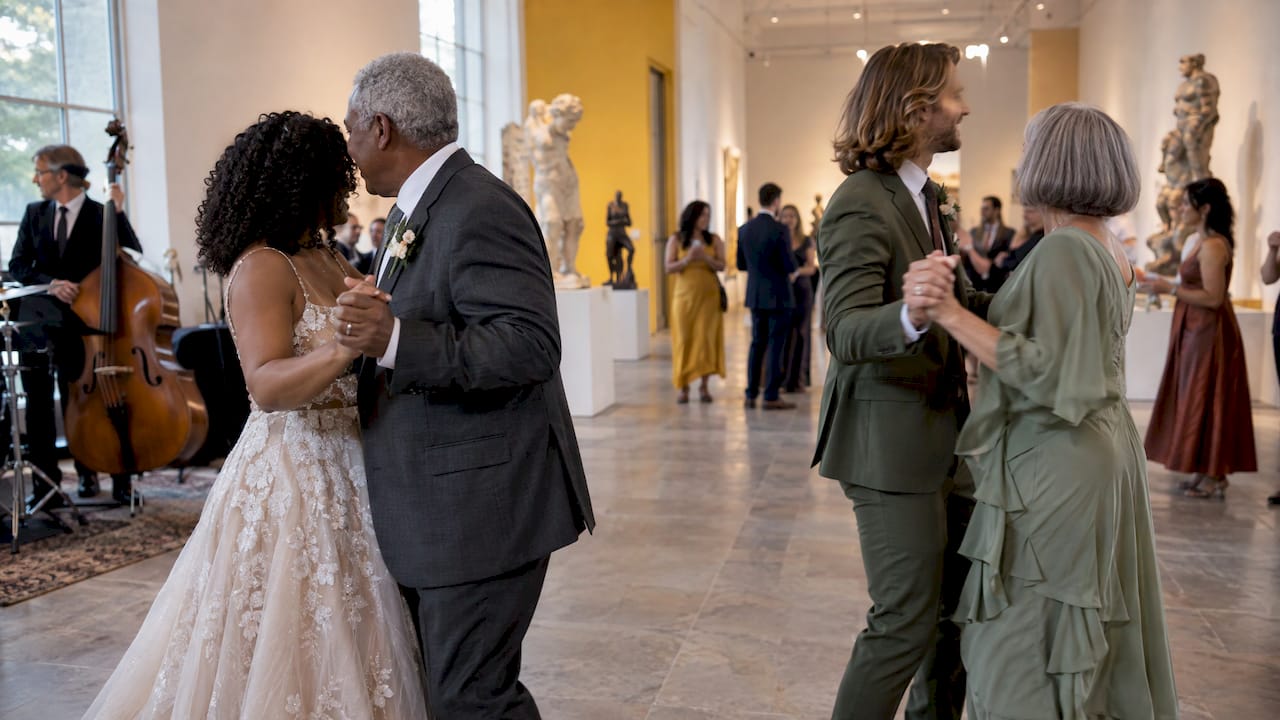
A widely shared example comes from Nancy Krieger and her father, Ronald Lestock, who opened their wedding dance with “My Girl” by The Temptations and then switched to Usher’s “Yeah!”. The mix continued through “Twist,” Ciara’s “1, 2 Step” and finally “Y.M.C.A.” They practiced every week for about eight to nine months, and that rehearsal time is a big part of why it looked effortless.
A few ways to shape your own:
- Old favorite, then new favorite. Start with a song the parent loved at your age, then move to one you actually listen to now.
- Slow to fun. Begin with a sentimental song and let other family members join in when the upbeat section starts. This also takes the pressure off a parent who is nervous about dancing alone.
- Keep it short. Parent dances are traditionally trimmed to a couple of minutes, which is plenty for a mashup with two songs.
- Think about the whole family. A mother-son dance, a dance with a stepparent, or a dance with both parents together all work with a mashup. Choose songs that mean something to the people on the floor, not only songs that sound good.
If you are planning several dances, such as a couple’s dance, a parent dance and a grand entrance, vary the pacing so they do not all feel the same. Our list of wedding grand entrance songs helps you set the tone before the dances begin.
Live band or recorded edit
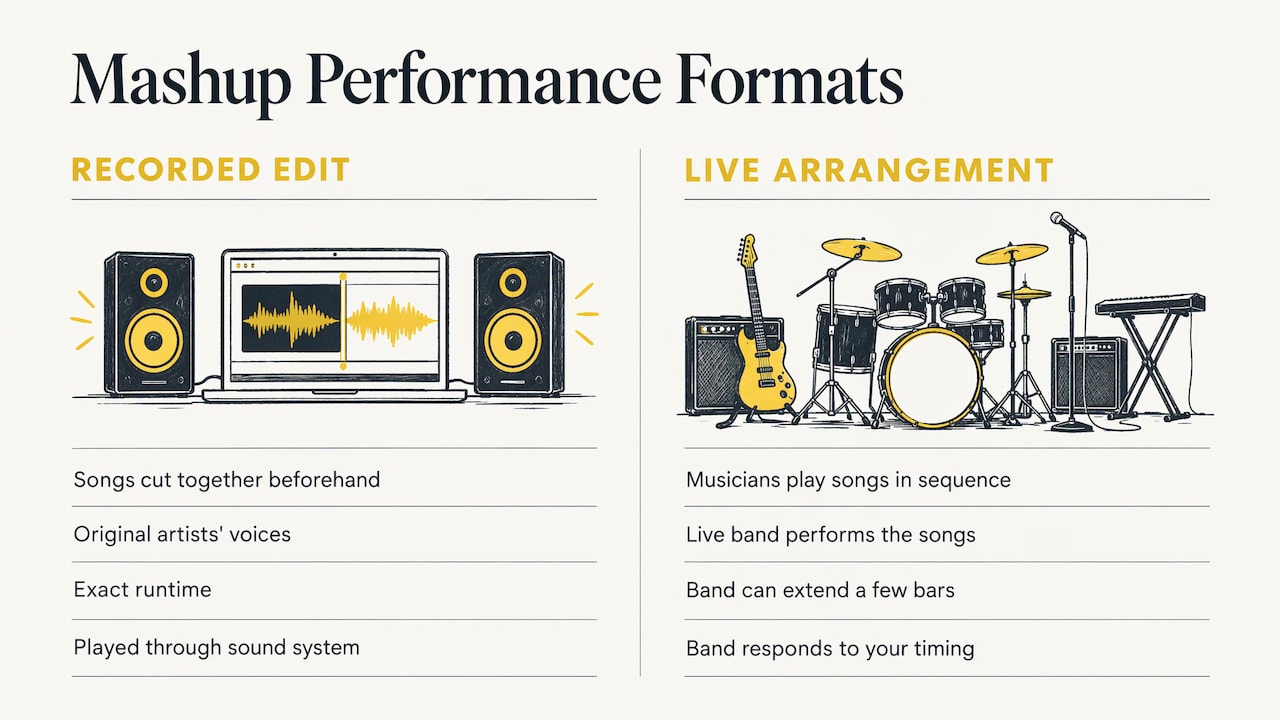
There are two ways to deliver a mashup. One is a recorded edit: a single audio file in which the songs are cut together in advance and played through the sound system. The other is a live arrangement, where musicians play the songs in sequence.
A recorded edit gives you the original artists’ voices and an exact runtime. A live arrangement gives you something a recording cannot: the band can respond to you. If you are a beat late on the dip, the ending waits for you. If the crowd is clapping along, the second song can stretch a few bars. Because the music is played in the room, the transition can be rehearsed with the people who will perform it, and the shift into the party can happen without any gap.
This is the world we work in. Lost Wax is a live band built around mashups, with customizable setlists and seamless transitions between songs. If you are comparing formats for the whole night, our guide to live band versus DJ lists the questions worth asking every vendor. For a sense of what the song library looks like, browse our song list.
What comes right after the dance
The first dance should hand the room to the party, not leave it standing in silence. Plan a clearly higher-energy song to follow the last note, so guests walk onto the floor while the applause is still going. Many couples invite the wedding party or parents onto the floor at the final chorus.
It also helps to think about how the whole evening flows. Some couples plan a late-night plan for the guests who want to keep going, and these wedding after party ideas are a good place to start when you want the celebration to continue beyond the reception.
Rehearse and coordinate
A mashup you have only heard in the car will not survive the first live run. Build rehearsal into your calendar:
- Eight weeks out: Lock the songs and the order. Choose the exact moment where the second song begins.
- Six to eight weeks out: Practice two or three times a week. Short sessions beat one long one.
- Four weeks out: Rehearse in the shoes you will wear and, if you can, in the dress or the suit, so the spin and the dip are tested with the real fabric and heels.
- Two weeks out: Give your music provider a written brief: the song order, the runtime, the cue for the transition and the cue for the ending.
- Wedding week: Run it once at normal speed and stop. Do not tinker.
Also agree on a discreet signal. If you want to wrap up early, a small squeeze of the hand or a nod to the bandleader lets the music end gracefully.
For couples working with a planner, share the written brief with the planner too, so that the venue, the photographer and the band are all working from the same timeline. The first dance usually sits right after the grand entrance or after dinner, and the lighting and sound should be set before you step out.
Planning a mashup for the rest of the event
The first dance is only one thread. Weddings, corporate galas and private celebrations all have moments where music has to change gears: a toast that turns into a dance floor, an awards segment that flows into a party. The same principles apply: contrast with a purpose, smooth transitions and a clear ending. If you are producing a corporate event, our ideas for corporate event music show how to pace the night from arrival to the final song.
Book a band that builds the moment with you
Lost Wax is the original mashup party band, with Pop, Rock, Hip-Hop and R&B blended into shows that keep guests of every age on the dance floor. We offer flexible band sizes, from a 5-piece up to the Collective, and larger 14-piece and 18-piece lineups, plus event production such as ceremony sound, lighting and staging. If you would like your first dance to flow into a full-band set, tell us about your wedding and we will start from your songs.
Perspective
A first dance is the only song of the night that is entirely yours, so we think the mashup should sound like you and not like a template.
What we have learned from playing for guests of every age is that people respond to contrast and to honesty. Give the room a tender first minute and a genuine lift, and they go with you. Try to squeeze in every favorite and they drift. Choose the two songs that matter, trust the turn, and let the end be clean.
This is why we build our shows around customized setlists and seamless transitions, and why we work closely with couples and planners so the first dance and the party that follows feel like one piece. When the dance leads straight into the floor filling up, the whole evening has momentum. That is what our band is for.
Jimmy
FAQ
How long should a first dance mashup be?
Aim for about two to three minutes in total. With two songs, that is roughly a minute to a minute and a half each. If you are using three songs, keep each excerpt to around 45 seconds so the story keeps moving.
How many songs can you put in a first dance mashup?
Two is the safest number and three is a comfortable upper limit. More than that and the dance starts to feel like a playlist rather than a story. Choose songs that each mean something to you, and let each one finish its main moment.
Can a first dance mashup work for a father-daughter dance?
Yes, and it often works better than a single song. Pair a classic that belongs to the parent with a newer song the child loves, and consider inviting family to join in when the tempo rises. A viral father-daughter mashup moved from a Motown classic to Usher’s “Yeah!” and relied on months of weekly practice.
How do you make the switch between songs sound smooth?
Pick songs in the same key or bridge them with an instrumental phrase, a drum fill or an echoed vocal line. Avoid fading to silence between songs. Then rehearse the exact moment of the switch until you can feel it in your steps.
Should the first dance mashup be live or recorded?
Both can work. A live arrangement lets the music follow you, so the ending lands on your final move and the party can start without a gap. We build our shows with seamless transitions and customizable setlists for exactly that reason.
Sources
- A Thousand Years, Wikipedia
- Rewrite the Stars, Wikipedia
- Say You Won’t Let Go, Wikipedia
- Father-daughter duo’s twist on wedding dance goes viral, Good Morning America
Recent Comments