
The best questions to ask a wedding band cover six things: availability and lineup, proof of live performance, how the set is built, production and venue logistics, contingencies, and the total contract cost. Ask every band the same questions in the same order, and a polished demo reel or a low headline fee can’t hide an operational gap. Below you’ll find the questions that matter, why each one matters, and what a good answer sounds like.
TL;DR
- Confirm the date, the exact lineup that will perform, and how many weddings the band plays a year before you talk about songs.
- Ask for unedited live footage and recent client references, not just a studio demo.
- Ask how the setlist is built, which requests are guaranteed, and how many new songs the band will learn.
- Get the timeline in writing: arrival, soundcheck, sets, breaks, teardown, and what happens under a sound limiter.
- Compare contracts on total cost, deposit schedule, and what is included, not on the headline fee.
Table of Contents
- Start with the screening questions
- Questions about the music and the setlist
- Questions about production and venue logistics
- Questions about backup plans
- Questions about price, packages and the contract
- How we answer these questions at Lost Wax
- Our perspective: ask about the dance floor, not just the demo
- Live band or DJ: a question to settle early
- See what the answers look like in practice
- A simple way to run the interviews
- FAQ
- Sources
Start with the screening questions
Before you fall for a band’s sound, find out whether they can actually play your day. The major wedding guides agree on the first filter. The Knot’s guide sorts its 36 questions into logistics, experience, budget and packages, and music style. Hitched’s list of 25 runs through availability, music, production, contingencies and pricing. Both open with the same basics.
Ask these five first:
- Are you available on our date? If the band plays more than one event that day, ask how that affects arrival time and soundcheck.
- Who exactly will perform? Some bands send substitutes from a pool of musicians. Ask whether the lineup in the video is the lineup at your wedding, and whether the band leader will be on stage.
- How many weddings do you play each year? Wedding experience is different from club or concert experience. Someone has to run the grand entrance, the toasts and the cake cutting without dead air.
- Have you played our venue? Familiarity with the room, the load-in route and the sound rules saves hours of guesswork.
- Can we see unedited live footage and speak to recent clients? Edited highlight reels hide a lot. Ask for a full song filmed from the back of the room, and ask for contacts from weddings in the last year or two.
A good answer is specific. “We played 60 weddings last year, here are three clips from full sets, and here are two couples who said we could share their emails” beats “We do lots of weddings.”
Questions about the music and the setlist
Musical taste is only half the decision, but it is the half your guests feel most. Dig into how the band builds a night, not just what they can play.
How is the setlist built?
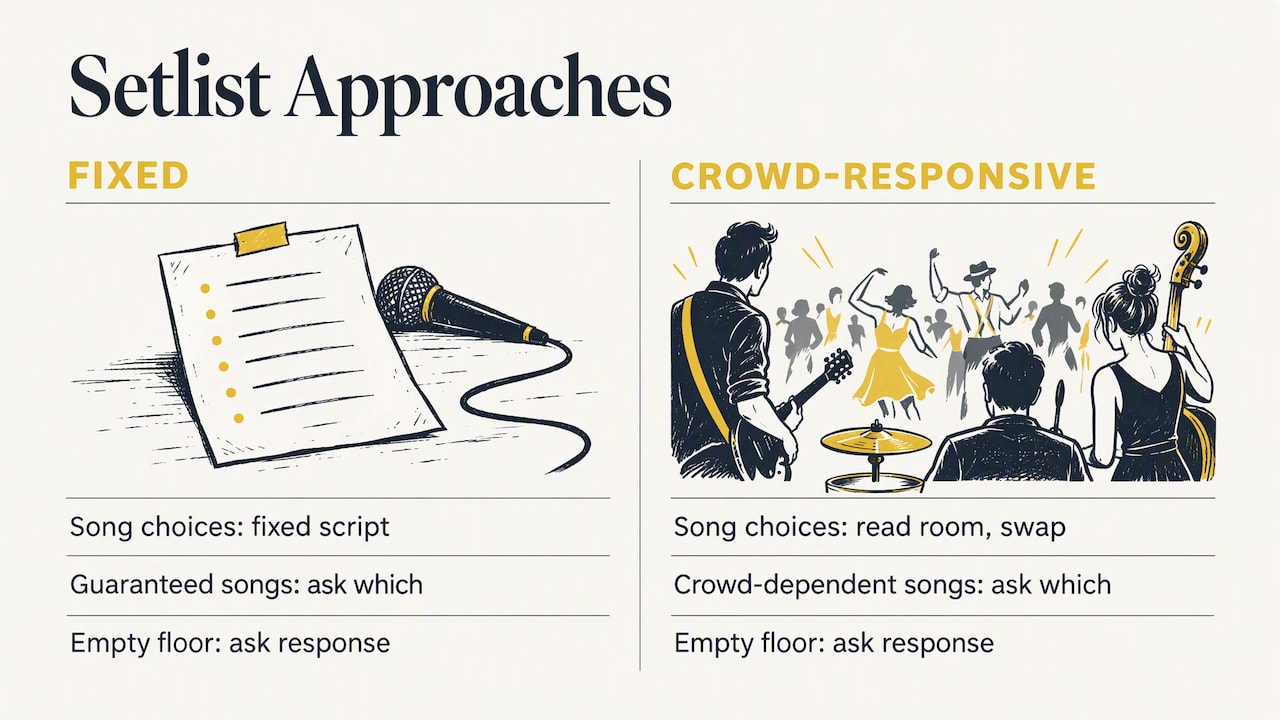
Ask how your input is collected, which songs are guaranteed and which depend on the crowd. Some bands play a fixed script. Others read the room and swap songs on the fly. Neither is wrong, but you should know which one you’re hiring. Ask what the band does when the dance floor empties.
Can we send must-play and do-not-play songs?
Any professional band should accept both lists. Ask whether there’s a limit, and whether a do-not-play song is treated as a hard rule. If you’re sending a long playlist, ask how it influences the night. A list of 200 songs can be inspiration rather than a contract.
Will you learn our first dance?
First dance, parent dances and the grand entrance are the moments when a learned arrangement matters. Ask how many new songs the band will learn, whether there is an extra fee, and how much rehearsal time they need. If you’re still choosing, our guide to first dance songs is a good place to start.
What plays during breaks?
Every live band takes breaks. Ask what fills the silence: a playlist, a DJ integration, or a smaller group playing acoustic. Also ask about the dinner break, which usually matches your meal service.
Can we see the full song list?
A real repertoire should be written down. You can browse our song list to see what a mashup band’s catalog looks like, then ask every band for theirs. Check that it covers the decades and genres your guests actually dance to, from pop and rock to hip-hop and R&B.
Can you play the ceremony and cocktail hour?
Ask what’s available for ceremony, cocktail hour and dinner: a smaller group, acoustic guitar, piano, sax or a string player. Then ask what each costs, and whether those musicians come from the reception band or are added on.
Questions about production and venue logistics
The overlooked questions are operational, and they rarely appear in promotional videos. According to WeddingWire’s guide, the strongest screening conversations test whether the band can work with your venue, planner and timeline without leaving you to coordinate technical details.
What is the day-of schedule?
Ask for a written timeline covering arrival, load-in, soundcheck, first set, breaks, second set and teardown. Then compare it with your venue’s rules. Some venues limit load-in to certain hours, and many require vendors to be out soon after the music ends.
How much space, power and access do you need?
Ask for the stage footprint, the number of power circuits and the load-in path. A 5-piece band needs a different corner of the room than an 18-piece show. Send the band your venue’s floor plan early.
What happens under a sound limiter or outdoor curfew?
Many venues and municipalities set decibel caps or end times for amplified music, and some cities require special event permits that spell out the rules. Ask whether the band has played under a limiter, and whether they can run quieter gear, in-ear monitors or a smaller lineup. For an example of how formal these rules get, one city’s special events guide is part of the permit application itself. Check yours before you book.
Who does the announcements?
Ask whether the band provides an MC, and whether that person can handle your grand entrance, toast introductions and any program cues. A band that follows your run-of-show saves your planner from cueing the music by hand. Ask, too, about microphones for toasts and the ceremony, because those are often separate line items.
How do you work with the planner and other vendors?
Your band is one piece of a day that includes the caterer, photographer, planner and venue staff. Speech timing, meal service and the schedule all affect when the dance floor opens. A venue-side guide to coordinating wedding vendors is worth sending to your planner. Ask the band whether they’ll talk directly to your planner and photographer, and whether they join a timeline call before the wedding.
What equipment do you bring?
Ask what’s included: full backline, sound system, a sound engineer, lighting, and staging. Then ask what’s not. If your room needs a dance floor, uplighting or a stage, you want to know whether the band can provide it or whether you’ll hire separate vendors.
Questions about backup plans
This is where cheap contracts fall apart. Ask:
- What is the backup plan if a musician gets sick? Is there a named substitute, and do they know the show?
- What if the sound system fails mid-set? Is there spare gear on site?
- What if rain moves the party indoors or the venue changes the layout?
- What happens if the band is delayed by travel? Where are the musicians coming from, and when do they arrive?
For travel, ask who pays for flights, hotels and ground transport. For an out-of-town wedding, ask for the travel line items in the quote so you can compare them across bands.
Questions about price, packages and the contract
Price is a pattern of questions, not a single number. The Knot Real Weddings Study reports an average live wedding band cost of $4,500, against $1,800 for a DJ. It lists set length, number of musicians, tech equipment, travel fees and custom requests as the main drivers. Use those drivers as your question list.
| Question | Why it matters |
|---|---|
| What is the total price, with every fee? | Prevents add-ons for taxes, travel, or equipment later. |
| What is included in each package? | A lower fee can exclude a sound engineer, MC or lighting. |
| How long is the set, and what is overtime? | Two hours and three hours are very different nights. |
| What are the deposit and balance dates? | Plan your cash flow and know the cancellation window. |
| What happens if I change the date or cancel? | Check the contract language before you sign. |
| Can I add musicians or production later? | Flexibility matters when your guest count changes. |
Ask for the quote in writing, with every line item named. Then lay the quotes side by side. If one band is far cheaper, find out what’s missing before you celebrate.
How we answer these questions at Lost Wax
You should hold every band to these standards, including us. Here’s how we answer the questions above, drawn from our own FAQ.
- Lineups. We offer 5, 8 and 10-piece bands, plus The Collective, 14-piece and 18-piece ensembles. Each step up adds lead vocalists, horns and texture. Your band leader recommends a configuration based on your venue, guest count and the energy you want.
- What’s included. Every wedding package includes full backline, live music, MC and announcement duties, a dedicated sound engineer, setup and teardown, a curated song list, sound production and timeline coordination.
- Set length and breaks. The dance party set generally runs 2 to 3 hours. The band takes a 15-minute break for every 60 to 75 minutes of playing, plus a dinner break that usually matches your meal service.
- New songs. The band will learn up to three new songs for your event. If a request doesn’t suit us, the band leader suggests another way to work it in.
- Cocktail hour. We offer cocktail hour options tailored to your band size at no additional charge, such as acoustic guitar, piano or saxophone.
- Ceremony. Playing your ceremony at the reception venue carries an additional fee per musician, and we can provide ceremony sound for an additional charge. Request a quote for your setup.
- Payment. A 50% deposit is due at booking, with the balance due 7 days before your event. We state that there are no additional costs beyond the quoted band price.
- Planning. About two months before the wedding you meet your band leader on Zoom to go over the timeline, announcements, music and logistics.
Our perspective: ask about the dance floor, not just the demo
We’ve played weddings since 2009, and the couples who are happiest in hindsight asked the same kind of question. They didn’t just ask “can you play our song?” They asked “what happens at 9:30 when the room needs a lift?”
Our approach is the mashup. We blend pop, rock, hip-hop and R&B so that a grandmother and a college roommate can both find a reason to dance. That only works when the band knows your room, so we build the night with you and your planner: the timeline, the announcements and the songs. We’d rather you ask us hard questions and book with confidence than book on charm.
If a band can’t tell you who’s on stage, how they’ll cover a sick musician or what the contract says about overtime, keep looking. If we can’t either, keep looking at us, too.
— Jimmy
Live band or DJ: a question to settle early
Some of your answers depend on a bigger one. A DJ costs less on average, but a live band changes the energy of a room. If you haven’t decided, our guide on live band vs. DJ for weddings lists the questions to ask vendors on each side. If you want both, ask about a band with a DJ integration so the music never stops between sets.
See what the answers look like in practice
If you’d like to compare a band’s answers with real events, our wedding band page covers the larger ELITE 14-piece and SHOWSTOPPER 18-piece ensembles, and our packages page walks through the 5, 8 and 10-piece options and The Collective. You can also look through event photos or read about a July wedding at the Oliver Building in Kansas City. When you’re ready, submit an inquiry for the band size you’re considering and our team follows up within 24 hours with availability, package options and next steps. If your event needs staging, lighting or ceremony sound, see our event production services.
A simple way to run the interviews
Don’t improvise on the call. Copy this process:
- Pick three to five bands and send each one the same email with your date, venue, guest count and start time.
- Ask the screening questions first and drop anyone who is vague about the lineup or the footage.
- Request the quote in writing with a line-by-line breakdown.
- Ask for two recent references and call them.
- Score each band on fit, evidence, logistics, backup plan and total cost, then decide.
FAQ
How many questions should I ask a wedding band?
Plan on 10 to 15 well-chosen questions rather than a list of 50. Cover availability, lineup, live footage, setlist, logistics, backup plan and total cost. The long checklists are useful as a reference, but the answers that decide the hire usually come from the first dozen.
What is the most important question to ask a wedding band?
Ask who exactly will perform at your wedding and whether you can see unedited live footage of that lineup. Many couples fall for a demo that doesn’t match the band that shows up. Seeing a full song filmed from the audience tells you more than a highlight reel.
Should I ask a wedding band for references?
Yes. Ask for recent couples or planners who will talk to you, ideally from weddings in a similar venue and with a similar guest count. Reviews online help, but a direct conversation tells you how the band handled timing, requests and surprises.
How far ahead should I book a wedding band?
Availability is the first question for a reason: popular bands fill their calendars well ahead of popular dates. Start your conversations as soon as you have a date and a venue. Bands answer faster when you send the date, location and guest count up front.
Sources
- 36 Questions to Ask a Wedding Band, The Knot
- Average Wedding DJ Cost vs. Live Band Cost, The Knot
- 25 Questions to Ask Your Live Wedding Band, Musician or DJ, Hitched
- 15 Questions to Ask a Wedding DJ or Band, WeddingWire
- 2026 Special Events Guide, City of Kennewick
Recent Comments