
A DJ usually wins on budget, song variety and floor space, while a live band costs more, needs a stage and delivers energy no playlist can match. The Knot’s study puts the average band at $4,500 and the average DJ at $1,800. Many couples split the difference with a hybrid. We are Lost Wax, a band that has played weddings, so we know this choice well.
TL;DR:
- Cap entertainment spending at 10% to 15% of your total wedding budget, then share that limit with vendors before discussing options.
- Bands need advance notice or a fee for songs outside their repertoire, while DJs can usually fill last minute requests from digital libraries.
- Confirm venue capacity, power, noise rules, and load in windows before booking, since these constraints can limit band size and affect speaker placement.
- Bands pause between sets, so arrange a curated playlist or DJ to keep music playing during breaks rather than leaving the floor silent.
- For a hybrid, give both vendors one timeline, assign a single production lead, and agree on handoff cues to prevent gaps between performances.
Table of Contents
- Live band vs DJ: how do they compare at a glance?
- How much do bands and DJs cost, and what changes the price?
- What does a band or DJ feel like on the dance floor?
- How do song choices and must-play requests work?
- Who leads the floor and handles announcements?
- What should you check about your venue?
- When does a band-and-DJ hybrid make sense?
- How do you decide? A checklist for vendor calls
- What a touring wedding band wants couples to know
- How can Lost Wax deliver the live-band advantages above?
- FAQ
- Sources
Live band vs DJ: how do they compare at a glance?
Use this quick scan to see which factors matter most to you.
- Cost: A DJ is the lower-cost route. A band costs more because you pay for several musicians, gear and sound support.
- Vibe and energy: A band gives guests a live focal point, with solos, harmonies and visible musicianship. A DJ gives you a smooth, club-style flow.
- Song variety: A DJ can pull almost any track on demand. A band plays a rehearsed repertoire, though a good one stretches further than you might expect.
- Space: A DJ needs a table and speakers. A band needs a real stage footprint, power and load-in access.
- Continuity: A DJ plays without gaps. A band takes breaks unless you plan for filler music.
- MC duties: Many DJs run announcements and timelines as part of the job. With a band, confirm who handles the microphone.
For an intimate dinner with live background music, a small band shines. For a large, dance-focused reception with wide-ranging tastes, a DJ is the safer default.
Hybrid: Choose it when you want live spectacle and nonstop variety in the same night.
How much do bands and DJs cost, and what changes the price?
Bands cost more because you are booking people, not just a playlist. More musicians, larger sound systems, a sound technician and travel all push the rate up. A DJ can climb toward band pricing with years of experience, an MC role, lighting and other add-ons.
The Knot Real Weddings Study found live bands average $4,500 and wedding DJs average $1,800. That gap is the first number to hold against your budget.
Several things move the price:
- Set length: Longer performance time raises the fee.
- Number of musicians: Each added player adds cost.
- Equipment: Sound, lighting and staging all count.
- Travel fees: Distance from the band’s home base adds up.
- Custom requests: Special arrangements take preparation time.
Here is a practical way to set your limit. Entertainment typically takes 10-15% of a total wedding budget. Calculate that share first, treat it as a hard cap, and tell every vendor the number before the call starts.
What does a band or DJ feel like on the dance floor?
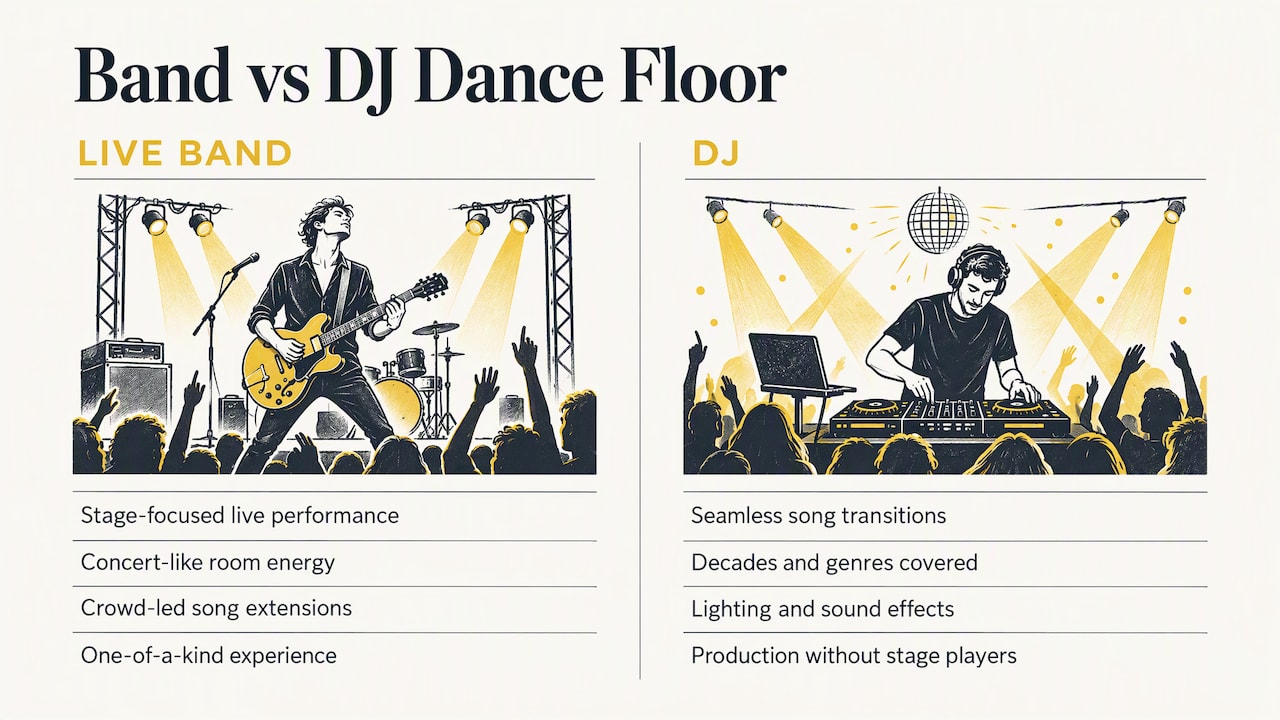
A live band gives your reception a focal point. Guests turn toward the stage, a guitar solo pulls people in, and the room feels like a concert. Bands can also read the crowd and stretch a song when the floor is packed. That improvisation is what you are paying for.
A DJ keeps the night moving. Seamless mixing means the energy never drops between songs, and a skilled DJ covers decades and genres in a single set. Lighting and sound effects add production value without adding people to the stage.
GigSalad’s planning advice boils it down: bands add a one-of-a-kind experience, while DJs offer broader playlists and smoother transitions. Match your pick to the flow of your day. If the ceremony and cocktail hour are intimate and you want the reception to feel like an event, a band builds that peak. If your guests span every age and taste, a DJ’s range covers more ground.
Think about who is attending. A crowd of dancers who love a sing-along tends to reward a band. A crowd that wants a specific mix of eras may do better with a DJ.
How do song choices and must-play requests work?
DJs have the edge on variety. They can reach vast digital libraries and honor specific requests on demand, a point Zola’s advice on choosing between a band and a DJ makes plainly. If a guest wants an obscure track at 10 PM, a DJ can usually find it.
Bands work from rehearsed setlists and an agreed repertoire. A song outside that list may need extra notice, a learning fee or rehearsal time. What bands give back is the live version: solos, mashups and arrangements that turn a familiar song into a moment.
A few habits prevent surprises:
- Put your must-play and do-not-play lists in writing.
- Ask a band how much lead time a custom song needs and whether it carries a fee.
- Ask a DJ how they handle guest requests and who approves them.
- Share your first dance and special songs early, whichever route you choose.
Who leads the floor and handles announcements?
Bands build live moments. The singer talks to the room, the drummer drives a big finish, and guests feel part of a performance. DJs excel at cueing and pacing, keeping momentum steady from the first dance to the last song.
Settle the MC question before you sign. Ask whether the vendor also acts as emcee, and who calls the timeline, introduces the wedding party and makes announcements. Some bands have a dedicated frontperson for this, and many DJs include it. Others expect your planner or a friend to cover it.
Plan for band breaks too. If you want music in the gaps, line up a curated playlist or a DJ to fill them. Ask the band how long its breaks run and how many it takes, then build the schedule around the answer.
What should you check about your venue?
Logistics sink more entertainment plans than taste does. Zola notes that stage size, power and load-in times are often underestimated, and that venue limits can cap the size of a band. Ask your venue:
- How large is the available stage or performance footprint?
- Where is the electrical access, and how much power is available?
- Are there noise restrictions or rules for amplified music?
- What are the load-in and load-out windows?
- Is there an acoustic issue, such as a hard-walled ballroom or an outdoor tent?
Bands usually bring more gear and may need a sound technician. DJs need less space, but speaker placement still matters, since poor placement leaves dead spots on the floor.
Pro Tip: Schedule a short sound-check plan with the venue and your vendor, so placement and volume are agreed before guests arrive.
When does a band-and-DJ hybrid make sense?
A hybrid works when you want live energy and unbroken variety. Common formats include a band for the ceremony and dinner with a DJ taking over late at night, a DJ covering band breaks, and fusion acts that pair a DJ with live instruments.
Coordination keeps it smooth. Build one timeline both vendors follow, assign a single sound technician or production lead, and agree on clear handoff cues so no silence falls between acts.
A hybrid is worth the budget when each side fixes the other’s weakness. The band delivers the peak moments, the DJ supplies the breadth and the continuous music. If funds are tight, use the hybrid only for the part of the night that matters most.
How do you decide? A checklist for vendor calls
Work through these steps in order:
- Set a hard budget cap, using the 10-15% guideline.
- Define your must-have experiences, such as a live solo or a packed all-genres dance floor.
- Confirm your venue’s constraints on space, power and sound.
- Request demos and references, and schedule a consultation or live audition where you can.
- Confirm the rider, the timeline and the exact musicians who will perform.
Then ask each vendor: How do you handle setlists and learning fees? Who is the MC? How long are your breaks? What does your technical rider require? What is your backup if someone cannot perform?
For a quick weighting exercise, give yourself 10 points to split across budget, vibe, variety and logistics. Whichever vendor type matches your top two categories is your answer.
What a touring wedding band wants couples to know
We have advised couples, and the detail couples miss most is production timing. Schedule the sound check well before guests arrive, not during cocktail hour, and agree on stage placement with your venue early. Always watch a live sample or video, and confirm the actual musicians who will play your wedding, not just the name on the contract.
— Jimmy
How can Lost Wax deliver the live-band advantages above?
If a live band is your direction, we build the show around your night. Our approach includes:
- Customizable setlists that blend Pop, Rock, Hip-Hop and R&B
- Flexible band sizes, from smaller groups up to larger ensembles
- Production add-ons such as lighting and sound
Your next step is simple: ask for availability, request a sample setlist and video, and talk through band size and production needs. Compare our wedding band packages to see which size fits your room, then contact us to check your date.
FAQ
Is a live band or a DJ better for a wedding?
Neither wins every time. A DJ suits tighter budgets and wide song variety, while a band suits couples who want a concert-style atmosphere. Many couples combine both.
How much should I budget for wedding music?
Entertainment usually takes 10-15% of a total wedding budget. Set that cap before vendor calls so you only compare options you can afford.
Can a band play any song a guest requests?
Usually not on the spot. Bands work from rehearsed repertoires, so unlisted songs may need advance notice or a fee. DJs can fill last-minute requests from digital libraries.
Do live bands take breaks?
Yes, bands typically pause between sets. Plan a playlist or a DJ to cover those gaps if you want continuous music.
Should I hire both a band and a DJ?
It makes sense when you want live moments and nonstop variety, and your budget and venue allow. Use one timeline and one production lead so handoffs stay smooth.
Sources
- How to Choose Between a Wedding Band or DJ – Zola Expert Wedding Advice
- The Average Cost of Hiring a Band or DJ for Your Wedding
- How to Choose Between a Live Band or DJ for Your Wedding
Recent Comments