
A medley plays songs one after another. A mashup layers them on top of each other so they sound at the same time. That is the whole distinction in one line, and the rest of this guide shows how it plays out on a dance floor, in a first dance, and in a live band’s setlist.
People swap the two words constantly, and in casual conversation nobody minds. When you are booking music for a wedding or a corporate night, though, the difference decides how a song is built, how it is rehearsed, and what your guests feel when it hits.
TL;DR
- A medley is horizontal: song A, then song B, then song C, with a transition between them.
- A mashup is vertical: parts of two or more songs play together, often the vocal of one over the instrumental of another.
- Medleys suit sentimental moments and quick tours of favorites. Mashups suit surprise, energy and genre-crossing dance sets.
- A live band can play either one, but a custom arrangement needs lead time, a clear brief and a check on keys and tempos.
- Using recordings to build a mashup raises copyright questions in the U.S. A live arrangement is a different matter, so ask your band and venue early.
Table of Contents
- The short answer: sequence versus layers
- What a mashup actually is
- What a medley actually is
- Why the confusion happens
- When a medley is the better choice
- When a mashup is the better choice
- Can a live band play a custom wedding mashup?
- Copyright and licensing: what to know in the U.S.
- Planning ideas: three mashup shapes that work
- Mashups beyond weddings
- Work with a band that builds both
- FAQ
- Sources
The short answer: sequence versus layers
The cleanest definition comes from music theory. A scholarly typology by Boone describes a mashup as combining portions of two or more existing songs into a single track, usually with vertical interaction. A medley, by contrast, is two or more recognizable songs performed one after another, with no break or only a simple transition.
Think of a sheet of music. In a medley, you read left to right: one tune ends, the next begins. In a mashup, you read top to bottom: two or more tunes stacked in the same bar.
Here is the comparison at a glance.
| Medley | Mashup | |
|---|---|---|
| How songs connect | One after another | Layered at the same time |
| Direction | Horizontal | Vertical (plus sequence at times) |
| Source material | Often whole sections, mostly intact | Pieces blended into something new |
| Typical feeling | Familiar, flowing, nostalgic | Surprising, playful, high-energy |
| Hardest part | Smooth transitions | Matching key, tempo and feel |
| Common use | Tributes, ceremonies, first dances | Dance floors, openers, party sets |
The boundary blurs in practice. Many reference sources note that a medley can have songs overlap briefly, and that when a piece specifically superimposes elements of several songs at once, it is more precisely called a mashup. Plenty of popular “mashups” are really medleys with a few stacked moments. Neither word is wrong in conversation. What matters is that you and your musicians mean the same thing.
What a mashup actually is
The classic definition: a song made by blending two or more pre-recorded songs, typically laying one song’s vocal over another’s instrumental and adjusting tempo and key where needed. Berklee Online’s guide describes it as beat-matching two songs to make a new blended mix, and cites the pairing of Kylie Minogue’s “Can’t Get You Out of My Head” with New Order’s “Blue Monday” as a classic example.
Mashups spread widely in the late 1990s and early 2000s, when digital audio tools became easier to get, including programs such as Pro Tools and Sound Forge. Before that, stacking two songs cleanly took studio time. Now it takes a laptop and a good ear.
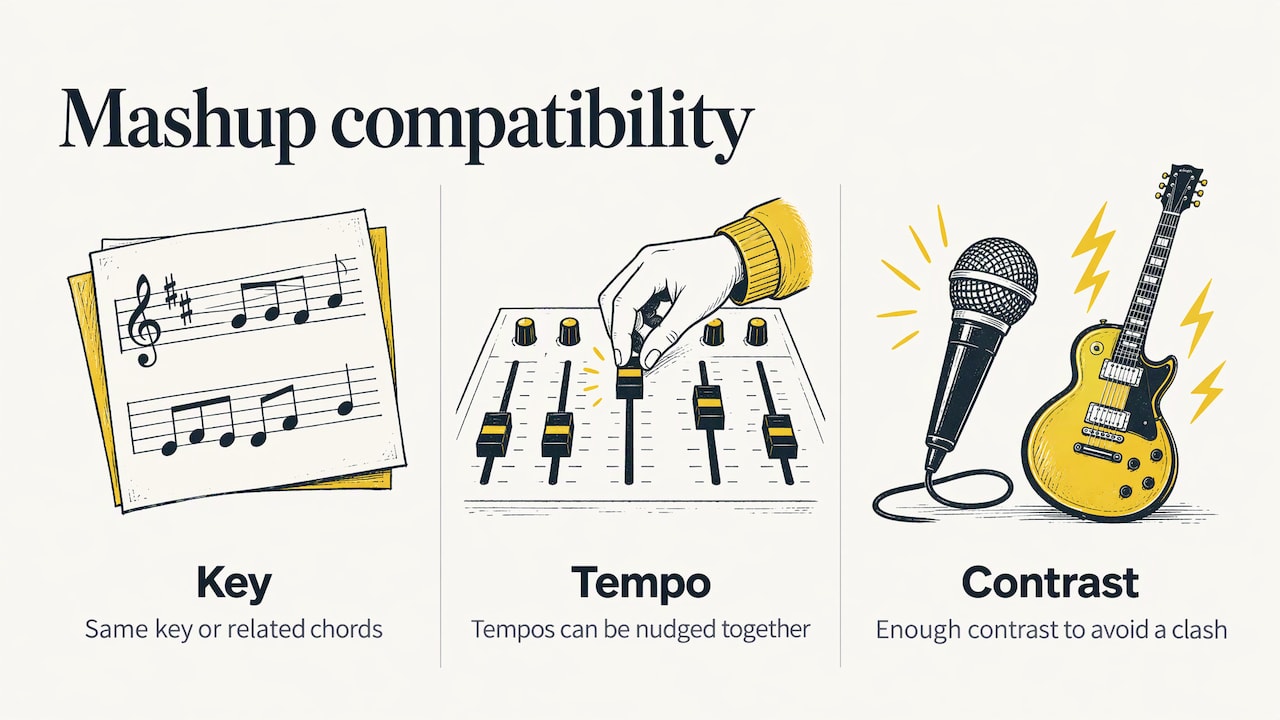
What makes a mashup work is compatibility. The songs share a key or related chords, tempos that can be nudged together, and enough contrast that the combination feels like a surprise rather than a clash. That is why a hip-hop vocal over a rock riff can land, while two random hits often fall flat.
Mashup versus remix
A related question people ask is whether a mashup is a remix. They are close cousins but not twins. The U.S. Copyright Office describes a remix as taking one existing sound recording and adding, changing or removing sounds to make a new version, while a mashup combines samples from two or more recordings into a new work. One song reworked is a remix. Several songs fused is a mashup. Several songs in a row is a medley.
What a medley actually is
A medley keeps the core of each piece intact and arranges them in a flow. Typically the songs run in order, sometimes shortened to their best-known sections, with a bridge or key change to get from one to the next. Think of a tribute set that moves through an artist’s hits, or a ballad run that lets a room sing along to three choruses in a row.
Because each song stays recognizable on its own, a medley rewards familiarity. Guests know what is coming, or at least recognize each piece as it arrives. The craft is in the joins: a clumsy jump from a slow ballad to a fast track feels like a mistake, while a smooth pivot feels like storytelling.
Why the confusion happens
There are three reasons the terms get tangled.
- Hybrid arrangements. A set might play a medley, then stack two choruses over a shared groove. It is both.
- Marketing language. “Mashup” sounds fresher, so a medley often gets the label.
- Live versus recorded. In a studio, vertical layering is literal: two audio tracks played together. On stage, a band recreates the effect with arrangement, switching a verse from one song into a groove from another, or combining a melody with a different song’s chords.
If a vendor tells you they do “mashups,” ask what that means in their show. Is it songs blended together, or songs played back to back? Both are great, but they feel different in the room.
When a medley is the better choice
Pick a medley when the goal is flow and emotional continuity.
- A first dance that tells a story. A soft opener leading into a second song with more lift lets the moment build without surprising anyone.
- A tribute. Honoring a family member’s favorite artist works well as a run of that artist’s songs.
- A ceremony or cocktail hour. Background-friendly sequences keep the atmosphere steady.
- A time-limited moment. Short grand entrances or toasts often need a quick tour of two or three recognizable hooks.
Our guide to grand entrance songs and how to time them is a good companion if you are planning one of those moments.
When a mashup is the better choice
Pick a mashup when the goal is surprise, energy or a bridge between audiences.
- Mixed-age crowds. A classic soul hook under a current hip-hop verse gives grandparents and cousins a reason to grin at the same time.
- Genre crossing. Pop, rock, hip-hop and R&B each have their own devotees. Layering them lets the dance floor hold all of them at once.
- A first dance with a twist. Start sweet, then flip into something upbeat.
- Corporate events. A recognizable stack of hits can break the ice quickly with a room of colleagues who have different tastes.
See our breakdown of mashup wedding dance songs, from ballads to floor hits for how these pairings look in a band arrangement.
Perspective: why we build sets around mashups
We started in 2009 with one belief: a dance floor should not have to choose between genres. A medley takes your guests on a tour. A mashup puts the whole party in one room at once. That is the experience we design our shows around.
When we sit down with a couple or a planner, we do not start with a song list. We start with the people in the room. Who is on the floor first? Who needs a reason to stand up? Our customized setlists blend Pop, Rock, Hip-Hop and R&B so that a guest who came for one genre stays for the others.
We still love a good medley. A well-built run of ballads can be the most moving three minutes of a reception. The skill is knowing which tool the moment calls for, and we would rather help you choose than push one style. Whatever you pick, we want the transitions to feel invisible and the energy to feel earned.
Jimmy
Can a live band play a custom wedding mashup?
Yes, and a live band has something a pre-mixed track does not: it can react to the room. A recorded blend is fixed. A band can extend a chorus when the floor is full, trim a verse when guests are restless, or slow the tempo for a nervous first dance. Lost Wax offers flexible band sizes and customizable setlists, so the arrangement can match the feel you want.
That said, a custom mashup is not something to improvise a week before the wedding. Here is what to coordinate.
Settle the format first
Decide whether you want a medley, a layered mashup, or a hybrid. Say it in plain words to your band: “two songs played one after another,” or “the verse of one over the groove of another.” This avoids the most common misunderstanding.
Keep it short
For a first dance, one planning guide recommends keeping the blend to two or three songs, opening with your “real” song and saving a surprise or an energetic closer for later. Dancing through four songs while everyone watches is a long time. Two or three keeps it fun.
Check keys and tempos
A song that is comfortable for the singer in one key may not stack with another. Ask the band to check keys and tempos on the shortlist before you fall in love with a combination. Slow ballads and fast floor hits can be bridged, but it takes an arrangement, not just goodwill.
Map the transitions
The joins are where a mashup or a medley can wobble. Mark where each change happens, what the cue is, and who leads it. If you are dancing, rehearse it. The transition is where couples need to feel confident, so a couple of run-throughs at home pays off.
Share the plan early
Give your band the song list, the order and any special moments (a dip, a spin, a surprise guest) well ahead of the date. If a DJ is also part of your evening, tell both teams who plays what. Lost Wax can integrate a DJ when you want one, and our comparison of a live band vs DJ for weddings lists the questions worth asking every vendor.
Tie the music to the rest of the day
Music carries emotion beyond the dance floor. If you are also planning a film of your day, think about how the songs will sit under the footage. This piece on the role of music in wedding videos is worth reading while you shortlist.
Copyright and licensing: what to know in the U.S.
This part matters most if you plan to create a recorded mashup, for example a pre-mixed first dance track.
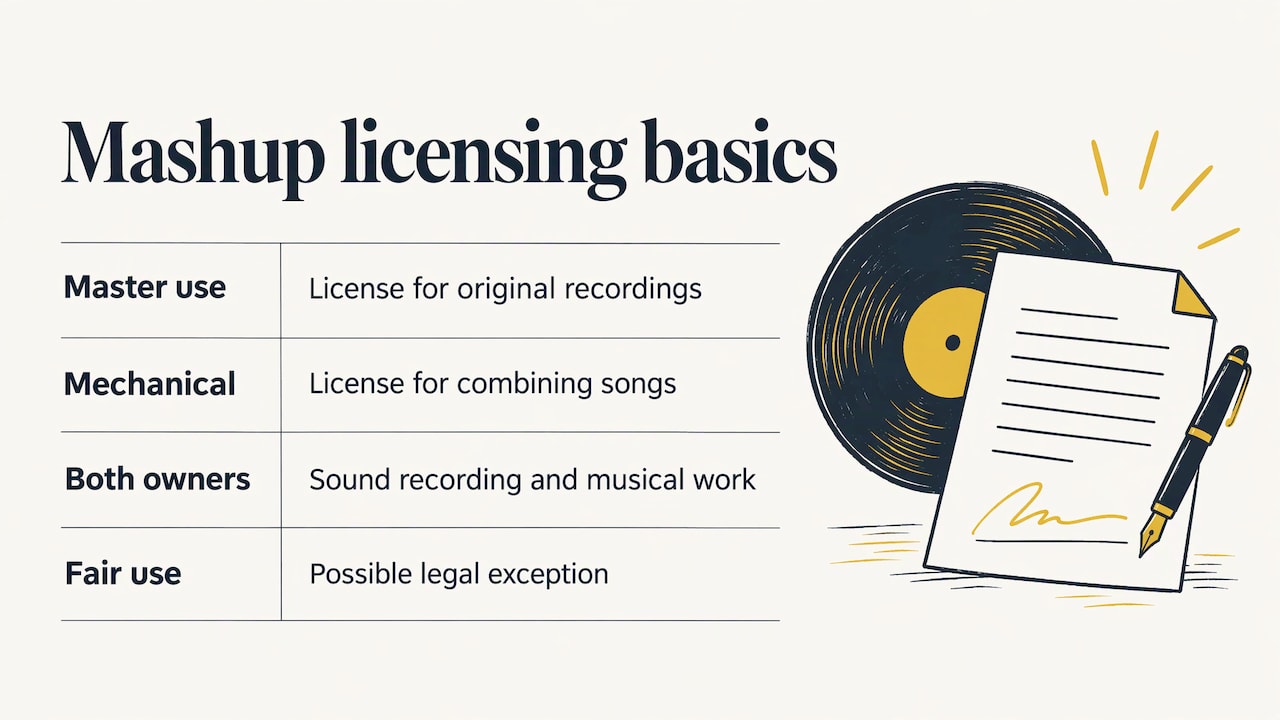
The U.S. Copyright Office explains that mashups may infringe copyright owners’ exclusive rights unless they are authorized or covered by a legal exception such as fair use. Because mashups use existing sound recordings, licenses from both the sound recording owner and the musical work owner may be needed. A music distributor’s guidance says the same in practical terms: using parts of original recordings calls for a master use license, plus a mechanical license for combining the songs.
For a private wedding played in the room, the practical step is simple: tell your band and your venue what you are planning, and ask how music licensing is handled at the venue. If you want to publish or distribute a recorded mashup, for instance online, talk to a music attorney first. Rules differ by country, so if you marry outside the U.S., check the local requirements.
Planning ideas: three mashup shapes that work
These are structures, not set recipes. Adapt them to your own songs.
- Slow start, surprise switch. Begin with the song that means the most to you. Midway, flip into an upbeat favorite that makes your guests cheer. This is the most popular first dance shape, and it works with a live band because the band can cue the switch to your steps.
- Genre journey. Move through three songs from different styles, for example a soul classic, a rock anthem and a current pop hit. Each one invites a different part of the room onto the floor.
- Emotional arc. Start soft, build steadily, end high-energy. Guests join as the tempo rises, and by the final chorus the floor is full.
For help choosing the opening song itself, see our guide to choosing the perfect first dance song. If your families bring different musical traditions, our piece on blending two traditions in wedding music shows how to weave them into one evening.
Mashups beyond weddings
The same logic applies to corporate galas, festivals and private parties. A medley is the safe choice for a seated dinner, where a smooth flow of recognizable songs sets a mood. A mashup is the stronger choice for the after-dinner dance, where the goal is to get people from different generations and teams moving together. Our guide to corporate event music ideas for every part of the night lays out how to pace a program from arrival to last song.
Work with a band that builds both
If you want a live show where mashups, medleys and straight-ahead covers all have their place, we can build it around your event. Lost Wax is a mashup party band that has played weddings, corporate events and private celebrations since 2009, with options from compact lineups to large ensembles. Browse our band packages and lineups, see the ELITE and SHOWSTOPPER wedding bands, or get in touch to talk through your date and the sound you want.
FAQ
Is a medley the same as a mashup?
No. A medley plays songs in sequence, while a mashup layers parts of songs so they sound together. People use the words interchangeably in casual talk, so it helps to describe what you want in plain terms when you brief a band.
Is a mashup the same as a remix?
Not quite. A remix reworks one existing song, while a mashup combines elements of two or more songs into a new piece. The U.S. Copyright Office draws the same line in its guidance for musicians.
Which is better for a first dance, a mashup or a medley?
The medley suits a story told in order, and the mashup suits a surprise. For most couples, a two or three song blend that starts sentimental and finishes upbeat gives the best of both. Keep it short enough that you still enjoy it.
Can a live band perform a mashup instead of a recording?
Yes. A band can arrange the layers live and adjust length and tempo to the room. Share your song list, preferred order and any special moments well before the event so the arrangement can be worked out and rehearsed.
Do I need a license for a wedding mashup?
It depends on how it is made and used. The U.S. Copyright Office notes that mashups built from recordings may need licenses unless an exception applies. If you plan to record or share one, speak with a music attorney, and ask your venue how performance licensing is handled.
Sources
- MTO: Boone, Mashing: Toward a Typology of Recycled Music
- Medley (music), Wikipedia
- Mashup (music), Wikipedia
- Berklee Online: Mashup History 101
- EBSCO Research Starters: Mashup (music)
- U.S. Copyright Office: Sampling, Interpolations, Beat Stores and More
- iMusician: Cover, edit, remix, mashup or medley
- Dedicated Song: First Dance Mashup and Medley Ideas
- Role of Music in Wedding Videos
Recent Comments