
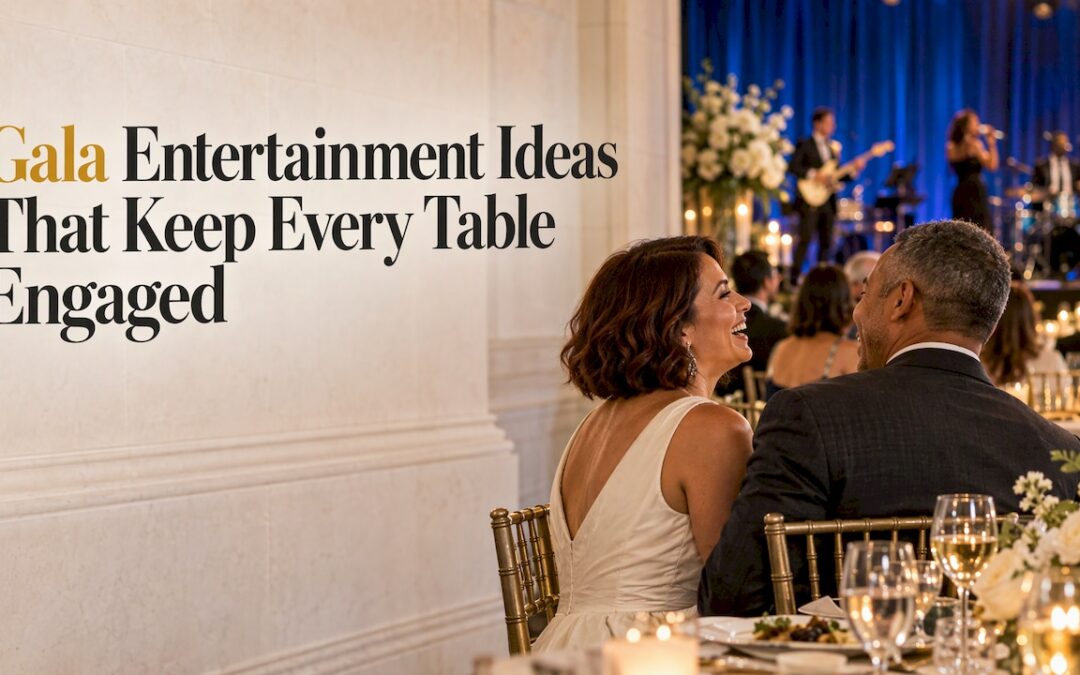
The best gala entertainment follows the shape of the evening. Quiet, elegant live music greets guests at the reception. Something interactive or visual carries the dinner. A short, well-placed feature fits around the speeches and awards. A high-energy live band then turns the room into a dance floor once the formal program ends. Pick acts by what the room needs at each moment, not by what looks impressive on a list.
Below you will find ideas for each stage of the night, a way to match acts to your audience, ideas for nonprofit galas, the venue and accessibility checks to run before you sign anyone, and a sample run of show.
TL;DR
- Build the evening in four beats: arrival, dinner, program, dance floor. Give each beat its own kind of entertainment.
- Keep entertainment during dinner conversational. Save the loudest, most danceable act for after the speeches and awards.
- At a fundraiser, every act should point back to the mission, not compete with it.
- Walk the room before booking: power, load-in, sound, sightlines and accessibility decide whether an act works.
- A live mashup band that blends pop, rock, hip-hop and R&B is a reliable way to keep a mixed-age crowd on the floor late into the night.
Table of Contents
- What makes an event a gala
- Start with the guests, not the act
- Entertainment ideas by moment of the evening
- Ideas that fit a nonprofit fundraising gala
- Fitting entertainment around dinner, speeches and awards
- Venue checks before you sign anyone
- Our perspective on gala music
- Booking the band for your gala
- FAQ
- Sources
What makes an event a gala
A gala is a formal occasion built around more than a meal. One fundraising software company describes it as a ticketed event built around a reception, dinner and structured program, with higher production value than a typical banquet and defined moments such as auctions or a paddle raise. Another planning resource lists formal seated dinners, cocktail-reception galas, awards galas and themed celebration galas as distinct formats.
That structure matters for entertainment. A gala is not one long party. It is a sequence, and the acts that work are the ones that respect the sequence.
Start with the guests, not the act
Before you scroll through performer catalogs, answer one question: who is in the room? Planning guidance for nonprofit events says that donor, volunteer, client and community profiles, and whether children attend, should shape the event design. The same logic applies to any gala.
Here is a practical way to match acts to audiences:
| Audience | What tends to work | Why |
|---|---|---|
| Senior executives and board members | Jazz trio, string quartet, a sharp emcee, a live band after the program | Conversation stays easy, and the dance floor opens when they are ready |
| Mixed-age donors and community members | A genre-blending live band, a short featured performance | Familiar songs from several decades give everyone a way in |
| Corporate teams and clients | Interactive acts at the table, a high-energy band, a photo moment | Mixers break the ice between colleagues who rarely sit together |
| Awards audiences | Opening act, polished emcee, walk-on music for winners | Pacing and ceremony matter more than spectacle |
| Families and multigenerational guests | Shorter sets, earlier dance floor, clean song choices | Younger and older guests both stay comfortable |
If you are not sure, ask the committee for the three oldest and three youngest likely attendees and picture what each would enjoy. Entertainment that works for both ends of that range usually works for everyone between.
Entertainment ideas by moment of the evening
Arrival and cocktail hour
Guests are still finding colleagues, handing over coats and holding drinks. They do not want to be performed at. They want atmosphere.
- A jazz trio or small acoustic ensemble. Quiet enough for conversation, elegant enough to set the tone.
- A string quartet playing familiar songs. Pop and rock favorites arranged for strings are a gentle surprise and give guests something to point at and smile about.
- A solo pianist or harpist in a lobby or foyer, especially where a larger setup will not fit.
- Live art. A painter or caricature artist working at the edge of the reception gives guests something to watch and, at a fundraiser, a piece to auction later.
- A smaller lineup from a full-service band. A 5-piece or 8-piece group can open with a lounge-style set, then return in full force later. Our band packages are built so the same musicians can cover more than one part of the night.
During dinner
This is where most galas lose the room. Guests are seated, servers are moving, and a loud act forces people to shout across the table. The goal is to keep attention without cutting off conversation.
- Table-side magicians or mentalists. Small groups get a personal moment, and the act travels while the courses come out.
- Interactive circus or aerial performers placed above or beside the dining floor, so the show is visible without demanding silence.
- Live music at dinner volume. Keep it at a level where the person across the table can still be heard.
- Smart comedy from an emcee or host. Short, well-timed humor between courses keeps energy up and helps guests relax before speeches.
- A themed dining moment, such as a chef’s presentation or a tasting course introduced on stage.
One rule helps: if guests have to stop eating to watch, keep it under ten minutes.
The program: speeches, awards and appeals
The formal program is where your message lands, so entertainment here should support it. A strong opening act sets the tone and signals that the evening has started. Walk-on music for award winners adds ceremony. A short musical interlude between segments resets attention after a long speech.
Avoid stacking entertainment on top of important moments. If a keynote or honoree is speaking, nothing else should compete.
The dance floor
Once the program ends, the room is ready to release energy. This is the single best use of a live band. A mashup band that moves between pop, rock, hip-hop and R&B in one set can bridge the age range in a typical gala crowd, because every generation hears something familiar within a few songs.
Some specifics that make the difference:
- Start with songs nearly everyone knows, to pull in the hesitant guests.
- Use seamless transitions between songs so the floor never empties during a gap.
- Share a must-play and do-not-play list with the band ahead of time.
- Plan one final high-energy stretch so the night ends on a peak, not a fade.
If you want a live band for the after-program portion, our corporate event entertainment page describes how we approach formal company events. For a closer look at how music can be matched to each part of an evening, see our guide to corporate event music ideas.
Ideas that fit a nonprofit fundraising gala
At a fundraiser, entertainment has a second job: it must keep guests connected to the cause. One nonprofit software company recommends a mission-focused program, donor showcases, Fund-A-Need moments and a Mission Immersion Night to tie the evening back to the work. A few ways to apply that:
- Let beneficiaries or program participants perform or present, if they are comfortable. A student ensemble or a short testimony often moves a room more than a hired act.
- Commission live art that tells the story of your mission, then auction it.
- Choose a theme that matches your story. Options that planners commonly suggest include masquerade, casino night, decades, garden party, awards ceremony, celebrity-chef dinner, art auction and concert gala. If you choose a casino theme, check your state’s regulations first.
- Keep the pre-appeal moment calm. Soft live music or a short video before the ask sets the mood. A drumline right before a paddle raise does the opposite.
- Save the party for after the ask. Once gifts are made, guests are relaxed and generous with their energy. A live band turns that goodwill into a dance floor.
Fitting entertainment around dinner, speeches and awards
Timing is where good ideas fall apart. A simple structure helps.
- Write the run of show backward from the end time. Start with when the venue needs the room cleared, then work back to the last dance, the program and the first course.
- Give speeches a hard cap. Short, scheduled remarks protect everything that follows.
- Break the program into segments. Instead of one long block, place a course, then a short segment, then a course. Entertainment fills the transitions.
- Brief the emcee and the band together. Cues, walk-on music and handoffs should be agreed before doors open.
- Build in buffer. Rooms run late. A ten-minute cushion before the dance set keeps the band from losing time.
- Plan the handoff to the dance floor. Have the emcee announce the band and the band start strong. A slow start loses the room.
A sample run of show for a four-hour evening might look like this:
| Time | Segment | Entertainment |
|---|---|---|
| 0:00 to 1:00 | Reception | Jazz trio, live art, photo moment |
| 1:00 to 1:15 | Seating and welcome | Emcee, opening act |
| 1:15 to 2:15 | Dinner | Table-side magic or dinner-level music, short host moments |
| 2:15 to 2:45 | Program | Awards, appeal or keynote, walk-on music |
| 2:45 to 4:00 | Dance floor | Full live band, with a planned finale |
Treat it as a template, not a rule. A seated awards dinner may need a longer program, while a cocktail-style gala may skip the seated block altogether.
Venue checks before you sign anyone
The act is only half of the decision. The room decides whether it works. One music planning guide advises confirming the performance area, available power, circuit limits, sound restrictions, load-in route, elevators, parking and the performer’s requirements before signing an agreement. It also suggests extra sound checks for hard-surfaced rooms, high ceilings, outdoor spaces or events spread across several rooms.
A quick checklist:
- Space. Is there room for the full lineup plus a dance floor, without blocking sightlines or service paths?
- Power. Do you know the circuit limits for lighting and sound?
- Sound. Are there volume limits? Is the ballroom hard-walled with a long echo?
- Load-in. Where do vehicles unload, and how far is the walk? Is there an elevator?
- Timing. When can performers access the room for setup and sound check?
- Production. Who handles lighting, staging and microphones? Our event production services cover lighting, staging and dance floor rentals so entertainment and production come from one team.
Accessibility
A gala should work for every guest. An AV planning checklist lists clear microphones, staging, lighting, rehearsal time, backup equipment, captions, hearing loops, interpreter lighting, ramps, clear paths and accessible seating. The same source makes the point that captions and assistive listening are only a starting point: sightlines, stage access and readable materials matter too.
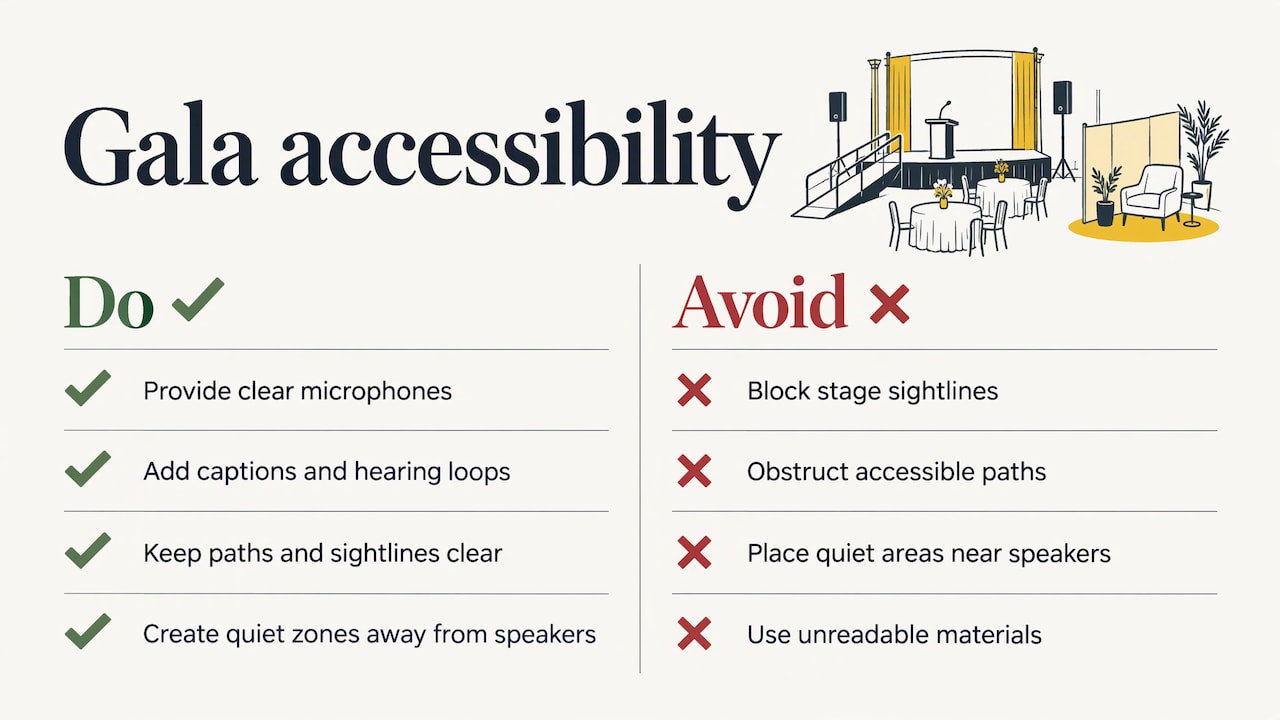
For loud entertainment, one event rental guide suggests keeping sightlines clear and creating a few quiet zones for guests sensitive to noise. A lounge area away from the speakers, or a dedicated quiet table, costs little and helps a lot.
Our perspective on gala music
We have played galas, corporate events and weddings since 2009, and the pattern is the same every time. The room tells you when it is ready. During cocktails and dinner, guests want atmosphere. After the program, they want to move.
That is why we build our shows around flexible lineups and customized setlists. A smaller group can set a refined tone early, and the full band can take over when the formal part is done. Because we blend pop, rock, hip-hop and R&B, a table of board members and a table of their younger colleagues can end up on the same dance floor.
We also work closely with planners. We would rather learn your run of show, your honorees and your must-play songs than guess. Transitions, announcements and handoffs go smoothly when everyone has seen the same plan.
If your gala needs one act that can serve as the finale, the energy that closes the night is what guests will remember when they leave.
Jimmy
Booking the band for your gala
If your evening ends with a dance floor, our team can help you plan it. We offer flexible band sizes, from the 5-piece to the 18-piece lineups, customizable setlists, optional DJ integration and production support for lighting and staging. For larger galas that call for a bigger sound, see our ELITE and SHOWSTOPPER bands. When you are ready to talk dates and details, send us a corporate event inquiry.
FAQ
What entertainment works best for a gala dinner?
Match the act to the moment. Use quiet live music or live art at the reception, table-side or low-volume acts during dinner, a polished emcee for the program and a live band for dancing afterward. This keeps guests engaged without forcing them to compete with the sound during conversation.
How long should entertainment run at a gala?
Keep dinner entertainment in short segments, ideally under ten minutes per feature. Reserve the longest block for the dance floor after the program. A live band often plays for one to two hours at that stage, depending on your venue and schedule.
Should the band play during speeches and awards?
Not over them. Use music for walk-on moments, transitions and breaks between segments. During keynotes and honoree remarks, nothing should compete for attention. Brief the emcee and the band on cues so handoffs are clean.
What entertainment suits a nonprofit fundraising gala?
Choose acts that reinforce the mission: beneficiary performances, live art for the auction, a mission-focused program and calm music before the appeal. After the ask, a live band lets guests celebrate together. If you plan a casino theme, check your state’s rules first.
What should I check before booking a gala band?
Confirm the performance area, power, sound limits, load-in route and setup time with your venue. Ask about lighting and staging, and plan accessibility from the start: clear sightlines, accessible seating and a quieter space for guests who need it.
Sources
- Gala Fundraising: Tips & Strategies for Nonprofits
- What Is a Gala Event? Types and Considerations
- Nonprofit Event Planning: A 12-Step Guide to Success
- 20 Fundraising Gala Ideas to Elevate Your Donor Stewardship
- How to Plan a Fundraising Gala: Step-by-Step Guide
- Essential Tips for Planning Live Music at Corporate Events
- AV Checklist for Conferences and Corporate Events
Recent Comments