
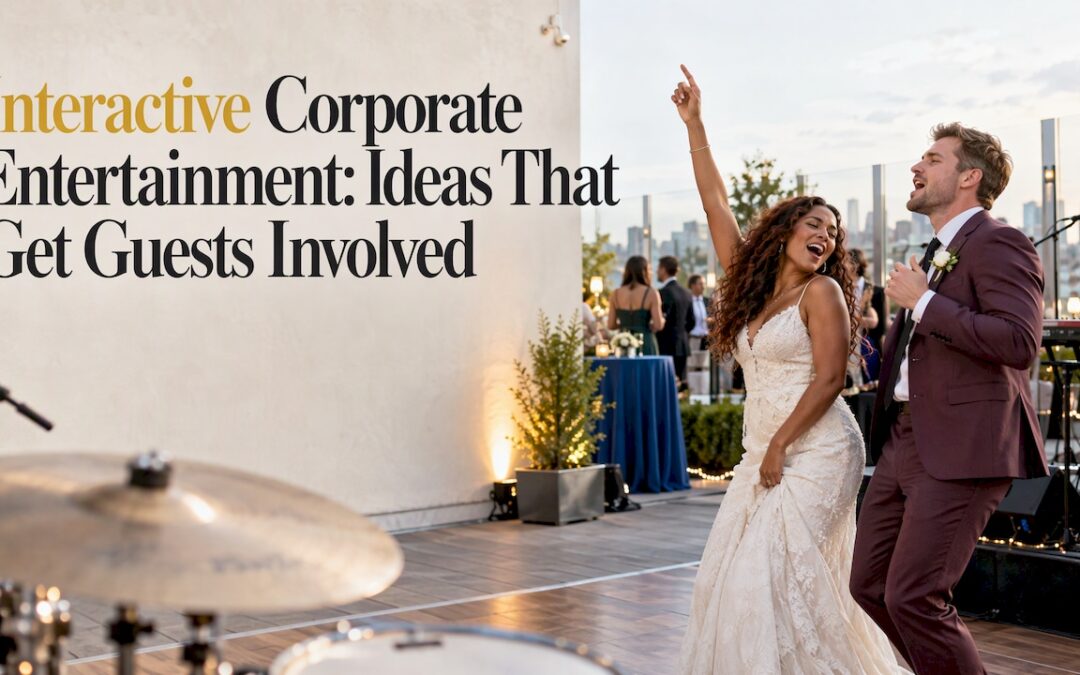
Interactive corporate entertainment is any act, game or activation that gives guests something to do rather than something to watch: answer, play, sing, compete, build or dance. The formats that work best match the room. Trivia and scavenger hunts suit teams who need to mix, photo and tech stations suit trade-show-style flow, and a live band that pulls people onto the floor suits an evening where you want the whole company in one shared moment. This guide compares the main options, shows how to choose, and explains how to use music for team building.
TL;DR
- Interactive entertainment turns guests into participants. Quizzes, scavenger hunts, game shows, photo stations and live music all qualify.
- Pick by goal: icebreaking, networking, brand exposure or celebration. Each goal favors a different format.
- Music is one of the few activities the whole room can join at once, from the quietest person to the CEO.
- Plan the logistics early: sound levels, music licensing, accessibility and a clear slot in the run of show.
- A band that builds the setlist around your crowd, and works with your planner, makes the music part feel designed rather than dropped in.
Table of Contents
- What counts as interactive corporate entertainment
- Why participation matters more than spectacle
- Interactive formats compared
- Using music for team building
- How to choose the right activity for your audience
- Planning the practical details
- Fitting the activity into your run of show
- Perspective: why a mashup band makes the room participate
- Bringing it together with Lost Wax
- Common mistakes to avoid
- FAQ
- Sources
What counts as interactive corporate entertainment
A performance becomes interactive when guests change what happens next. A magician who borrows a volunteer is interactive in a small way. A trivia round where every table submits answers is interactive for everyone. A band that takes requests, calls out the room and builds a singalong is interactive in a way that scales to hundreds of people without anyone needing instructions.
Planners tend to sort options into four groups:
- Competitive and puzzle formats: quizzes, game shows, scavenger hunts, escape-style challenges.
- Creative stations: photo activations, digital graffiti walls, caricature artists, image galleries guests contribute to.
- Technology experiences: virtual reality, simulators, app-driven games, leaderboards.
- Live performance with audience participation: comedians, mentalists, drummers, MCs, bands.
The event industry press lists a wide range of these. One Skift Meetings roundup of entertainment for large crowds covers quizzes, crowd-activated games, fitness workshops, digital graffiti walls, scavenger hunts, mentalists, interactive storytelling, live bands and musical challenges. It also notes that planners should weigh space, theme and the preferences and needs of attendees before choosing.
Why participation matters more than spectacle
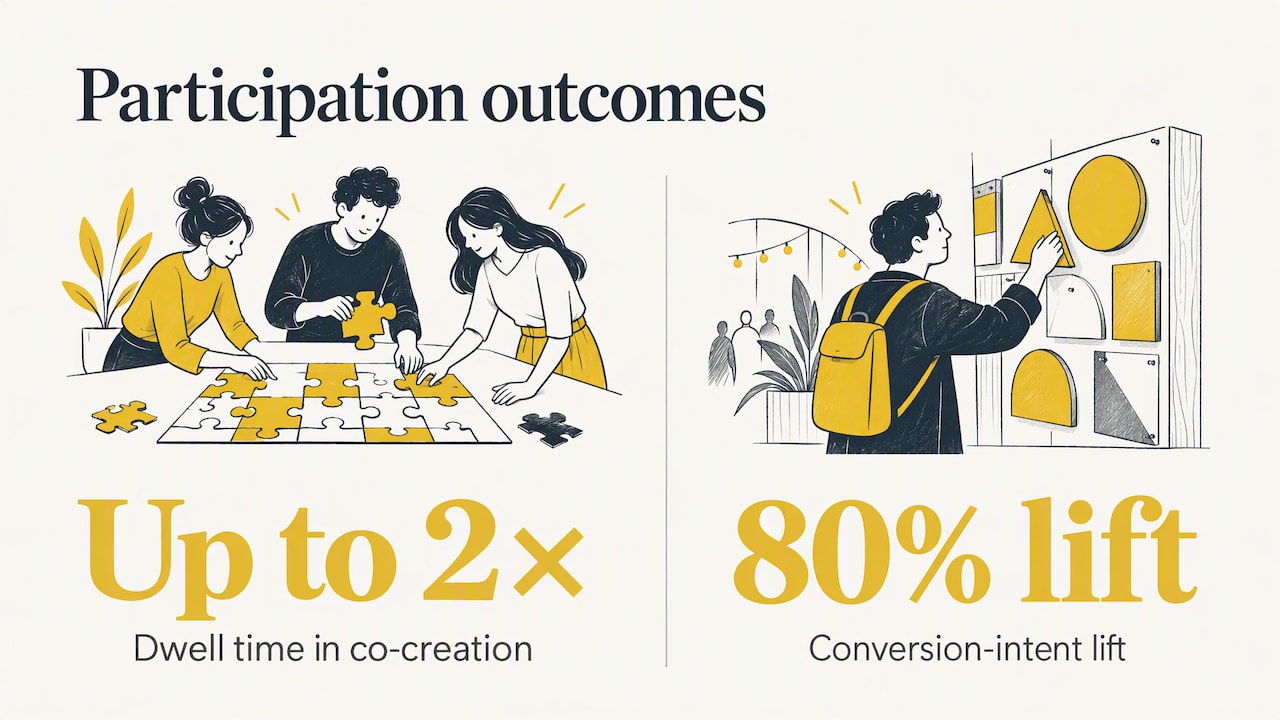
Guests remember what they did more than what they saw. The International Association of Exhibitions and Events (IAEE) reports that experiences driving emotion and active participation deliver the highest engagement, and that co-creation environments can see up to twice the dwell time of passive formats, according to its 2026 piece on designing experiences. The same article says personalized activations, where attendees act as co-creators instead of spectators, can lift conversion intent by 80%. That research speaks to exhibitions, but the principle carries to any corporate gathering: people invest in what they help make.
There is also a social reason. Event-software company Zoho Backstage argues in its corporate entertainment guide that shared puzzles and challenges ease networking awkwardness, because guests collaborate on a common goal instead of being told to go and socialize. Anyone who has stood alone with a drink at a company mixer knows the problem.
Interactive formats compared
| Format | Best for | Group size | Works poorly when |
|---|---|---|---|
| Trivia or quiz | Mixing departments, breaking the ice | Any, with teams | Guests arrive staggered and miss the start |
| Scavenger hunt | Offsite days, conferences with free time | Small to mid teams | Venue is tightly controlled or cramped |
| Escape-style challenge | Small-team bonding | Small groups | You need everyone involved at once |
| Photo or digital station | Brand moments, steady flow | Any | Lines form and nobody talks |
| VR or simulators | Novelty at expos and open houses | Rotating individuals | Most guests wait their turn |
| Comedian, mentalist, magician | Awards dinners, seated programs | Medium to large | Conversation is the priority |
| Live party band | Galas, holiday parties, celebrations, anniversaries | Any, from 50 to thousands | Venue has strict sound limits and no plan for them |
The weakness in each row is not a flaw in the format. It is a mismatch with the situation, and that is why the choice matters more than the idea itself. Zoho Backstage makes a similar point: live performers can change the mood of a room in real time, but they may not suit an event where conversation is the main goal.
Using music for team building
Music is the most inclusive interactive format because it needs no rules. Nobody has to understand a scoring system or wait their turn. Walk into a room where a band is playing something everyone knows, and within a song or two the finance team and the sales team are singing the same chorus.
There is research behind the idea that making music together builds working relationships. A case study published by Emerald followed 15 staff members at a Manchester company who wrote songs, played instruments and performed live. The authors report that the process stimulated creative thinking, listening, communication, synchronization, cooperation, a sense of achievement and self-esteem. You can read the Oddfellows music-making study for the detail. It is a small, UK-based case, so treat it as encouraging evidence rather than a guarantee, but it matches what planners see on the floor: shared rhythm lowers social walls.
Here are practical ways to put music to work for a team:
- Open with a short set during cocktail hour. Familiar songs at a conversational volume give people something to talk about.
- Build a request moment. Invite tables or departments to submit a song, then have the band work them into the set. Teams tend to cheer for their own pick.
- Run a musical challenge. Name that tune, a lyric relay or a guess-the-decade round, with the band playing the clues live.
- Save a peak moment for the dance floor. After dinner or awards, move from seated to standing with high-energy sets that cross genres.
- Close together. One final singalong sends people home on a shared high rather than drifting out in clusters.
For a longer breakdown of how music fits each part of an evening, see our guide to corporate event music ideas for every part of the night.
How to choose the right activity for your audience
Start with the outcome, not the idea. Ask what should be different when guests walk out.
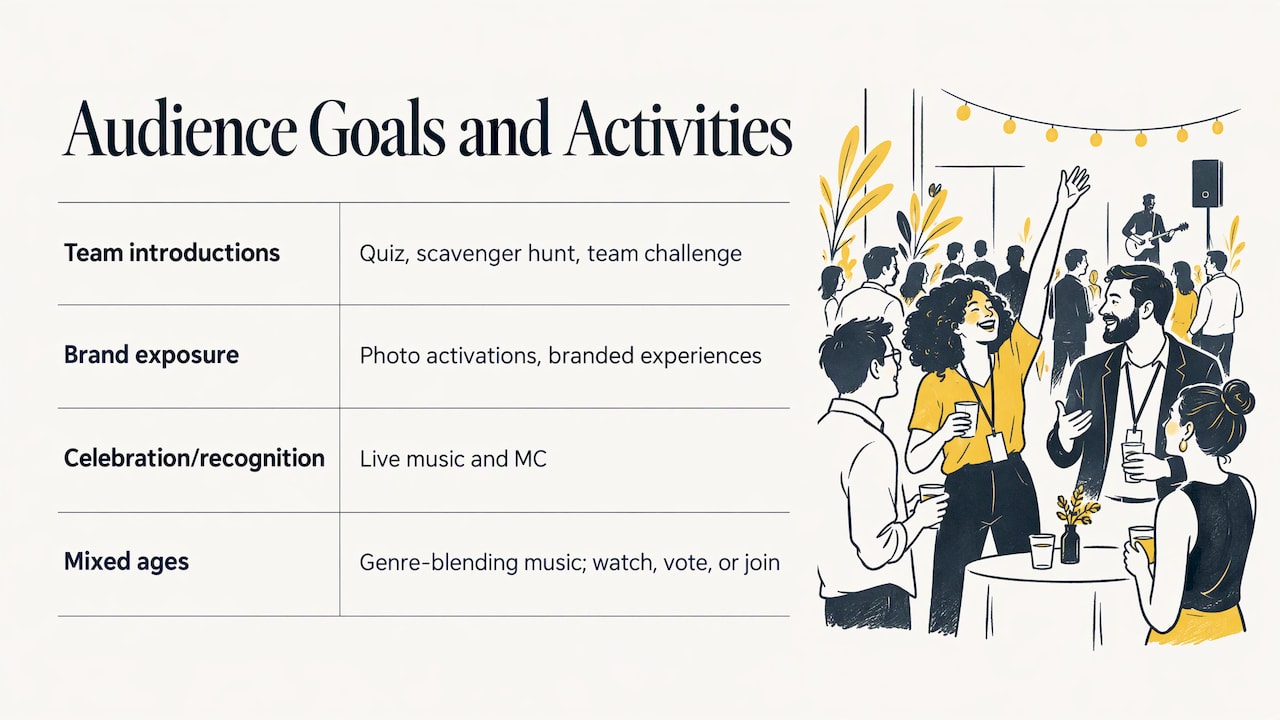
If the goal is introductions between teams, choose something with a shared task and low stakes: a quiz with mixed tables, a scavenger hunt, a collaborative challenge. Team challenges built around a common goal give people an easy reason to talk, and even branded team gear, as in this overview of custom logo apparel options for corporate teams, can help groups feel like one unit during a friendly competition.
If the goal is brand exposure, pick stations that fit your message and attract steady traffic, such as photo activations or branded experiences. Watch queue length so the activity does not become a waiting room.
If the goal is celebration or recognition, pick something that unites the whole room at the same time. This is where live music and an MC shine, because the energy is communal instead of individual.
If the audience is mixed in age and comfort level, avoid anything that requires public embarrassment. Offer a way in for introverts: watching, voting, requesting a song, or joining at the edge of the floor. Genre-blending music helps here, since a set that moves between pop, rock, hip-hop and R&B gives each generation a moment.
A quick test before you book: picture the quietest attendee. Can they take part at their own comfort level? If yes, you probably have a format that works for the room.
Planning the practical details
Sound levels and the venue
If your event includes an exhibition floor or booths, check the rules. The IAEE’s display guidelines recommend that booth sound generally not exceed 85 decibels measured from the aisle in front, with speakers directing sound inward. Those are IAEE guidelines for display rules for the United States and Canada, and your venue or show organizer may set its own limits. Ask for them in writing early, then share them with your entertainment provider so the band’s setup fits the room.
Music licensing
The same IAEE document notes that music in event spaces, live or recorded, is subject to copyright law and may require fees to performing rights organizations such as ASCAP, BMI or SESAC. Many venues already hold blanket licenses. Ask yours, and do not assume.
Accessibility
Think about who cannot take part in your chosen activity before the invitations go out. Seating, sight lines, step-free access to the floor, captioning for spoken segments and quiet areas away from loud sound all matter. Planning these from the start is far easier than fixing them later, and an accessible events checklist is a useful way to audit a venue. It was written with Australian events in mind, so check local requirements, such as the Americans with Disabilities Act, for your own venue.
Power, space and staging
Bands, simulators and photo stations all need power, load-in access and floor space. Confirm load-in times, ceiling heights, and where the dance floor goes relative to dining tables. We offer event production services including lighting, staging and dance floor rentals, so the floor, the sound and the show can be planned as one piece.
Fitting the activity into your run of show
Interactive segments fail most often because of timing, not content. A few habits help:
- Give interaction protected time. If a game must squeeze between a speech and dessert, guests feel rushed and the activity feels like an obligation.
- Plan the handoffs. Decide who introduces the activity, who explains the rules in under a minute, and who announces the next item. Facilitation firm Wolf & Heron stresses explicit transitions and a structured wrap-up in its guidance on planning interactive sessions.
- Have a backup. If the projector fails, the app crashes or half the group is late, what happens? A live band is one of the easier acts to adapt: it can extend a set, drop a song or fill a gap without anything needing to reboot.
- Alternate energy levels. Follow a seated, listening segment with something active, and give people a calmer stretch after a high-energy one.
- Put music where the mood needs it. Quieter acoustic or small-ensemble sets work during networking; full-band sets work once dinner is cleared.
A sample evening might run: arrivals with a small ensemble, a short welcome, dinner with background music, an awards or speaking block, then a full-band dance set with a request moment and a closing singalong.
Perspective: why a mashup band makes the room participate
We started Lost Wax in 2009 because we kept seeing the same thing at events: a good band plays, guests politely watch, and the planner holds their breath until the dance floor fills. We wanted a show built to remove that gap.
Mashups do that job. When a pop hook meets a rock riff and a hip-hop verse inside one song, there is something for the CEO, the new hire and the vendor sitting at table twelve. Nobody needs to be told when to join in.
We also treat the planner as part of the creative team. We customize setlists to the style and energy of your event, think through transitions between dinner, speeches and dancing, and scale the band, from a tight five-piece to a much larger production, to the size of your room and your goals. If you want a DJ integrated, lighting, staging or a dance floor, we can bring those too.
Interactive entertainment is not about forcing people to perform. It is about giving them a reason to look up from their phones and a safe, fun way to join in. That is the show we try to build every time.
Jimmy
Bringing it together with Lost Wax
If your goal is an evening where the whole company ends up on the dance floor, our corporate event entertainment is built for that. We play pop, rock, hip-hop and R&B, tailor the set to your crowd, and work alongside your planner so the music fits the program. You can compare band sizes on our packages page, read what past clients say in our Lost Wax reviews, or go straight to the corporate event inquiry form to tell us about your date, venue and guest count. Smaller gatherings are covered in our piece on boutique corporate event bands.
Common mistakes to avoid
- Choosing for novelty instead of fit. A simulator is impressive, but if only ten people try it all night, the other hundred feel left out.
- Forgetting the quiet guests. Always include a low-pressure way to join.
- Overloading the schedule. One strong interactive moment beats four rushed ones.
- Ignoring sound. A band too loud for networking, or a game too quiet for the room, undermines the plan.
- Leaving licensing and venue rules to the last week. Ask early.
- Skipping the brief. Tell every performer your goals, audience mix and any sensitivities. Good entertainers want this information.
FAQ
What is interactive corporate entertainment?
It is entertainment that asks guests to take part rather than only watch. Examples include trivia, scavenger hunts, photo and tech stations, game shows, and live music with requests, singalongs and dancing. The aim is to boost engagement and help colleagues connect.
Can live music really work for team building?
Yes, when it is designed for participation. Shared experiences like singing along, requesting songs or joining a musical challenge give colleagues common ground. A small Emerald case study of staff making music together reported better listening, communication and cooperation. A live band gives the whole room an easy way in.
How do I pick an activity for a mixed-age, mixed-comfort crowd?
Choose formats with several levels of involvement: people can compete, cheer, vote or simply watch. Genre-blending live music suits this well, because a set moving across pop, rock, hip-hop and R&B gives every age group a moment to join.
Do I need a license for music at my corporate event?
Music in event spaces, live or recorded, is subject to copyright law, and fees may be owed to organizations such as ASCAP, BMI or SESAC, according to IAEE guidance. Many venues already hold licenses, so ask yours first and confirm in writing.
When should I book an entertainment provider?
As soon as you have a date and venue. Popular bands and production teams fill peak seasons, and early booking gives you time to shape the setlist, confirm sound limits and plan the run of show. Send your details through our corporate event inquiry page to start the conversation.
Sources
- 17 Interactive Entertainment Ideas For Large Crowds, Skift Meetings
- Design Experiences That Exceed Expectations, IAEE
- 25+ corporate event entertainment ideas, Zoho Backstage
- Oddfellows employees hit the right notes: Music-making, Emerald Insight
- Guidelines for Display Rules and Regulations, IAEE
- 5 Tips for Planning an Interactive Session, Wolf & Heron
- Accessible Events Checklist
- Custom Logo Apparel Options for Corporate Teams
Recent Comments