
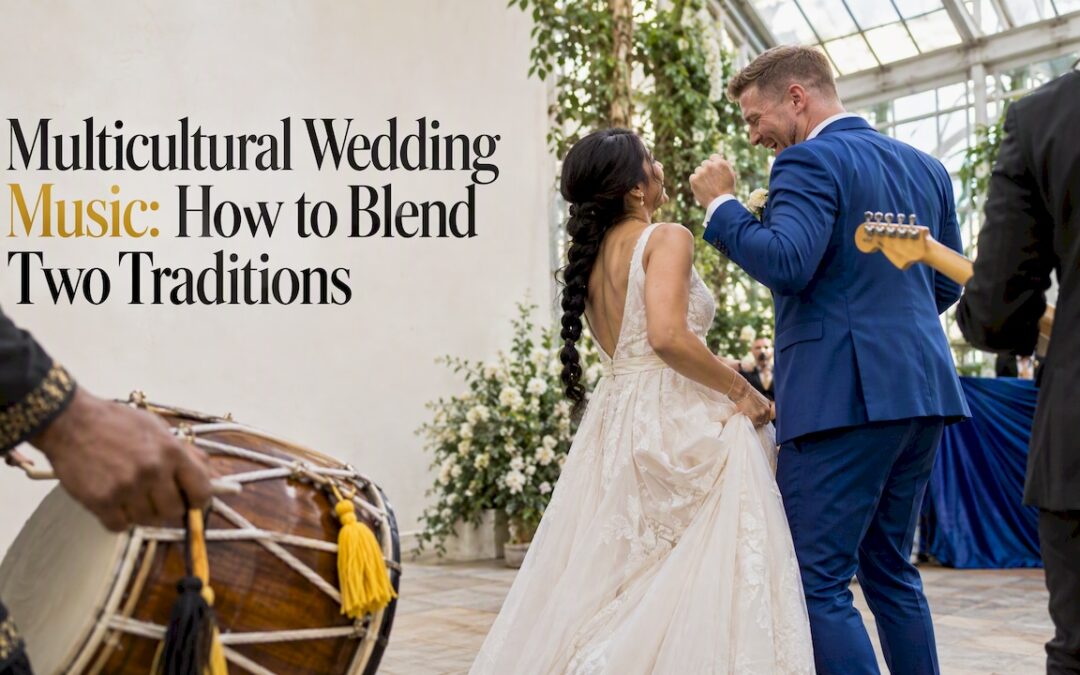
Great multicultural wedding music does two things at once: it gives each family the sounds that make them feel at home, and it keeps every guest on the dance floor. The way to get there is to protect a few non-negotiable cultural moments, then weave both traditions through the rest of the night with bridge songs, instead of splitting the evening into “your hour” and “my hour.” Below is how we plan it, moment by moment.
TL;DR
- Ask both families, separately at first, which songs and traditions are essential, then agree on a short must-play list and a do-not-play list.
- Lock in the culturally important moments (processional, first dance, parent dances, any ritual) before you build the party playlist.
- Weave both cultures through the whole reception rather than playing one hour of each, and use bridge songs to move between styles.
- Help guests join in with short explanations, simple instructions and singalong songs.
- Ask your band or DJ what weddings from each culture they have actually played, and ask for a sample set.
Table of Contents
- Start with the families, not the playlist
- Respect the tradition without turning it into a costume
- Map the night: where each tradition lives
- Weave the cultures, don’t alternate hours
- Help every guest join in
- Live band, DJ, or both?
- Our perspective: why a mashup band suits a multicultural wedding
- How Lost Wax can help
- A sample timeline you can adapt
- FAQ
- Sources
Start with the families, not the playlist
The most useful first step has nothing to do with songs. Sit down with each family separately, then together, and ask which musical traditions are essential to them. Some answers will surprise you. A grandmother may care about one specific song during the entrance, while a parent who seems very traditional may only want one dance with their child.
Turn those conversations into two short lists:
- Must-play: the songs or rituals that would be missed if they were gone.
- Do-not-play: songs that carry the wrong memory, the wrong lyrics, or simply the wrong mood.
Keep the must-play list short. A list of sixty required songs leaves no room for a dance floor to develop its own energy. Ten to fifteen is far easier for a band to honor well.
Be specific about which culture you mean
Labels hide a lot. Planners who specialize in the area point out that “South Asian wedding” is not a single thing: region, community and religion all change the traditions, so the useful question is which region, community and religious background you identify with. The same is true of “Latin,” “African,” “Middle Eastern” or “Asian.” A Punjabi Sikh wedding and a Gujarati Hindu wedding sound different. A Mexican reception and a Puerto Rican one don’t share a playlist.
When you brief your musicians, name the region, the language and, if relevant, the religious tradition. Then bring examples: a favorite recording, a family video, a song a relative sings at every gathering.
Respect the tradition without turning it into a costume
Blending cultures asks for care as well as taste. Research on intercultural music-making, including a 2024 article in the International Journal of Music Education’s research community, says shared music can build connection across cultures, and it stresses humility, cultural context and awareness of power, and warns against tokenistic or appropriative treatment. At a wedding, that translates into plain rules of thumb:
- The person from that culture, or their family, decides what is meaningful. The other partner’s family doesn’t get to approve a “nicer” version.
- Use the real thing where it matters. If a ritual song has a role, play it at that moment, not as background novelty.
- Don’t use a tradition as a gimmick for a partner who has no connection to it, just because it looks good in photos.
- Have a native speaker check the lyrics of any song in a language you don’t speak well. A love song can be a funeral song, or a joke, in the wrong context.
Map the night: where each tradition lives
Think of the day in four zones. Each has a different job, so each calls for different music.
| Part of the day | Job of the music | How multicultural music fits |
|---|---|---|
| Ceremony and processional | Mark the moment, set the tone | Reserve for the most meaningful cultural pieces, live or recorded |
| Recessional and cocktail hour | Release the tension, welcome guests | Joyful, recognizable music; a good place for live traditional styles |
| Dinner and toasts | Conversation, warmth | Instrumental or low-key versions from both cultures |
| Dancing | Energy, participation | Both cultures interleaved with crowd-pleasers |
Ceremony: protect the non-negotiables
The entrance, the first dance and the parent dances carry the most emotion, and they are where cultural moments belong. If one family has a specific processional or ritual music, give it room. If your ceremony includes two traditions, you can also pair them: one family’s music for the entrance and the other’s for the exit, or an arrangement that brings melodies from both together.
Outdoor ceremonies also need a practical check. Amplified sound is regulated at the city or venue level, so ask the venue early about sound limits and cutoff times, and confirm any local noise rules with your city. A live band or a ceremony sound system needs that answer before the plan is final. We cover this under event production because it affects the setup, not just the setlist.
After the ceremony: recessional and cocktail hour
The recessional works best with something joyful that both families recognize, even if it is a song with no cultural tie at all, such as a classic everyone knows. Cocktail hour is the easiest place to feature a traditional live act, such as a mariachi group, a dhol player, a steel pan duo or a string quartet playing folk melodies. Guests are standing, mingling and listening, which makes it the perfect time for music they may not have heard before.
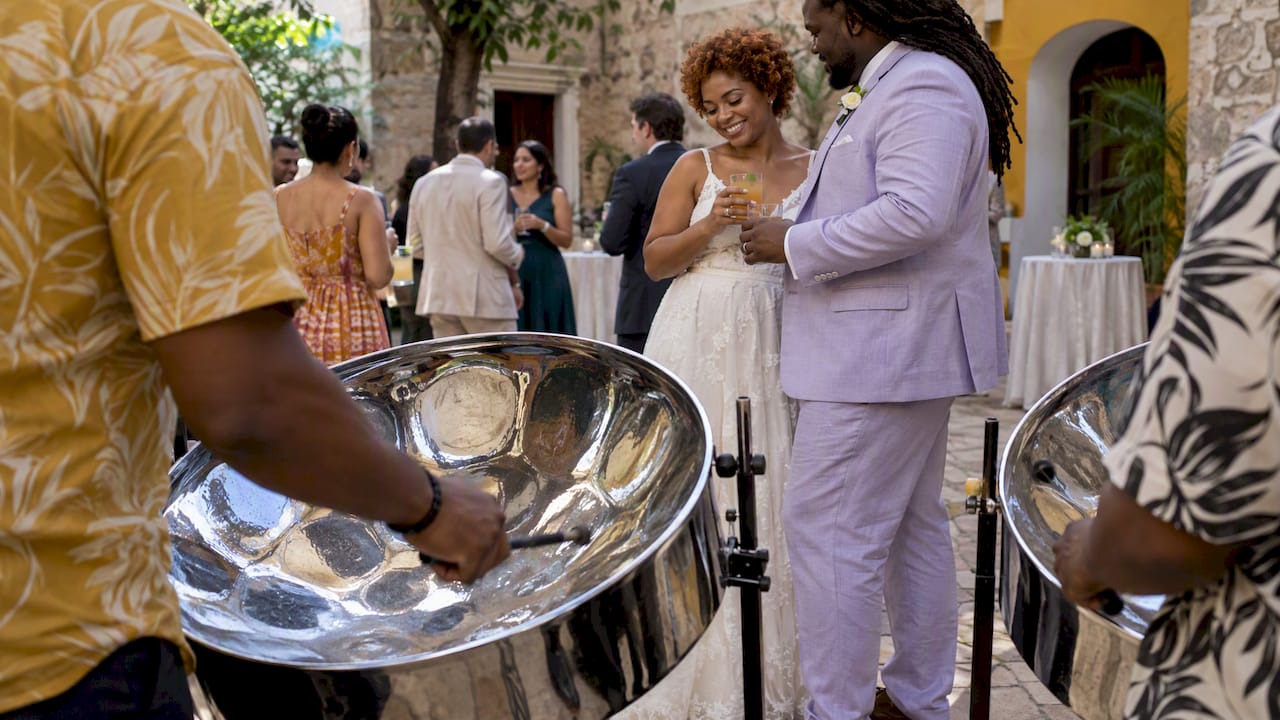
A tradition can also arrive with its own procession. In North Indian weddings, for example, the baraat is the groom’s procession to the wedding site, accompanied by the rhythm of the dhol. If that is part of your day, tell your band and your venue early, because it changes where the music happens and when.
Dinner and toasts
Dinner is the time for quieter versions. Instrumental arrangements of songs from both cultures let each family hear something of home without anyone having to dance. This is also where short spoken explanations land best, which we’ll come back to below.
Weave the cultures, don’t alternate hours
The most common mistake on the dance floor is sequencing by culture: an hour of one tradition, then an hour of the other. Planners warn that this builds an invisible wall in the room, where one side of the guest list sits down while the other dances. Weaving songs from both traditions all night keeps everyone involved.
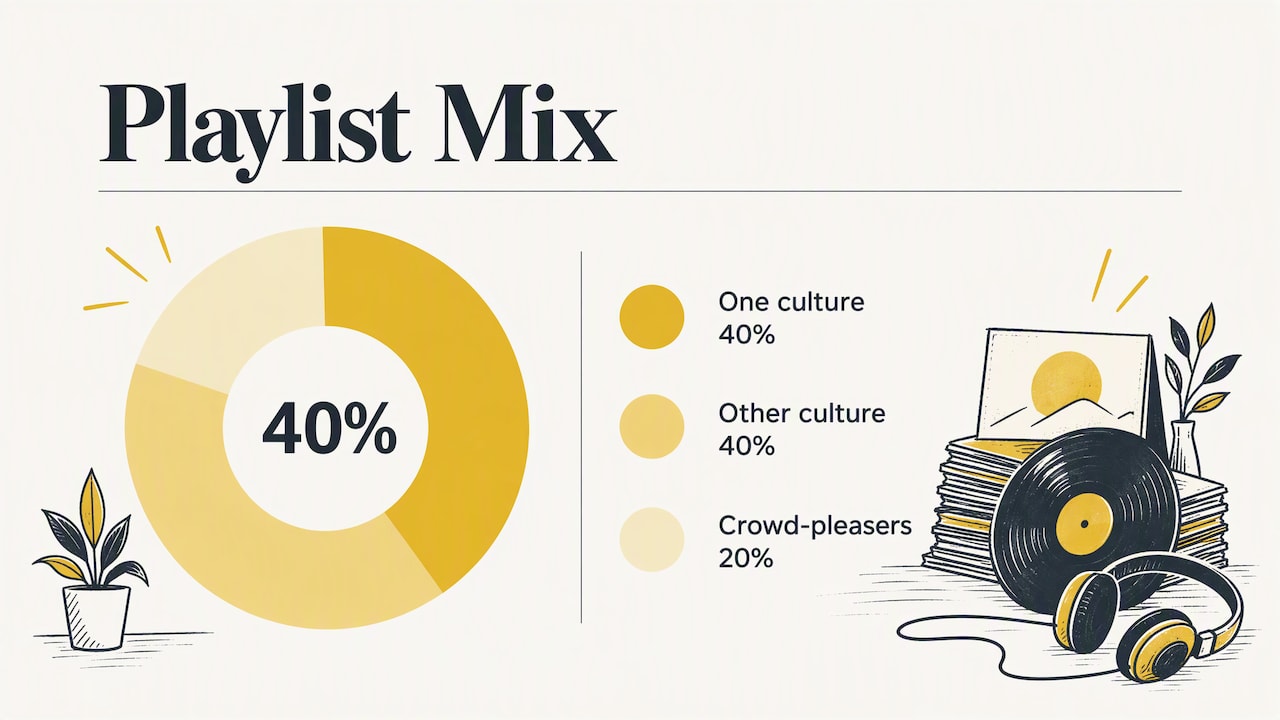
Here is how we think about the mix. As a rough starting point (our own rule of thumb, not a formula), try about 40 percent music from one culture, 40 percent from the other, and 20 percent universal crowd-pleasers that glue the night together. Then adjust it by room. If one side of the guest list is ten times larger, or if the other family is traveling from overseas and will love hearing home, shift it.
Use bridge songs
A bridge song is a track that sits close enough to both styles that the room doesn’t feel a jolt. Some ways to find them:
- Shared tempo and groove. A Bollywood dance track and a current pop hit at the same tempo can be mixed with no gap.
- Shared hooks. Songs with a clear singalong chorus, in any language, pull in guests who don’t know the words.
- Cross-cultural collaborations. Many global pop hits already blend Latin, Afrobeats, hip-hop and South Asian sounds.
- A familiar anchor. Follow a heritage song with a nostalgic favorite everyone knows, so the energy doesn’t drop.
The point is flow. A smooth transition holds the dance floor. An abrupt one clears it.
Think in generations too
Cultural heritage is only one dimension of your guest list. Grandparents, parents, your friends and the kids all want different things. Include songs that reach across ages, and mix classic heritage tracks with current hits so the younger guests aren’t waiting for “their” song. Our guide to mashup wedding dance songs covers ballads, floor-fillers and how a band arranges them for mixed crowds.
Help every guest join in
A song in a language you don’t speak can feel like a closed door, or it can feel like a party you’re invited to. Hosts decide which.
- Explain briefly. A short note in the program or a few words from the emcee about a dance or ritual helps guests understand what they are seeing. Welcoming, clear instructions help them take part.
- Teach the dance. A thirty-second walkthrough before a circle dance, a line dance or a group step turns watchers into participants.
- Print it where guests look. Table cards and menus are read during dinner. The same logic applies to your florals: guests notice what sits at eye level, as this centerpiece versus bouquet comparison says about flowers, so a small card at the table explaining a tradition gets read too.
- Choose singalongs. A chorus anyone can shout works in any language.
- Don’t force it. Invite, never push. Some guests will watch happily.
Some customs are interactive by design. In Mexican receptions, for instance, the vibora de la mar and the money dance put guests directly in contact with the couple, and they often come late in the night. Know where those moments fall so you can brief your musicians and reserve time for them.
Live band, DJ, or both?
A multicultural wedding asks for range. A DJ has the whole world’s recordings and can play the original version of a heritage song. A live band can reinterpret songs, read the room in real time and blend styles in a single arrangement. Many couples want both: a DJ or playlist for specific recordings and a band for the energy of the dance floor. We lay out the tradeoffs in live band vs DJ for weddings, and our questions to ask a wedding band before you sign can be used for either.
What to ask before you book
- What weddings from each culture have you played? Ask for specifics and a sample set, and for video if they have it.
- Can you play our must-play songs, and how? Recorded track, live cover, or a mashup arrangement.
- Can you pronounce the names and understand the rituals? An emcee who gets a name wrong in front of the family does damage that music can’t fix.
- Who learns the unfamiliar songs, and by when? A band needs time and a reference recording.
- How do you transition between styles? Ask them to describe it, not just promise it.
- What power, space and sound limits does the venue have? Confirm them with the venue and the city before the setlist is final.
- How will you work with my planner and my families? Look for a vendor that wants your input rather than one who hands you a fixed list.
Share your do-not-play list in writing. It’s easier to enforce when it’s on paper.
Our perspective: why a mashup band suits a multicultural wedding
We’ve been playing weddings since 2009, and the pattern we see is simple: the rooms that work are the ones where nobody has to choose between honoring family and having fun. That is the premise of a mashup band. We blend pop, rock, hip-hop and R&B in the same set, moving from one genre to another without stopping, so a transition from a heritage song to a current hit is already how we work.
We don’t believe in handing a couple a fixed list. We customize the setlist, and we involve the couple and their planner in the process, because the best moments come from details only you know: the song a grandfather hums, the tune from the village, the chorus your cousins have shouted at every party since they were children. Where a ceremony or ritual needs particular music, we plan that first and build the party around it.
We also think about size. A smaller band suits an intimate room, a larger one suits a ballroom with a full dance floor and a mix of generations, and the lineup can change to cover instruments that matter to your tradition. And we say plainly when something is outside our wheelhouse: if a ritual needs a specialist, such as a traditional drummer or a cantor, we plan around that person instead of imitating them.
— Jimmy
How Lost Wax can help
If you want one band that moves smoothly between pop, rock, hip-hop and R&B and builds the night with you, start with our wedding band packages, which range from a 5-piece to larger lineups. For bigger rooms, see our ELITE 14-piece and SHOWSTOPPER 18-piece bands. If your ceremony needs clear sound for a processional or a ritual, our ceremony sound and event production services can handle it. Browse our song list and videos to hear how we blend styles, then tell us about your families and your must-play songs.
A sample timeline you can adapt
This is an illustration, not a prescription. Change it to match your own traditions.
- Processional: one family’s meaningful piece, played live or recorded.
- Recessional: a joyful song both families know.
- Cocktail hour: live traditional music from one culture, with background songs from the other.
- Entrance and first dance: a song with personal meaning, which can be bilingual or an arrangement that joins two melodies.
- Dinner: instrumental versions from both sides, with a short spoken explanation of any ritual.
- Parent dances: one song from each family’s tradition.
- Opening dance sets: the crowd-pleasers that fill the floor, with the first heritage song dropped in early so nobody feels it is being saved for later.
- Late night: high-energy interactive customs, singalongs and a final song everyone can shout.
Notice what the timeline does: it spreads each culture across the night, it leaves room for surprises, and it puts the intimate moments where guests are quiet enough to hear them.
FAQ
How much of each culture’s music should a multicultural wedding include?
There is no official ratio. We suggest starting around 40 percent from each culture and 20 percent universal favorites, then adjusting by guest list and by which traditions are non-negotiable. The goal is that both families hear plenty of home and nobody sits out for an hour.
What music should we play after the ceremony?
Choose something joyful that both families recognize for the recessional. Cocktail hour is a good time for live traditional music from one culture, like mariachi, because guests are listening and mingling rather than dancing.
How do we keep guests dancing when songs switch languages?
Use bridge songs with a similar tempo or a familiar hook, and put singalong choruses between the heritage tracks. A short explanation or a quick demonstration before a group dance helps guests who don’t know the language or the steps.
What should we tell our band or DJ before the wedding?
Give them a short must-play list, a do-not-play list and the specific region, language and religion of each tradition. Ask which weddings they have played from each culture and request a sample set. Also confirm sound limits with your venue and city, especially for outdoor ceremonies.
Sources
- How to Plan Music for a Multicultural Wedding (uRequest)
- Exploring the Real-World Applicability of an intercultural music approach (Taylor & Francis, 2024)
- Planning South Asian Weddings in Canada: Expert Tips (WPIC)
- Baraat (Wikipedia)
- Centerpiece vs Bouquet for Weddings (La Fleurel)
Recent Comments