
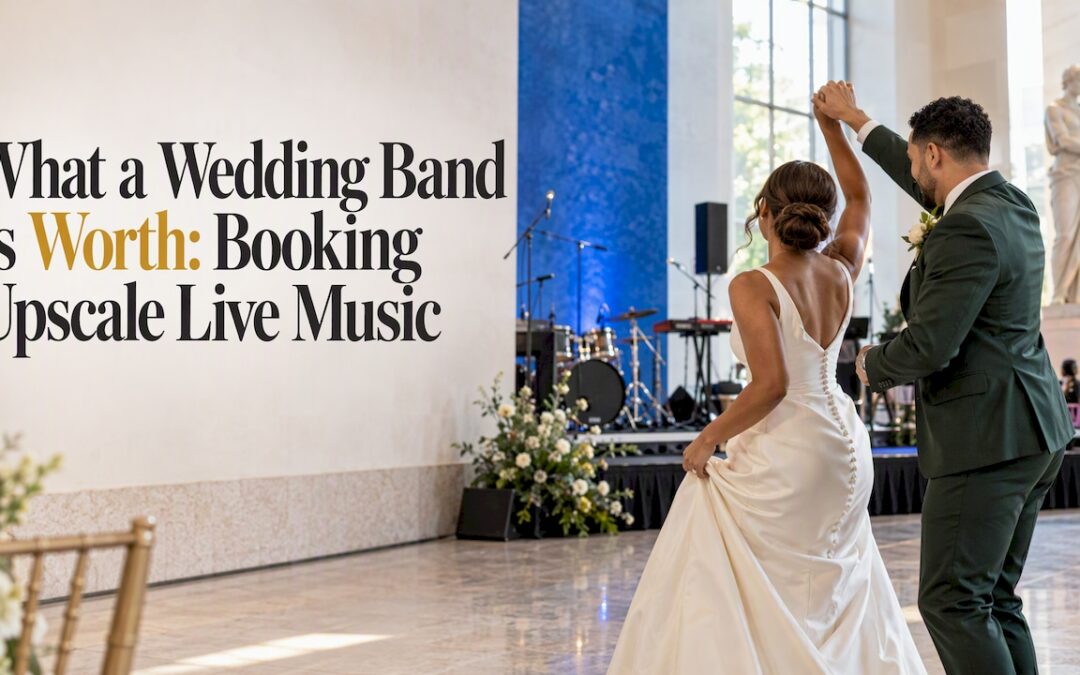
Couples who search for wedding band cost are usually asking a better question underneath: what do I get, and will it be worth it? This guide answers that one. We skip the dollar figures and look at what shapes a live band’s proposal, what an upscale show delivers that a playlist cannot, and how to compare proposals so you pick the band that fills your dance floor, not the one with the shortest line item list.
TL;DR
-
A live band’s proposal reflects people, hours, production and preparation. Compare scopes, not headlines.
-
Value comes from guest impact: vocal quality, repertoire fit, smooth transitions and crowd interaction.
-
Confirm what is included: sound, lighting, staging, setup, breaks, MC duties, travel and overtime.
-
Settle on the guest experience first, then choose ensemble size and technical scope.
-
Check your venue’s power, stage space and sound rules before you compare proposals.
Table of Contents
Why the question is really about value
A wedding band is not one product. Zola’s planning guidance describes live music as a range of experiences: a small acoustic group, a standard reception band and a full show band solve different problems. One sets a mood during cocktail hour. Another runs the dance floor for four hours.
That is why a single national number tells you very little. Two proposals with the same band name can describe very different nights. One might cover a ceremony, cocktail hour and reception with a full sound and lighting package. The other might cover a single set with your venue supplying the rest.
So start with the brief, not the budget line: what should your guests be doing at 9:30 p.m.? If the answer is “dancing, singing along, and not checking their phones,” you are shopping for a show, and you should evaluate it as one.
What shapes a live band proposal
You do not need figures to understand what moves a quote. WeddingWire’s guide names the main drivers: the number of performers, playing hours, date and location, travel, sound and lighting, equipment, special song requests and the level of production. The Knot adds that set length and custom requests matter too.
Here is how each plays out in practice.
People and preparation
A band has several musicians, and behind them there may be a booking agent, sound technicians and stage crew. Event planner Hailey Keyees, quoted by The Knot, points to exactly this overhead. She also notes that learning requested songs takes rehearsal time. A professional show is built, not pressed play on.
Hours and the real time commitment
Advertised playing time is not the same as the band’s total commitment. Musicians arrive early for load-in and soundcheck, they take breaks, and they tear down after the last song. Your contract should spell out live sets, break music, overtime, ceremony or cocktail-hour coverage and the exact finish time.
Date, place and travel
Peak dates and distant venues change a proposal. If you are marrying outside the band’s home region, ask early how travel is handled so nothing surprises you later. A band that performs nationwide, as we do, plans for this routinely.
Production level
Sound, lighting and staging can come from the band, from the venue or from a separate vendor. Who owns that responsibility is one of the biggest differences between two otherwise similar proposals.
What an upscale band actually delivers
Numbers of musicians are a poor shortcut for quality. We would judge an upscale band on seven things you can observe before you sign.
-
Live vocal quality. Ask for unedited live video from a real wedding, not a studio reel.
-
Repertoire fit. Does the band cover what your guests, across ages, actually know?
-
Transitions. Do songs flow, or does the floor empty between tracks?
-
Crowd interaction. Does the band read the room and pull people in?
-
Stage presentation. Lighting, attire and stage layout shape how the night looks in photos.
-
Sound quality. Clear for dancers, comfortable for grandparents at the back tables.
-
Coordination. One team handling music, lighting and staging means fewer handoffs.
That last point is practical, not decorative. A band professional quoted by Hitched advises sourcing staging and lighting from the same company, because wedding-day timing is tight. A slightly broader, integrated scope can reduce technical risk.
Band, DJ or both: compare the experience, not the label
The most useful comparison is the experience you want. A DJ generally offers broader instant song selection and simpler logistics. A live band offers visible performers and dynamic interpretation, but needs more space, people and technical coordination, as The Knot outlines.
| What you care about | Live band | DJ |
|---|---|---|
| Dance-floor energy | Performers feed off the room | Depends on the DJ’s read of the crowd |
| Song breadth | Set by the repertoire and arrangements | Very wide, on demand |
| Visual focus | Musicians on stage | Booth and equipment |
| Space and logistics | Stage, power, load-in | Lighter footprint |
| Interaction | Singing along, solos, shout-outs | Announcements and requests |
You do not have to choose one. Some couples pair a band with a DJ for the cocktail hour or late-night finish. We cover the trade-offs in more detail in live band versus DJ for weddings, including questions to put to every vendor.
Our perspective: why mashups change the room
We have played weddings, galas and private celebrations since 2009, and one pattern keeps repeating. Dance floors fill when everyone in the room recognizes something within the first few seconds, and stay full when the music keeps moving.
That is the thinking behind our mashup approach. We blend Pop, Rock, Hip-Hop and R&B, so the 25-year-old and the 65-year-old each hear a piece of their own playlist inside one arrangement. Customized setlists mean the night reflects you, not a template.
We also work closely with planners and couples before the event. The band that arrives on the day should not be a surprise. When you have shaped the setlist, the timeline and the energy curve with us, the show feels like yours.
Our recognition, including Wed KC Band of the Year and a place in The Knot Best of Weddings Hall of Fame, came from guests and couples telling us the night worked. That is the measure we would ask you to apply to any band: not the size of the stage, but what happens on the floor.
— Jimmy
Choosing ensemble size by the experience you want
Once you know the atmosphere, size follows. We offer a range, so the match is a design choice, not a compromise.
A bigger ensemble is not automatically better. A small room with a large band can feel crowded and loud. A large ballroom with a small band can feel thin. Ask for an honest recommendation based on your venue’s footprint, not the biggest option available.
If you want a broader walkthrough, our practical guide to choosing a wedding band covers auditions, references and fit.
Production: the part guests feel but never see
Sound and lighting decide whether a good band feels great. Clear vocals, balanced levels and warm lighting that changes with the energy of the night all come from production. Basics of event lighting and coordinating technical setup with a band are worth reading before you speak with your venue.
Questions to settle before you compare proposals:
-
Who supplies sound and lighting, and who operates them?
-
Is there a sound engineer on site throughout?
-
What are the venue’s power, load-in and volume rules?
-
Is there a stage, or does the band need a footprint on the floor?
-
Is ceremony sound included, and where is the ceremony relative to the reception?
Wedding planner Valarie Kirkbride, quoted by Minted, says the venue is the biggest factor shaping the direction of a wedding plan. For entertainment, that means the room’s access rules, power, stage space and schedule should be confirmed first.
How to compare proposals fairly
A fair comparison needs the same scope on both sides. Send each band the same brief so the answers line up. A credible request states:
-
Venue and event date
-
Guest count
-
Performance areas (ceremony, cocktail hour, reception)
-
Desired set length and break plan
-
Band size you have in mind
-
Who handles sound and lighting
-
Special songs or first-dance arrangements
-
Travel details
-
Whether a DJ or recorded music is needed between sets
Then read each proposal against a checklist:
| Question | Why it matters |
|---|---|
| Total live music time vs. break time | Sets the length of the dance floor |
| Break music included? | Avoids silence between sets |
| MC duties included? | Keeps the timeline moving |
| Setup, soundcheck, teardown covered? | Prevents day-of friction |
| Overtime terms in writing? | Protects your finish time |
| Backup plan for illness or travel issues? | Contingency matters on a single-date event |
Our questions to ask a wedding band before you sign goes deeper on contract language.
Where entertainment fits in your priorities
Budget frameworks vary. Minted’s planner guidance offers a starting structure, and the commonly repeated 50/20/30 split is not an industry rule. The practical takeaway is to decide your total ceiling and a contingency reserve, then allocate by what defines your day.
If you picture your wedding as a party, the music deserves a prominent place in those priorities. Guests may forget the centerpiece. They rarely forget the moment the whole room sang together.
Questions to ask yourself before you inquire
-
Do I want people dancing for most of the night, or is music background?
-
Are my guests spread across generations?
-
Does my venue support a full stage and sound setup?
-
Do I want the band to guide the evening as MC?
-
Would a single production team simplify my day?
If you answered yes to the first four, a full-service live band is likely the right call. If the fifth also appeals, ask about integrated production.
Work with Lost Wax
We build fully produced shows: customizable setlists, seamless transitions, crowd engagement, flexible band sizes, optional DJ integration and production services including lighting, staging and dance floor rentals. You can see how it fits together on our event production page, explore wedding band packages, or start with our home page to tell us about your date, venue and the night you want. We will talk through the scope and send a proposal that fits your event.
FAQ
Why do live bands vary so much from one proposal to the next?
Because the scopes differ. Musician count, playing hours, travel, sound, lighting and special requests all change what is being offered, as WeddingWire explains. Compare like with like by sending every band the same brief.
Is a live band worth it compared with a DJ?
It depends on the experience you want. A band brings visible performers and live interpretation, while a DJ offers wide song selection and simpler logistics. If energy, interaction and a sense of occasion lead your priorities, a band is often the stronger fit.
What should a wedding band contract include?
Live set lengths, break music, setup and soundcheck times, ceremony or cocktail-hour coverage, overtime terms and the exact finish time. It should also state who supplies sound and lighting and how travel is handled.
How far ahead should I book?
As soon as you have your venue and date. Bands can only play one event at a time, and the venue’s rules shape the technical plan, so locking in both early gives you the most choice.
Can a band handle lighting and staging too?
Some can. We offer event production including lighting, staging and dance floor rentals, which can reduce handoffs on a busy wedding day.
Recent Comments