
“Wedding band size” can mean two things, and both come up when you plan a wedding. It can be the size and width of the ring that goes on your finger. It can also be the size of the live band that plays your reception. This guide covers both. For the ring, match your measured ring size to the width you like, and size up slightly for wide bands. For the music, choose the lineup that fits your guest count, your room and the kind of night you want.
We are a live mashup party band, so we spend our days on the second meaning. Couples still ask us about the first, because it is on everyone’s checklist. Here are the two answers in one place.
TL;DR
- Ring size is how big the ring is around. Width is how wide it sits across your finger. Both decide how a wedding ring feels.
- Common widths run from about 2mm to 4mm for women and 4mm to 8mm for men, depending on the source. Wider bands feel snugger, so many guides suggest going up a quarter to half size for 6mm to 8mm bands.
- Measure your finger more than once, at different times of day, before you order.
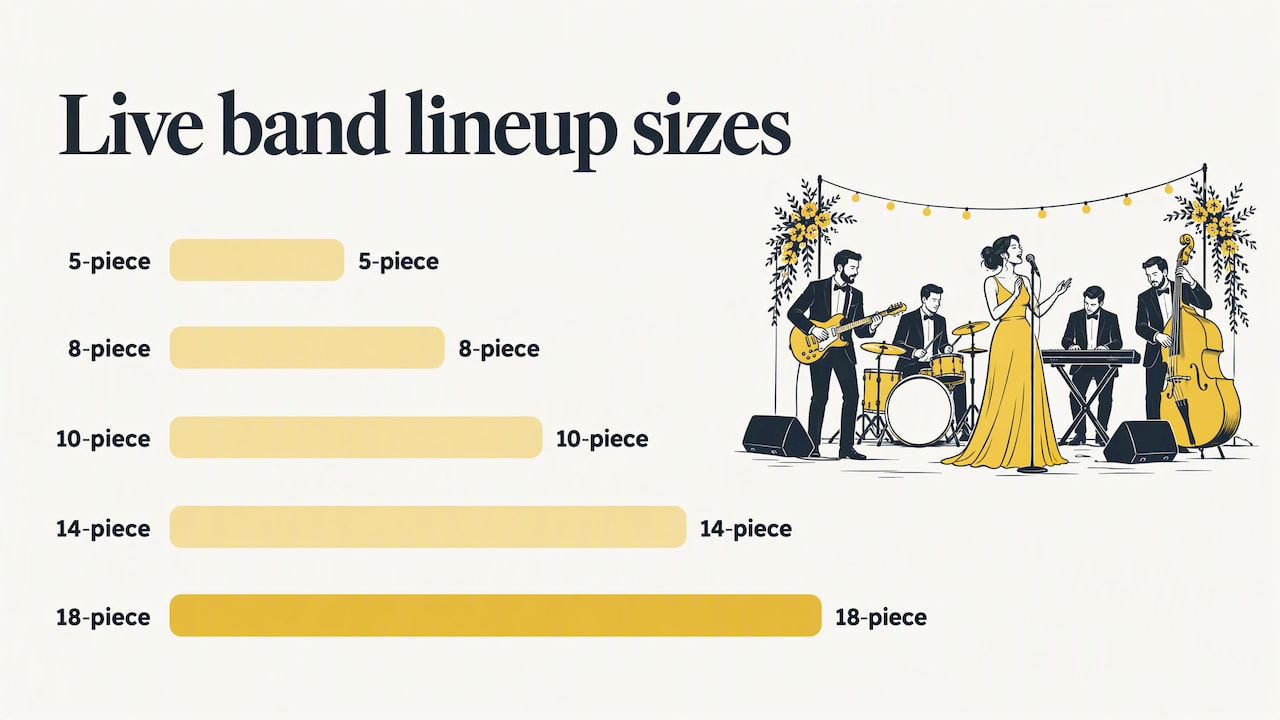
- For a live band, size follows guest count, room size and energy. We play as a 5-piece, 8-piece, 10-piece, 14-piece or 18-piece band, plus The Collective.
- Smaller lineups suit intimate rooms. Bigger ones add a fuller sound, more movement and more spectacle.
Table of Contents
- What “wedding band size” means for a ring
- How wide are wedding bands?
- Why a wider band may need a bigger size
- How to measure your ring size
- The other wedding band size: how big should your live band be?
- Our perspective
- Plan your lineup with us
- Common mistakes to avoid
- FAQ
- Sources
What “wedding band size” means for a ring
Two separate measurements make up a ring’s size. The first is ring size, which comes from the inside diameter or circumference. The second is band width, the physical measure across your finger. A ring size guide from a wedding band retailer explains that width can change how a given ring size fits. That is why two rings with the same number on the label can feel different.
Keep the two measurements apart when you shop. Ring size answers “will it go over my knuckle and stay on?” Width answers “how will it look, and how snug will it feel?”
How wide are wedding bands?
Sources disagree a little on the exact ranges, and that is normal. Width is a style choice, not a standard.
| Source | Narrow or delicate | Common women’s range | Common men’s range | Wide or statement |
|---|---|---|---|---|
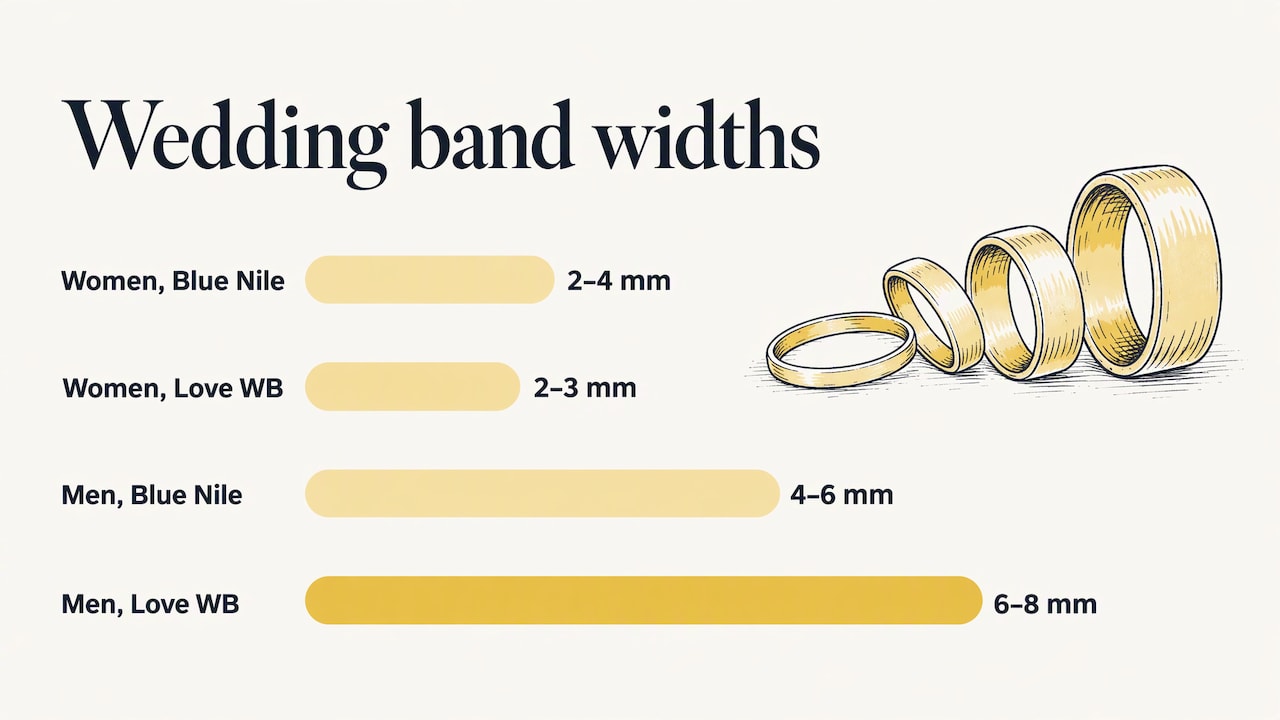
| Blue Nile’s 2026 width guide | 1.5 to 1.9mm | 2 to 4mm | 4 to 6mm | 6mm or more |
| Love Wedding Bands | n/a | 2 to 3mm | 6 to 8mm | n/a |
A men’s wedding band retailer says its most popular widths are 5mm for men and 2mm for women, and that there are no rules for width. Blue Nile adds that most rings are about 1.6 to 6mm wide overall.
Treat these as ranges, not rules. If you wear a stacked set, a slim 2mm band next to an engagement ring can look balanced. If you want one bold ring on its own, 6mm or more makes a statement.
What width does to the look and feel
Narrow bands usually look delicate and feel lighter. Wider bands have a bolder presence and cover more of the finger. According to Blue Nile’s width guide, a wider band may feel snugger even at the same ring size.
Hand proportions matter too. One jeweler’s width comparison notes that people with larger hands or longer fingers usually find wider bands more comfortable. People with smaller hands or shorter fingers often prefer narrower ones.
Why a wider band may need a bigger size
A wide ring displaces more skin than a narrow one. Wedding Rings Direct explains that this can make a wide ring feel tighter than a narrower ring of the same nominal size. Its advice is to check fit using the width and profile you are actually buying.
The ring size guide from Love Wedding Bands recommends sizing up by a quarter to a half size for bands 6mm to 8mm wide.
Profile matters as well. A comfort-fit band has a rounded interior, and one jeweler’s guide says its fit can differ from a flat-profile band by about half a size.
In practice:
- Pick your width and profile first.
- Then confirm your size with that width in mind, ideally by trying a sizing ring of the same width.
- If you land between sizes with a wide or comfort-fit band, discuss which way to go with your jeweler.
How to measure your ring size
The most accurate method is a jeweler’s metal mandrel or sizing tool. At home, the same ring size guide suggests this approach:
- Wrap a paper strip or non-stretchy string around the base of the finger.
- Mark where the ends overlap.
- Measure the length in millimeters.
- Match that number to a size chart.
Finger size is not fixed. Goodstone’s wedding band guide says finger dimensions vary with temperature, exercise, a salty meal, dehydration and time of day, and it recommends measuring more than once. Another guide suggests measuring at least twice in a day. It also notes that the menstrual cycle and pregnancy can cause temporary swelling, so consider whether a reading is your baseline size.
If you notice persistent or sudden swelling in your fingers, ask your doctor. Do not rely on a ring size chart to explain it.
How a properly fitted band feels
A correctly sized wedding band slides on easily but resists coming off. It sits firmly at the base of the finger and does not press on the joint or obstruct the neighboring fingers. If it spins loosely or leaves a deep dent after a few minutes, revisit the size.
Finding a partner’s size without asking
If you want to keep a proposal or a ring swap a surprise, borrow a ring that already fits the same finger. Measure its inside diameter and compare it with a chart, as the ring size guide describes. Rings on different fingers and hands vary, so use one from the right finger.
Converting between sizing systems
US and Canadian sizes are numbers. The UK, Ireland, Australia, New Zealand and South Africa use letters. The EU system follows ISO 8653 and is based on inside circumference in millimeters. Japan and China use a separate numerical scale. Ordering from abroad is easy once you have a measurement in millimeters, because you can match the diameter or circumference to the chart instead of guessing a conversion.
The other wedding band size: how big should your live band be?
Now the music. A live wedding band comes in lineups from a tight five-piece to a large show band. The right size is less about the biggest number and more about the room, the crowd and the energy you want.
We built our lineups around that idea. Here is how we think about each one.
| Lineup | Where it tends to shine |
|---|---|
| 5-piece | Intimate receptions, smaller ballrooms, restaurants and private parties |
| 8-piece | Mid-size weddings that want fuller harmonies and arrangements |
| 10-piece | Signature weddings with a big dance floor and a broad mix of genres |
| The Collective | Events that want a flexible, curated musical experience |
| ELITE 14-piece | Luxury celebrations and large ballrooms |
| SHOWSTOPPER 18-piece | Grand events where the band itself is part of the spectacle |
You can see the smaller lineups on our band packages page, and the larger ones on our wedding band page.
Match the band to your guest count and room
Start with the number of guests and the footprint of the dance floor. A small room with a large band feels crowded and loud. A large ballroom with a very small band can leave the energy thin at the edges. A good rule is to ask your venue for its floor plan, then talk through stage placement with your band before you sign anything.
It also helps to ask your band these questions early. Our guide to questions to ask a wedding band before you sign covers them in detail.
Match the band to the night you want
Think about how your evening flows. A cocktail hour with light, danceable arrangements calls for different instrumentation than a late-night floor of Hip-Hop, Rock and Pop hits. Larger lineups give more room for layered sounds and big moments. Smaller ones give a tighter, more conversational feel.
Genres matter too. Our mashup style blends Pop, Rock, Hip-Hop and R&B so guests of all ages find something to move to. Our mashup wedding dance songs guide shows how those arrangements work on a real floor. If your families bring different musical traditions, see how to blend two traditions in wedding music.
Band or DJ, or both
Some couples want a live band for the main sets and a DJ for transitions or after-hours. We offer optional DJ integrations so the music never stops. If you are still deciding between the two, our comparison of live band vs DJ for weddings lists the questions to ask each vendor.
Plan the rest of the night around the band
The band is one piece of a timeline. Sound, lighting and staging should fit the lineup, and food and decor affect where guests gather. If you plan a late-night bite, a late-night snack idea guide can help you pick a format that keeps people on the dance floor. A gift table guide helps with placement so the table stays clear of speakers and traffic paths.
Our perspective
We have played weddings since 2009, and the lineup question comes up in nearly every first conversation. Couples often start by asking for the biggest band. What they really want is a dance floor that never empties.
Our view is that the right size is the one that matches your room and your people. A five-piece can feel electric in a room of 100. An eighteen-piece can turn a large ballroom into a show. Because we build every setlist around your event, we can scale the same mashup energy up or down.
We also like to treat the band as part of the production. Sound, lighting, staging and a proper dance floor change how a lineup feels, which is why we offer those services alongside the music.
The ring on your finger is a one-size decision made once. Your band should be built to fit your night.
Jimmy
Plan your lineup with us
If you are weighing lineups, tell us your guest count, venue and the feel you want. We will suggest a band size that fits. Browse the options on our packages page, or start from our homepage to see our weddings, luxury weddings and corporate events. For ceremony sound, staging, lighting and dance floors, see our event production services. Planning a company event? Our corporate band page shows how the same lineups work at galas and parties.
Common mistakes to avoid
With the ring
- Measuring once, on a cold morning or right after exercise. Measure at different times and take the typical result.
- Ordering a wide band in your narrow-band size. Allow for the extra snugness.
- Ignoring profile. Comfort-fit and flat interiors can differ by about half a size.
- Forgetting that swelling can be temporary. Do not size on a day your hands feel unusual.
With the band
- Picking a lineup before you know your room. Get the floor plan first.
- Treating size as a quality ranking. Each lineup is built to deliver a full show at its scale.
- Leaving sound and staging until the last week. Production planning belongs in the same conversation as the booking.
- Skipping the planner. We work closely with event planners so transitions, announcements and timing run smoothly.
FAQ
What is the most common wedding band width?
It depends on the source. Blue Nile describes 2 to 4mm as a common women’s range and 4 to 6mm as a common men’s range. A men’s band retailer lists 5mm for men and 2mm for women as its most popular choices. Pick the width that suits your hands and style.
Should I size up for a wide wedding band?
Often, yes. A wide band covers more of the finger and feels snugger, and one guide suggests sizing up a quarter to half size for 6mm to 8mm bands. Try a sizing ring of the same width and check how it feels. Your jeweler can advise on the final call.
How big should my wedding band (the music kind) be?
Choose by guest count, room size and the energy you want. A smaller lineup suits an intimate room, and a larger one suits a big ballroom or a grand celebration. We offer 5, 8, 10, 14 and 18-piece lineups, so we can match your event.
Can I add a DJ to a live band?
Yes. We offer optional DJ integrations that blend with live sets, so the transitions stay smooth. Tell us how you want the evening to flow and we will plan around it.
Do you only play weddings?
No. We also play corporate events, galas, festivals and private celebrations across the U.S. The same lineups and customizable setlists apply, and you can start on our corporate event inquiry page.
Sources
- Ring Size Guide: How to Measure Your Ring Size at Home
- Choosing Your Ring Band Width: The Complete Guide
- Compare Men’s Wedding Band Widths
- Wedding Band Widths Comparison
- Profiles & Widths: Ring Buyers Guide
- How to Choose Your Wedding Ring Size
- Wedding Band Guide
- How to Choose Your Wedding Band Size: Conversion Chart
Recent Comments